Tag Archives: 1994

Virtua Cop

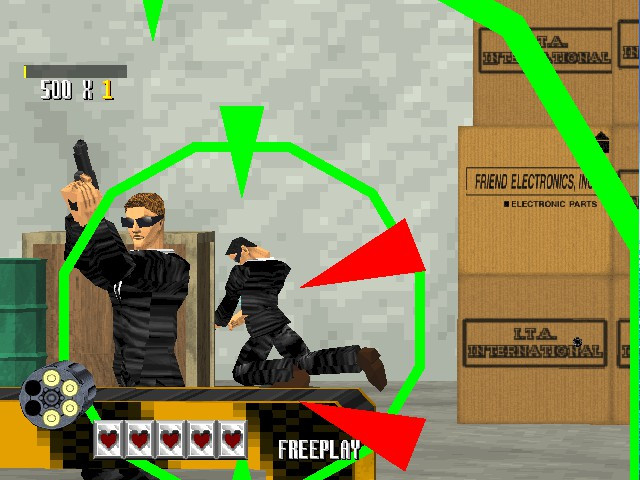
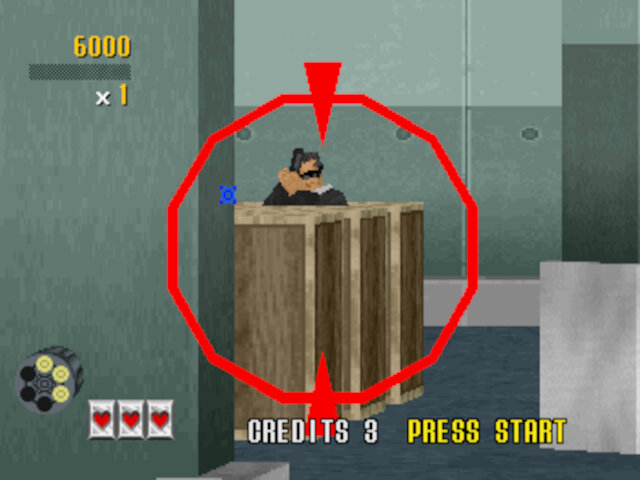
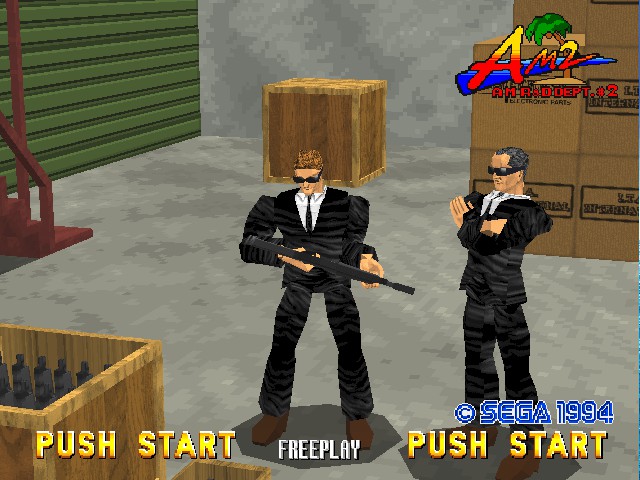
An on-the-rails arcade shooting game, here you only have to worry about aiming and shooting and all the movement is done automatically. There is still a challenge though and fast reflexes are essential to get a good score in Virtua Cop. If you’ve played Time Crisis you will be familiar with the concept, but Sega have implemented different mechanics.
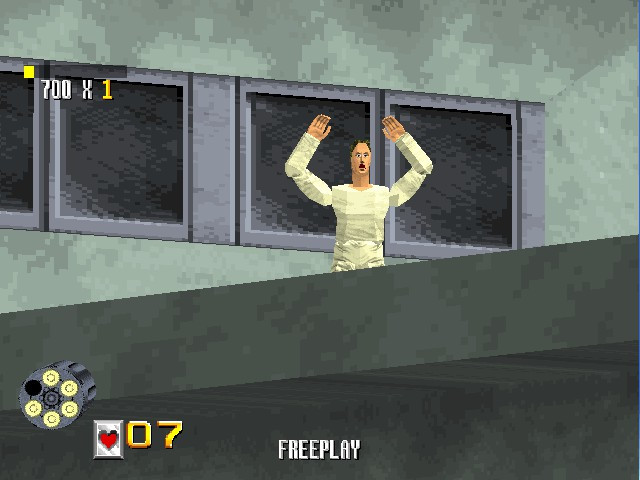
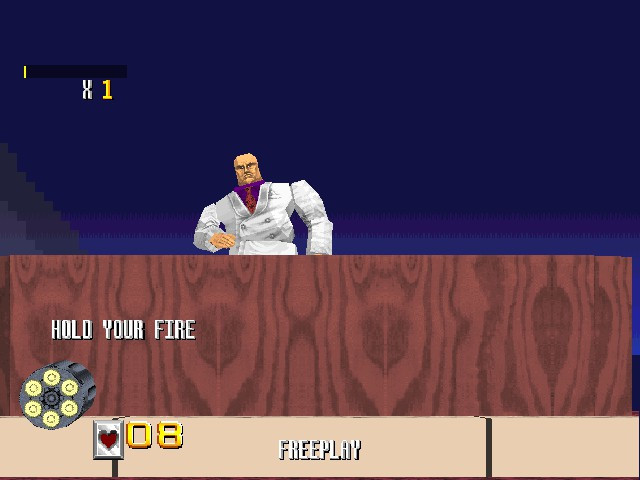
Don’t Shoot! Proceeds to run in front of player

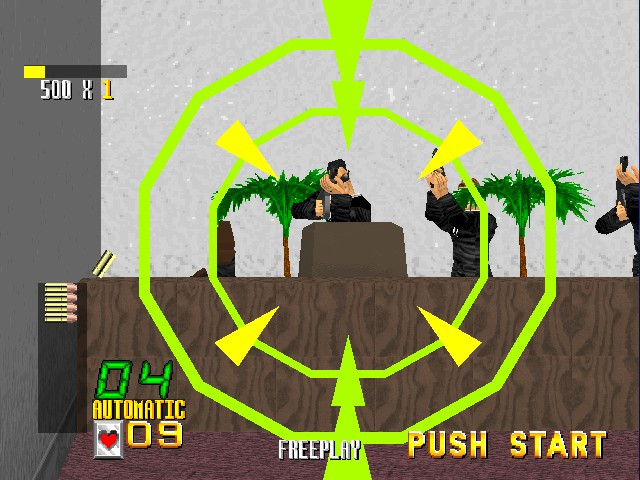
By default you start off with the revolver, which is a standard pistol. Over the course of the game other weapons can be picked up like the shotgun or an automatic, which holds more ammunition and can fire more rounds without being reloaded, but can only be used through one ammo clip.
You will lose the additional weapon if you get shot by an enemy or if you hit a civilian, when this happens you will revert back to the standard revolver.
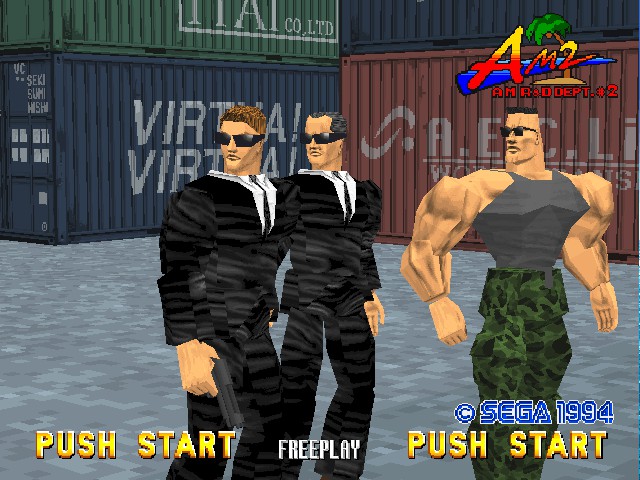
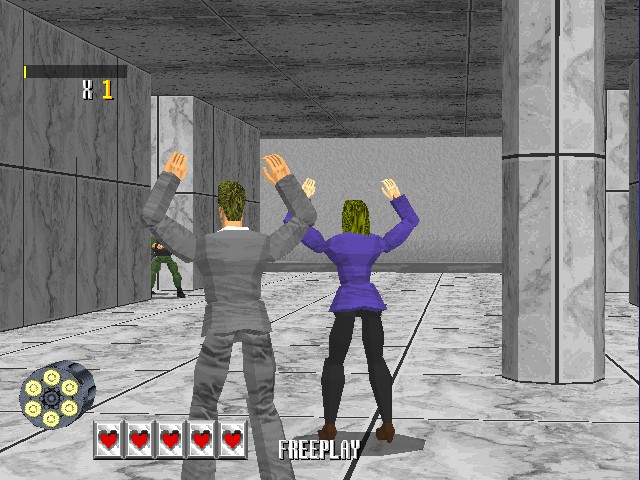
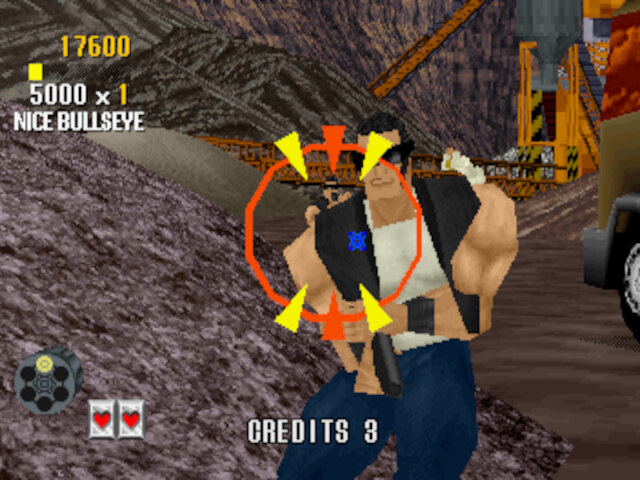
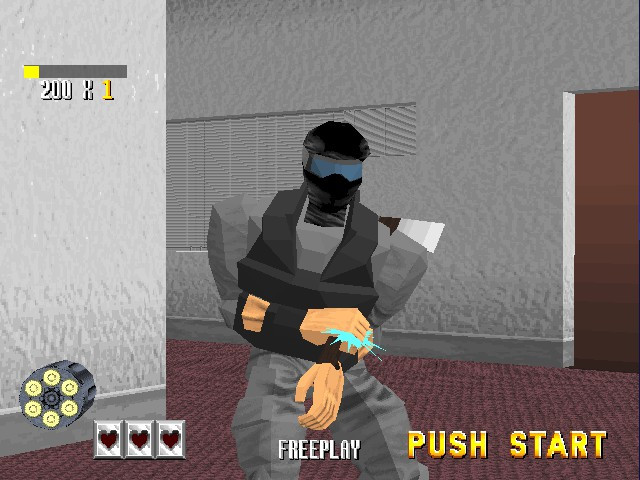
The whole objective of the game is to shoot the bad guys, whilst avoiding the civilians. Shooting a civilian will cause you to lose a life whilst shooting and disarming an enemy gives you a justice shot bonus. You can use the environment to help you, by shooting the red barrels you can create explosions that can take out several enemies.
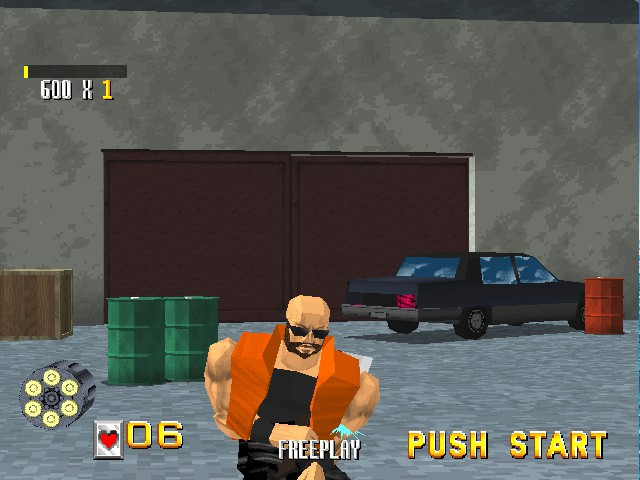
Occasionally enemies will pop up on the screen and will throw an axe, you will need to shot them before their axe makes contact otherwise you will lose a life. These can take you by surprise, but remain consistent through multiple playthroughs, so over time you can memorise the enemy sequences.
Some enemies will also throw a grenade, you must shoot the grenade before it lands.

Levels:

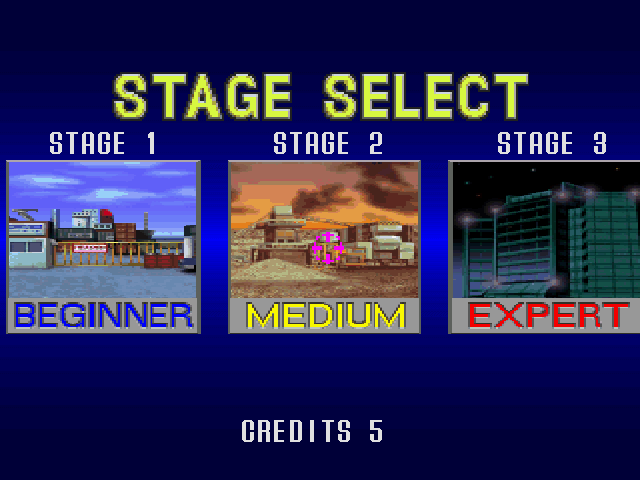
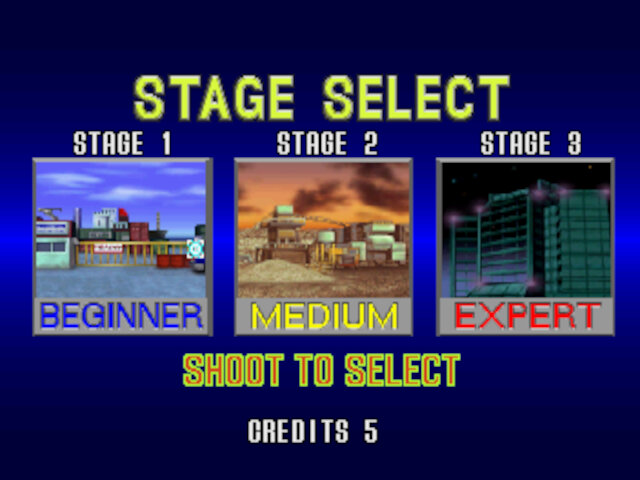
There are three stages in total, at the end of each stage is a boss fight where you will need to shoot both the boss enemy and their projectiles.

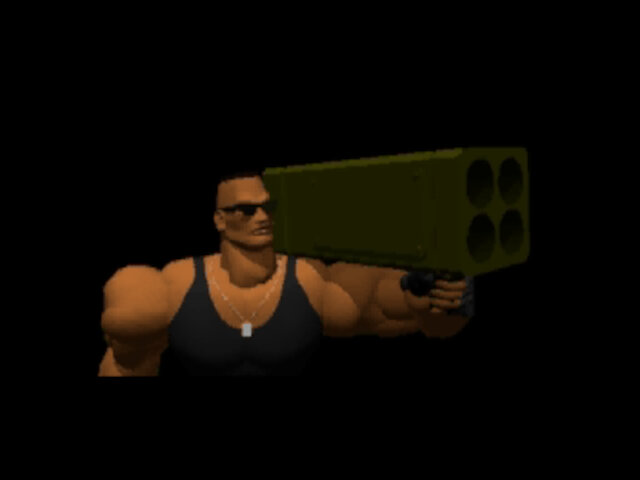
Stage 1: Arms Black Market, Starts off on a shipping yard, where this is suspected criminal activity going on with the illegal import of weapons. The end boss is Kong, who uses a rocket launcher.

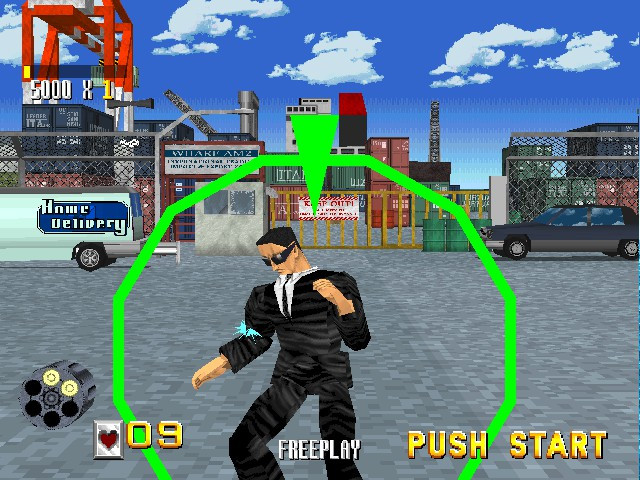
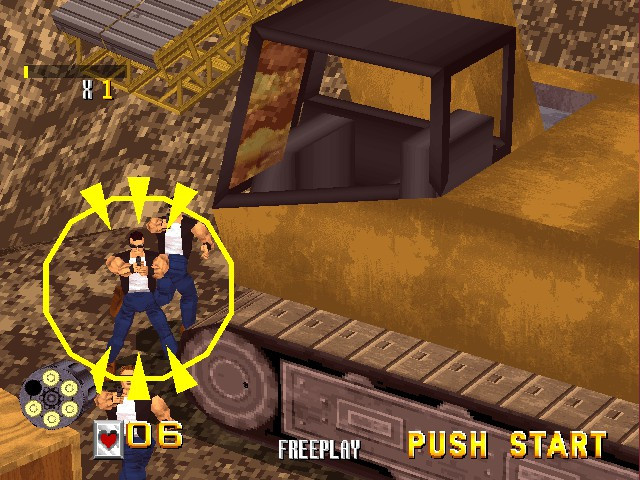
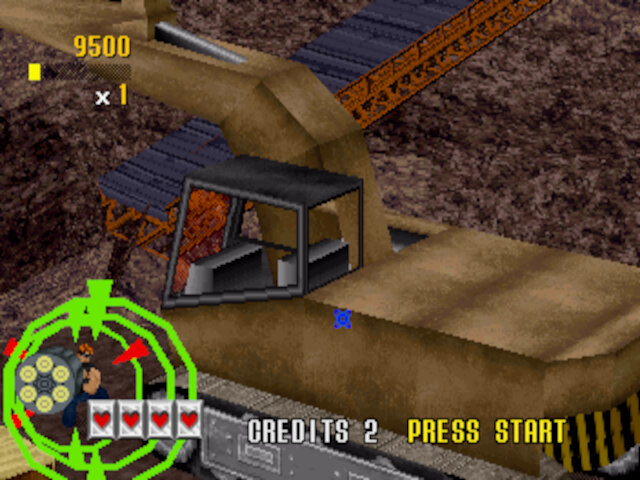
Stage 2: Underground Weapon Storage, Takes place on a construction site. Here the enemies start to become more frequent, with many popping up on screen, and environmental hazards involving vehicles now talking place. End boss here is called King (No, not the one from Tekken), and uses a flame flower that shoots balls of fire.
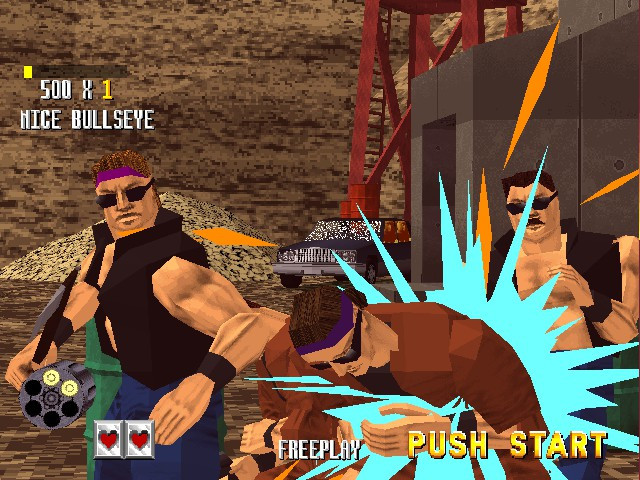
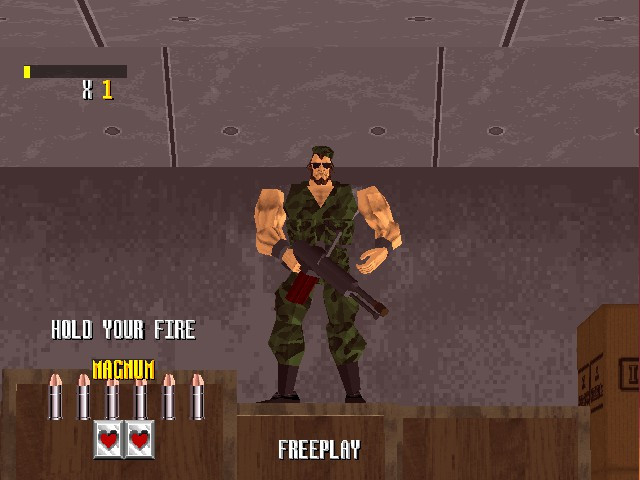
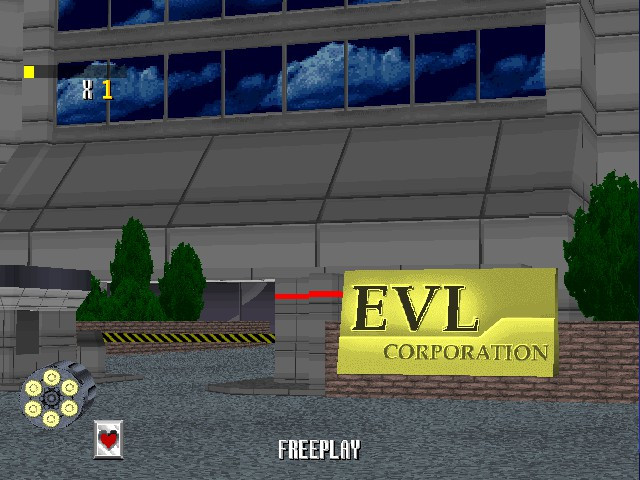
Stage 3: Gang Headquarters, We’re here in the EVL corporation headquarters. You fight shoot your way through the Skyscraper, through the various offices (equipped with Apple Macintosh Quadra 900s, guess we know what computers Sega was using back then). Here the enemies are a lot more quicker to react compared to the previous stages. At the end there are two gang bosses, Boss and Fang. Boss desk transforms into a mecha-suit that fires missiles, whilst Fang is an attack helicopter.
Versions

Arcade

Virtua Cop debuted on the original Model 2 arcade board and was a light gun based game. The player uses the gun to aim at targets to fire and shoot enemies. Reloading is done through aiming the gun away from the screen and shooting.
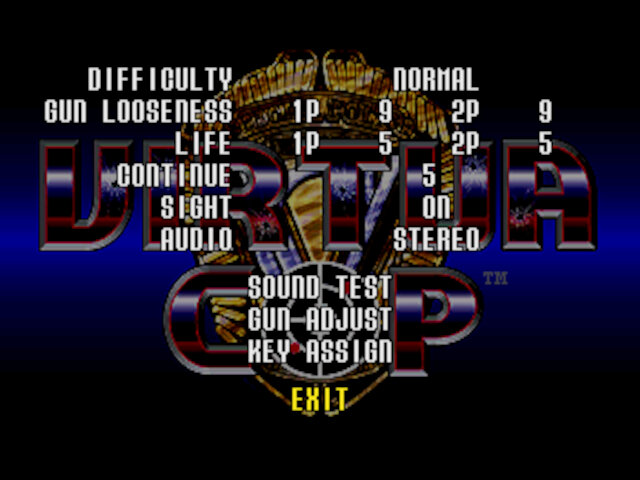
In total there are 3 stages, and can be played in any order. By default you have 5 lives, which can be amended in the games test mode. After all your lives have been lost, you need to insert credit in order to continue, but the game does allow you to pick up where you left off instead of starting from the first level again.
Sega Saturn

Sega ported the game to the Saturn in 1995 and was one of the fist games to be developed using the Saturn Graphics Library, which was intended to make it easier to develop games for the Saturn. Like other Model 2 to Saturn ports, the graphics quality has been reduced in order to adapt to the Saturn’s graphics hardware.
The Saturn does make use of pre rendered FMV for some of the opening sequences, however the arcade opening sequences is rendered in engine, although modified to account for the Saturn’s design.
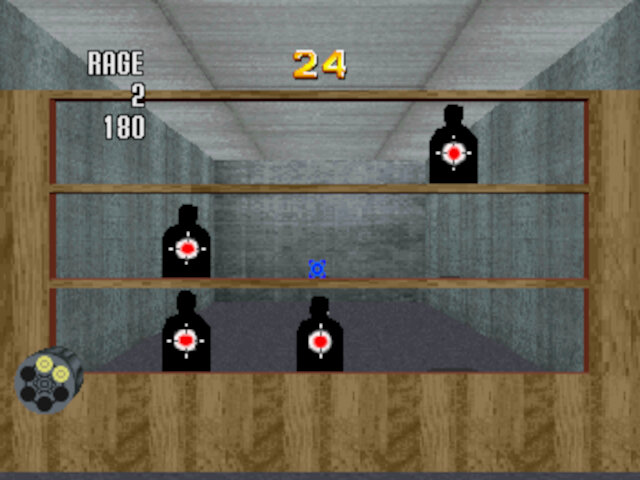
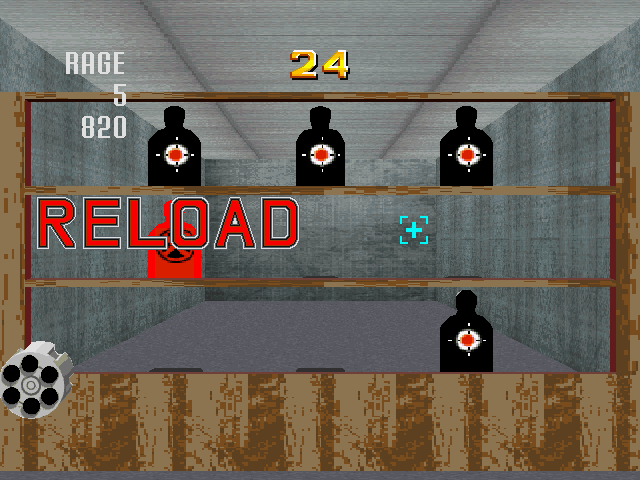
The Saturn compensates for this with the addition of a couple of features like the training mode which helps you get used to the shooting mechanics by shooting a set amount of targets under a time limit. There is also a two player mode that can be access through the training menu.
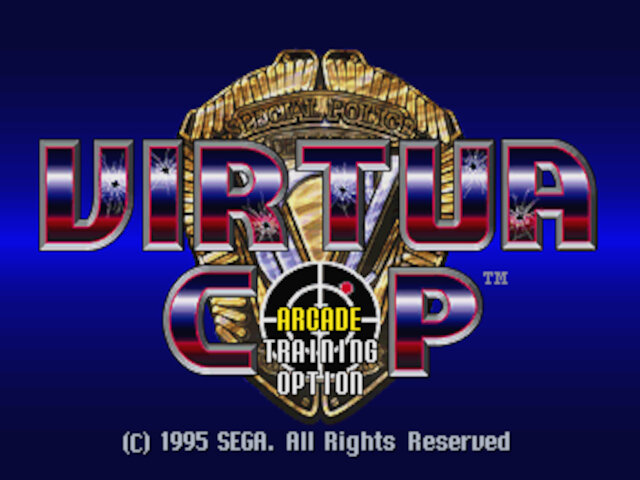
The Saturn version also makes use of the Virtua Gun which is a light gun that functions only on CRT TV’s or the Saturn mouse.

Windows

Sega also ported the game to Windows in 1996 and makes use of DirectX X
Like the Saturn version it also features a couple of features. However it still lacks the visuals of the arcade, even though some high end systems of the time were capable of Model 2 like graphics. It’s likely Sega assumed most players would be using software rending as opposed to a dedicated 3D card, and designed the game as such rather than targeting high end hardware.

Settings screen in glorious Comic Sans, and when 640×480 was considered high res
The PC port does suffer from a few issue’s in regards to how it is controlled. Navigating the menus is a pain, as you have to use the keyboard arrow keys and the enter key to select, the mouse cannot be used at all. Seems like the game was designed to be used mostly with the gamepad. The mouse can be used to aim and shoot, with reloading being done by double clicking the right mouse button quickly.

In terms of support the game was meant to be used for Windows 95, but will also work with Windows 98. No support for NT (Not tested yet). The game makes use of DirectX 2 for its 3D API. There is also support for the Nvidia NV1 accelerator, which Sega’s early 3D PC titles had support for, this also makes use of a special executable that runs on that graphics card only. No modern API wrapper for that card exists, and many emulators (PCem/86Box/QEMU) have no support for this unique card.

As with all CD-ROM based games from this era, this makes use of CD Audio for the games background music. In order for this to play back you must have the game in a BIN/CUE format since this preserves the audio subchannel data. PCem and 86Box do support this form of audio when mounting those images directly into the emulator, providing the correct image format is used. On an actual system an IDE hard drive with the CD Audio header must be connected to the CD Audio port on the soundcard, otherwise the music will not play, modern SATA drives and onboard soundcards will likely lack this interface.
Daytona USA

Sega’s hit racing game and part of the new generation of 3D arcade titles. Here we are introduced to texture mapped polygons, an upgrade from the flat shaded graphics from Virtua Racing. Daytona would be in prime competition with Ridge Racer, which was released by Namco.

Tracks

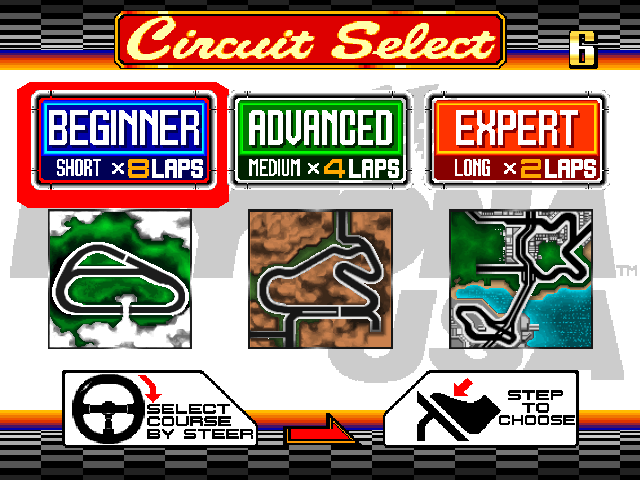
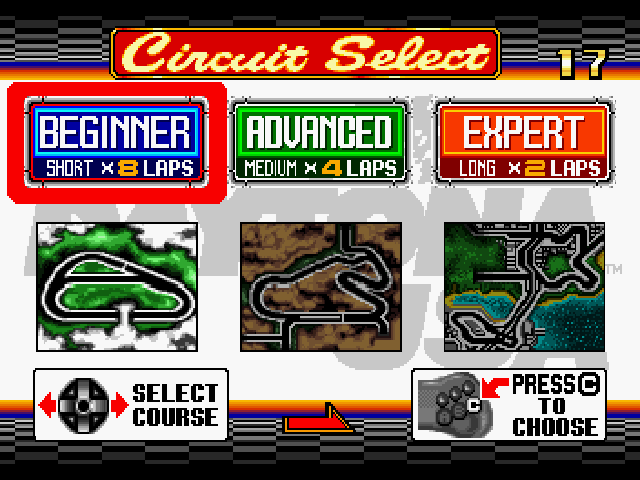
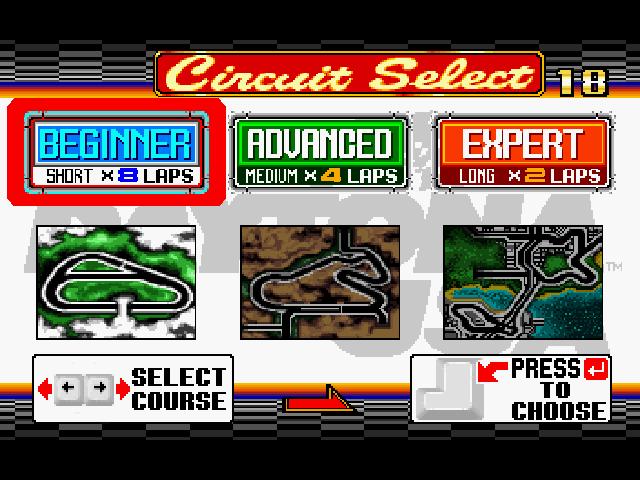
Beginner: A simple track but has 40 opponent cars, this track can get crowded in places. The only track on the game that begins with a rolling start and features a pit in area. There are 8 laps to race in total, but this can be extended to 20 or 40 with the Grand prix or endurance modes.

Advanced: A regaular track but has a couple of sharp turns. ‘Lets Go Away’ is the song that plays for this track, which a portion also plays during the games attract mode. Theres a few hidden messages in this track that appears in the grass during the race.
Expert: The hardest track with frequent sharp turns and a couple of obstickles in the track, Thankfully these don’t affect your cars speed and are mostly for visual effect. Powersldiing is reccomended to get the best lap times.

The tracks would be renamed in later releases after further tracks would be added.

Modes:

These can be set in the options menu (Test mode on the arcade release)

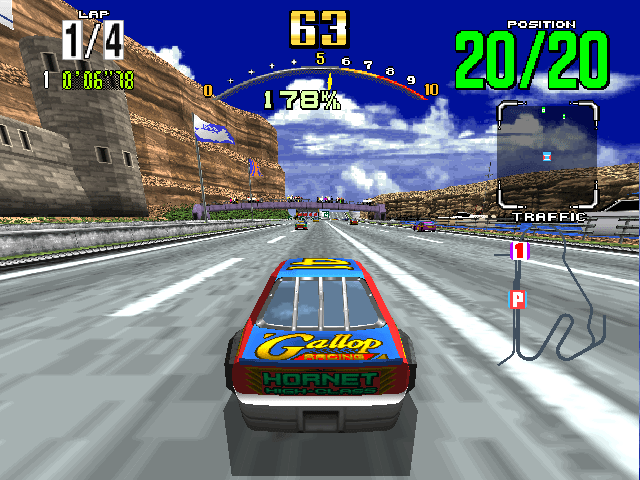
Standard: The default option with 8 laps for the beginner track, 4 for the advanced and two for expert

Grand Prix: Addidtional laps are added which expands the game’s length, with 20 laps for the beginner, 10 for advanced and 5 for the expert. With these laps you will want to use the pit stop to replace the cars tyers.

Endurance: 80 laps for beginner mode, 40 for advanced and 20 for expert mode.

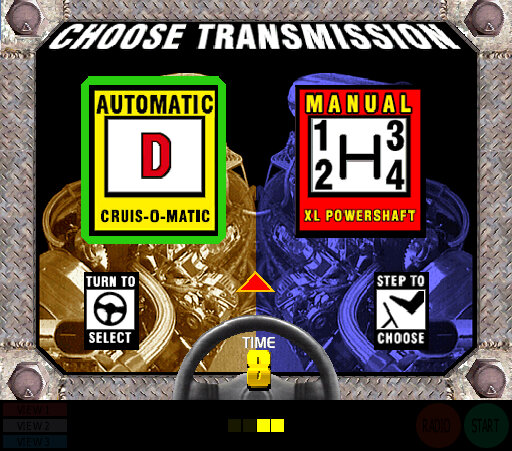
There is also a time attack mode which can be accessed by holding down the 1P Start button on the arcade version whilst choosing transmission.

Releases

Arcade

Where it all started, running on Sega’s Model 2 hardware. This was initially released in 1993, and a updated version came out in 1994 to promote the Sega Saturn version. This version also amended the HUD elements slightly. 3 tracks are present in this version and lcoal multiplayer is avalible by linking the arcade machines together. This version of the game runs at a constant 57fps and a higher resolutiob compared to the Saturn, but lower then the PC version.

Can be emulated using the Nebula Model 2 emulator, or recently MAME. However the Model 2 core is still under development and there has been some improvements to the MAME core.

Daytona USA Arcade had three releases, all of which run on the original Model 2

  • 1993 release that was exclusive to Japan
  • 1994 release that was worldwide that amended the on screen counter display
  • Sega Saturn update that added adverts for the console, for before and after the consoles release (Changeable in the games test mode the Model 2 had no RTC clock)
  • There were a couple of unofficial modifications that were done by a few third party programmers that added RPG like elements to the game, known as GTX edition and To the Maxx

The game was only compatible with the original Model 2 board.

Sega Saturn

The first version that was ported for the home market, this was a rushed port due to wanting to be a Saturn launch title and the difficultly of the Saturn’s hardware for the developers. Also, its no secret that 3D wasn’t the Saturn’s strong point, being built primarily as a 2D sprite scaling system, and Daytona USA being designed for the 3D model 2 arcade board. The music is altered in this version, taking advantage of the red-book CD audio.

There are two game modes, an arcade mode which plays the same as the arcade original, and a Saturn mode which gives the option of selecting a car. Mirror tracks are also selectable for all tracks in the game and a 60 lap endurance mode. This version has no support for multiplayer.

Sega would later release a revised version for the Sega Saturn that corrected a couple of issues that the original port recieved.

Windows

Very similar to the Saturn version, the game is designed to run on Windows 95 but features little graphics acceleration, rending entirely in software mode (on the CPU). The game uses DirectX 2 which limits it to Windows 95, although it will work on later Windows 9x releases, things start to break on more modern systems.

This release is not recommended since a better version was released a few years later, and the limited resolution and graphics settings this game offers. There’s also black bars at the top and bottom which makes it feel like I’m playing an ported PAL game, either that or they thought Daytona PC needed to be cinematic?

Comparison

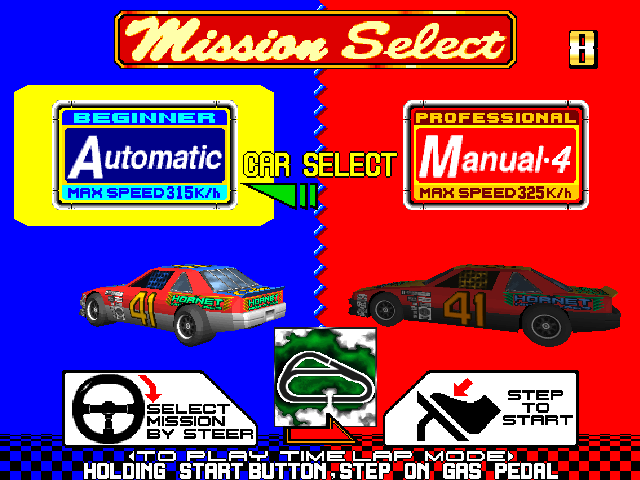
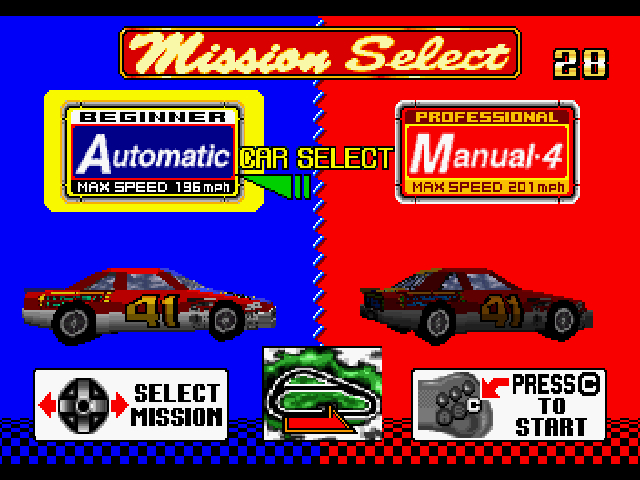
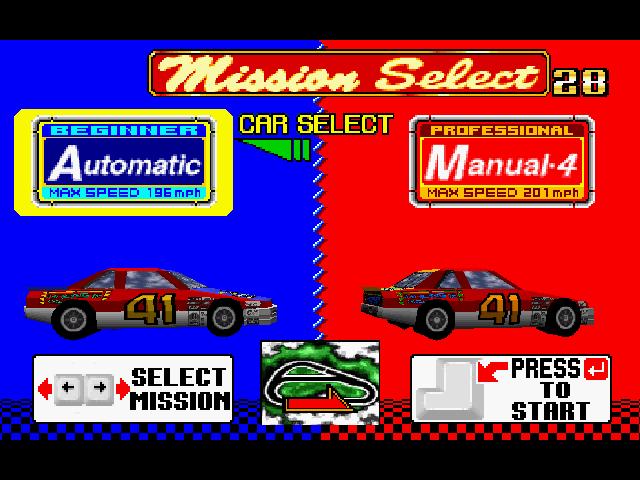
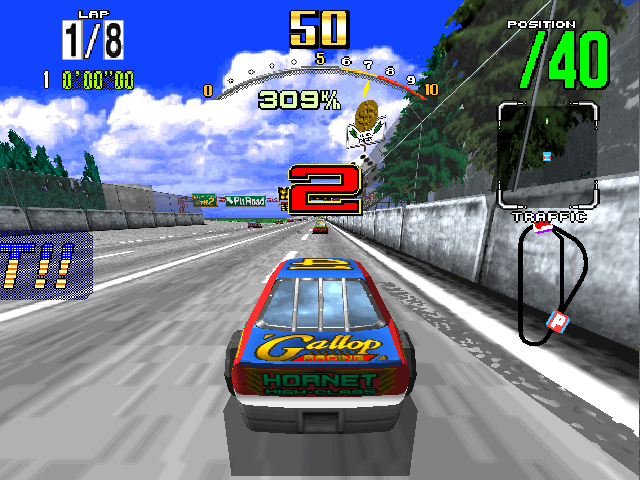
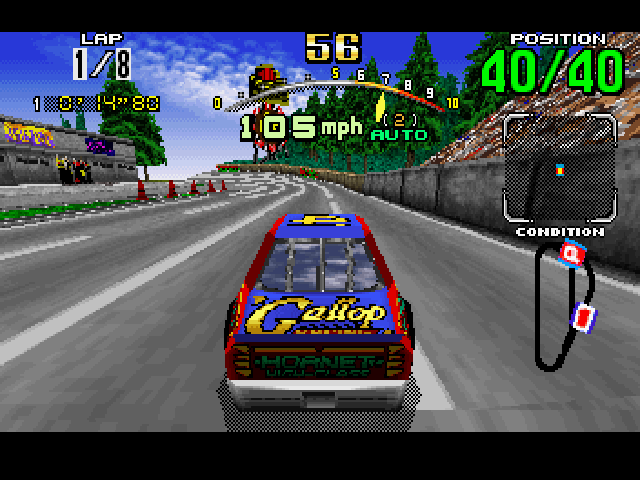
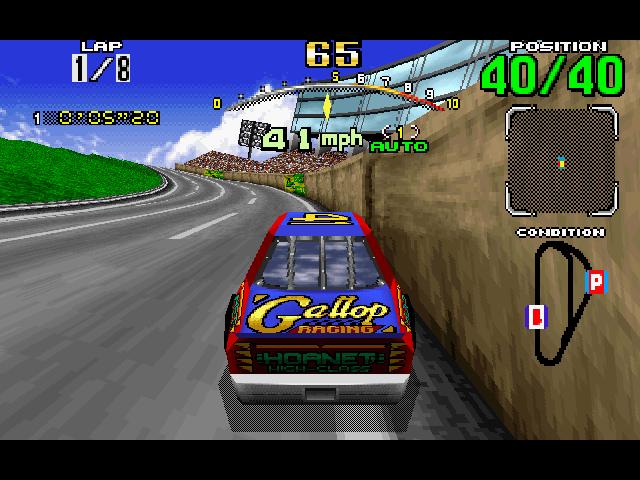
Arcade version is running in the Nebula Model 2 emulator with default settings, Saturn is running the NTSC build in Retroarch Beetle Saturn, Windows is running in a PCem virtual machine running Windows Me.

Arcade

Saturn

Windows

The home versions remain very faithful to the arcade original when it comes to the menu layout

Car transmission selection

Saturn version has the worst draw distance, to the extent that some background elements don’t appear fully and look like they are floating

Only major difference being the lap time dispay, with other HUD elements remaining consistant.

Conclusion

Daytona USA would go on to become very popular in the arcades thanks to the pioneering 3D graphics technology, despite the high price of the Model 2 hardware. The home ports were not greatly recieved, with the Saturn port having a negative reception in comparision to Ridge Racer, which was also ported from the arcade to the Playstation and was considered a bettrer adaption.

Sega would later release newer home versions of Daytona USA, being the Champtionship edition which helps fix the issues of the initil Saturn port and was ported to the PC shortly after. It was released again for the Sega Dreamcast in 2001 with slightly remastered graphics.

In the arcades, Sega would follow up with Daytona USA 2, being a showcase for the Model 3 platform.

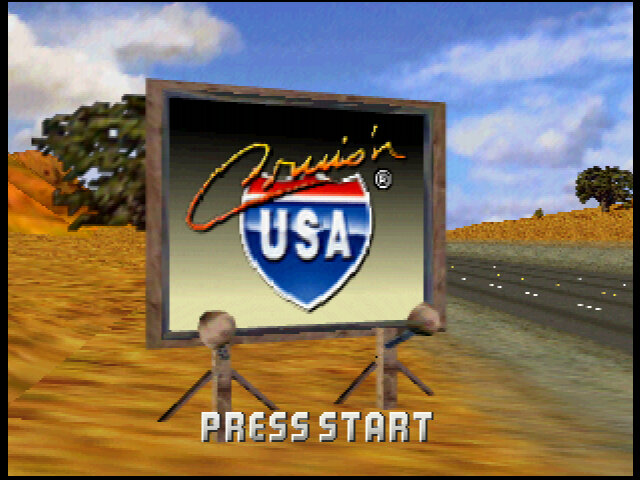
Cruis’n USA

Wooo! ahhh! ohhhh – The House Special Lady

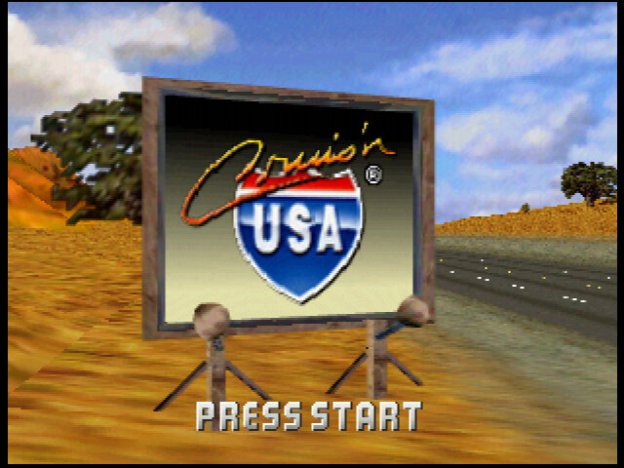
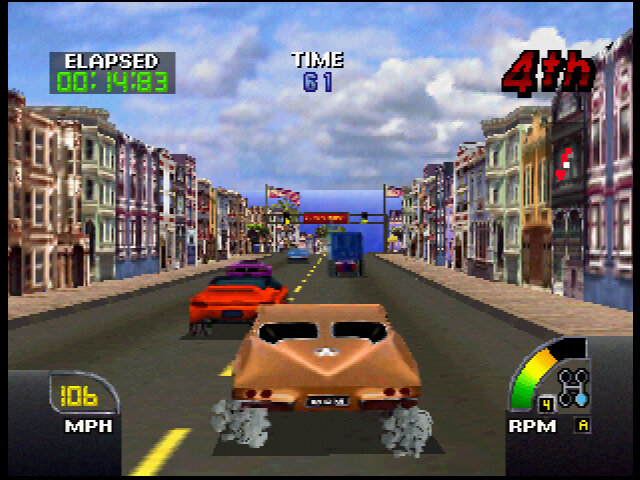
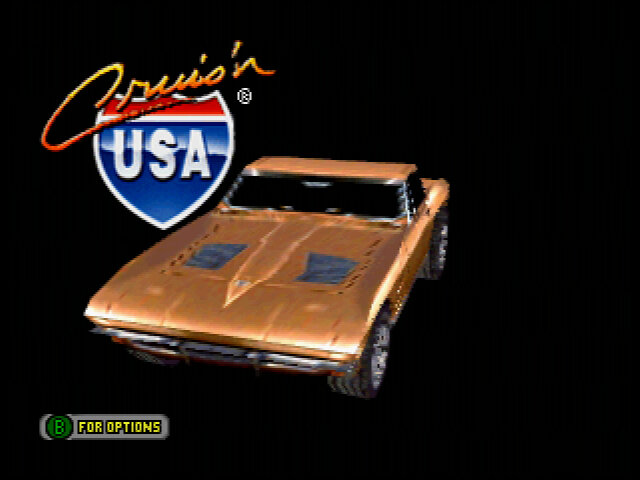
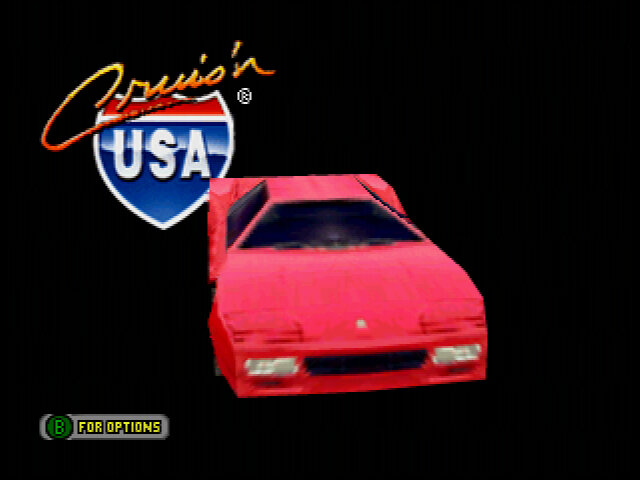
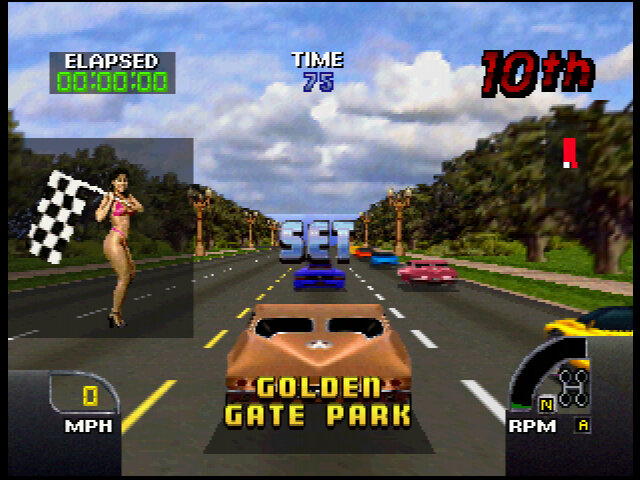
A racing game set across the USA, you play from point A to point B with a single lap, giving the impression you are travelling through (Cruising) the USA. Each track has unique scenery and opponents, with rival cars and traffic becoming a hinderance, thankfully the controls are easy to adapt although collision detection can be an issue.

Not to be confused with Cruising in my 64, An Eazy-E song

Tracks

All of these tracks are set around different parts of the USA, and vary in environmental scenery and difficulty.

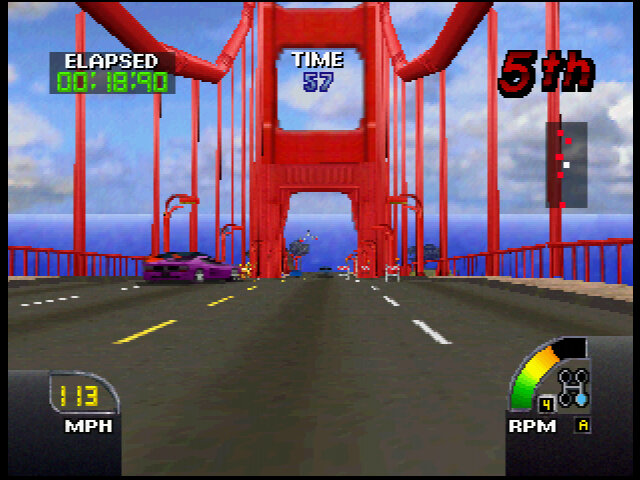
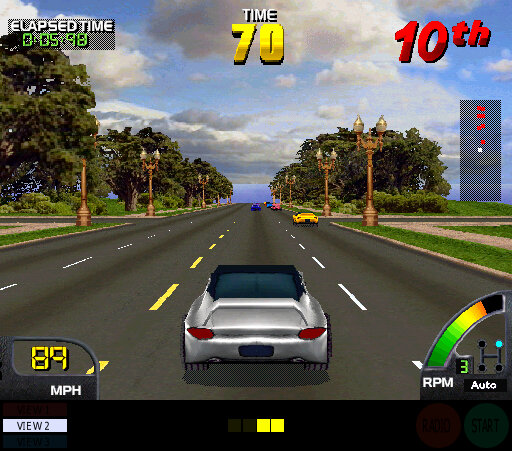
Golden Gate Park: The first track in the game which features the golden gate bridge. Very easy with only slight bends and wide roads

San Francisco: Featuring rolling hills and an increase of traffic from the previous track, ends with a tunnel.

US 101: Set in a rural desert, the track here is narrower and features a lot more bends, there are also gaps in the road which your car must drive over

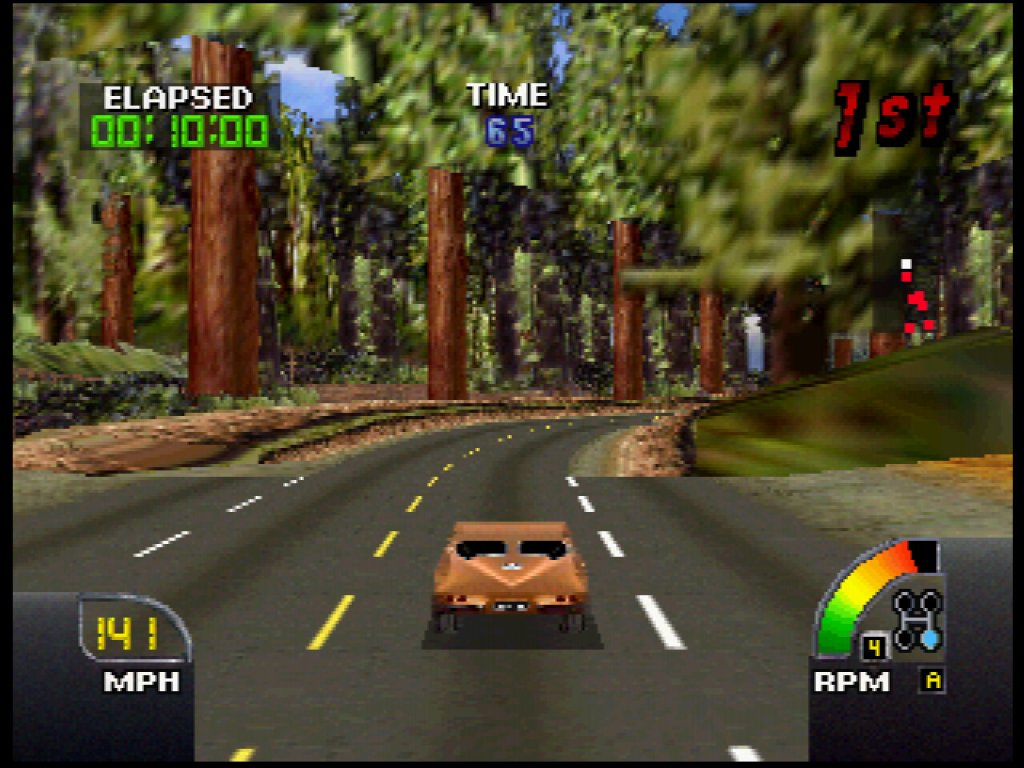
Redwood Forest: Continuing from the desert and into the forest, the road here is a lot more narrow which gives little space to navigate through opposing traffic and rival cars.

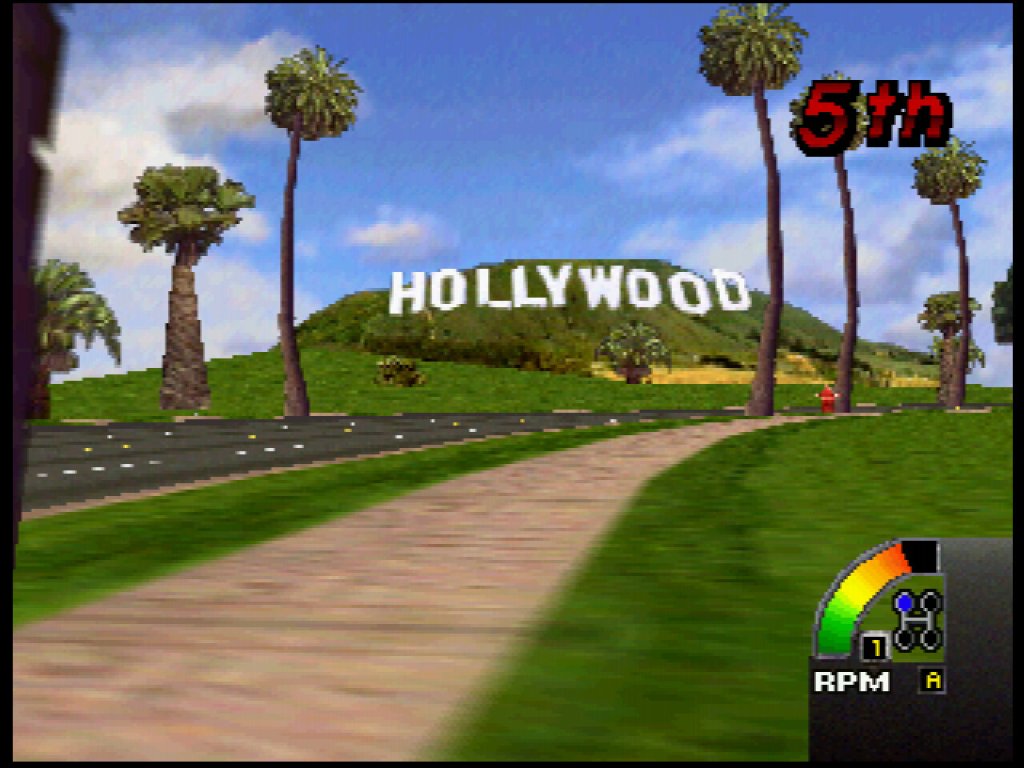
Beverly Hills: Featuring Bel-Air style houses and mansions along with the Hollywood sign. The scenery here can be distracting so try to focus and concentrate on the road.

LA Freeway: There’s a lot more traffic on this one

Death Valley: Sounds a bit morbid but is set in a rural desert area, this one also features a narrow road so watch for traffic

Arizona: Set in a rural desert in the first half, this one has powerlines as obstacles that can be knocked down but will impact your cars speed.

Grand Canyon: Drive through the Grand Canyon itself, again has powerlines as obstacles that can be knocked down, also features Mount Rushmore

Iowa: Set on rural green farm which looks more like an English countryside, has narrow roads and powerline obstacles and a toll booth which you have to be careful not to hit the hubs in between

Chicago: Features factories and an urban like environment with large buildings and an underpass. Be careful not to hit the overhead railway columns

Indiana: Very similar to Iowa

Appalachia: Track with a bumpy road and a lot of curves and hills, defiantly one of the more challenging tracks.

Washington DC: The final stage with a lot of nice scenery but equally as difficult as Appalachia, Ends with a money tunnel

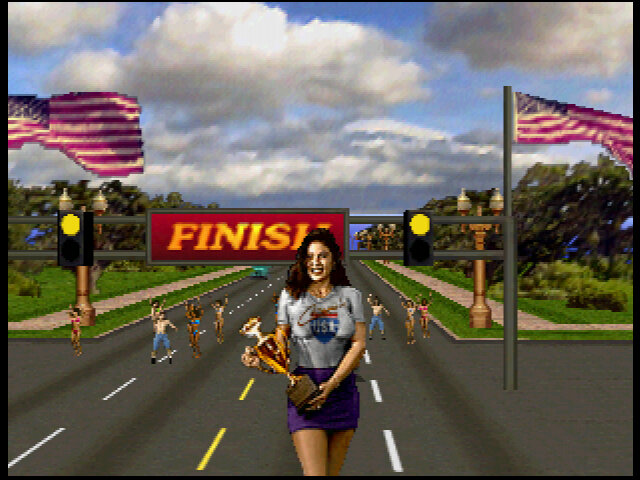
Completing Cruse the USA mode unlocks a faster car, and the arcade features a very special ending FMV featuring the then current Present and the First Lady

Arcade Version

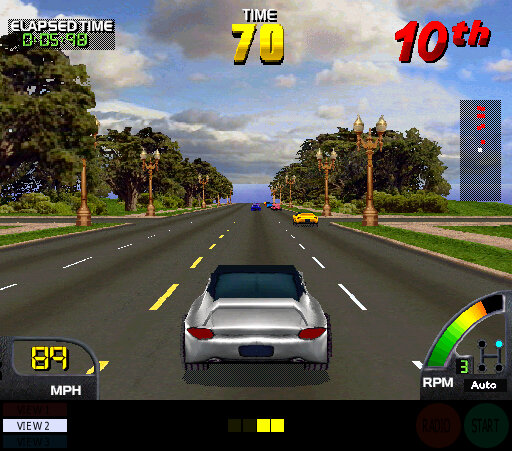
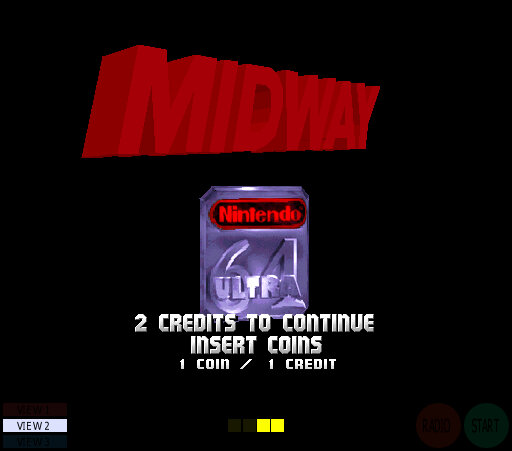
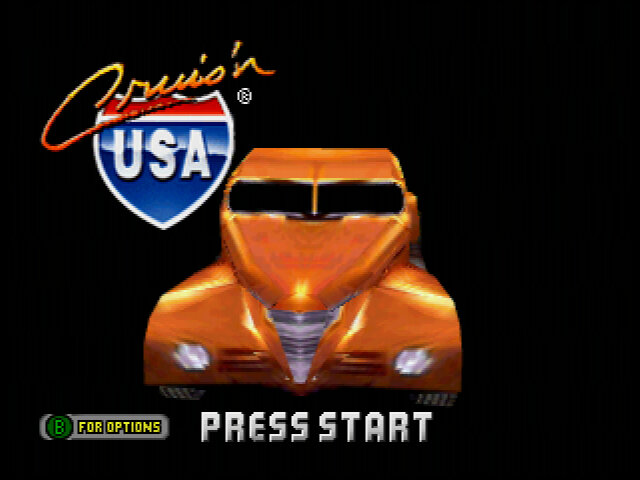
Released in 1994 on the Midway V Unit arcade board, it was one of the early textured 3D racers alongside Ridge Racer and Daytona USA.

Not much is known about Midway’s V unit 3D hardware, originally believed to be based upon the Nintendo Ultra 64 that was in development at the time, however closer inspection of the specification revels the hardware to be very different. With the V Unit running a Texas Instruments TMS32031 CPU at 50Mhz compared to the NEC VR4300 MIPS CPU in the Nintendo 64. Whilst the N64 is complemented by the SGI Reality co-processor, the V unit uses an currently unknown 3D processor, which accelerates the 3D graphics used. As it was released in 1994, there are a few possible vendors:

  • A PC graphics accelerator like the Yamaha Tasmania 3D or Matrox Millennium
  • SGI (Possible the V Unit is a very early design of the N64? unlikely since SGI have always used MIPS CPU’s, unless they wanted to cut costs and use a TI CPI instead)
  • Or it could be an entirety custom chip Midway had designed…

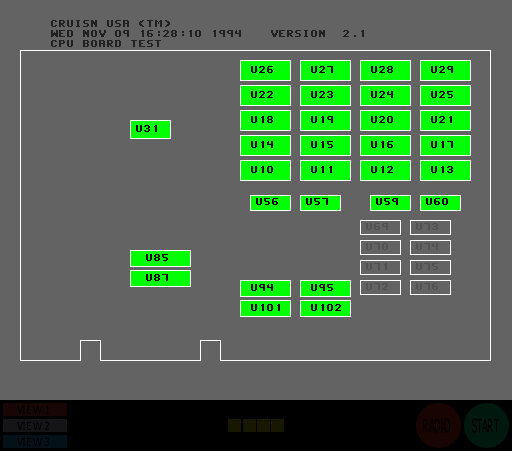
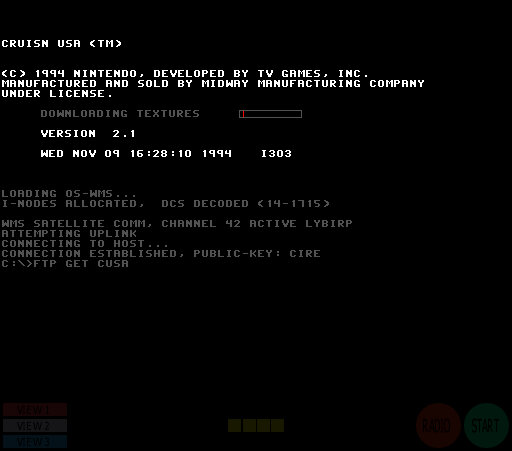
The boot screen of the arcade version is interesting, the first seems to going into some hardware test routine, whilst the second looks like its downloading something off a remote server, or simulating it. OS-WMS is mentioned, and the next line reads WMS Satellite COMM, CHANNEL 42, which makes me think the game was capable of being distributed over the air via satellite? its not out of the ordinary since that’s how Nintendo’s Stellaview worked, and BSB’s data service allowed you to broadcast data in the early hours of the morning whilst its TV channels were off air. The last command looks like it’s trying to retrieve something off an external FTP server, despite the game being stored in ROM. These messages appear every time you start the game, so its not some first-time utilisation process.

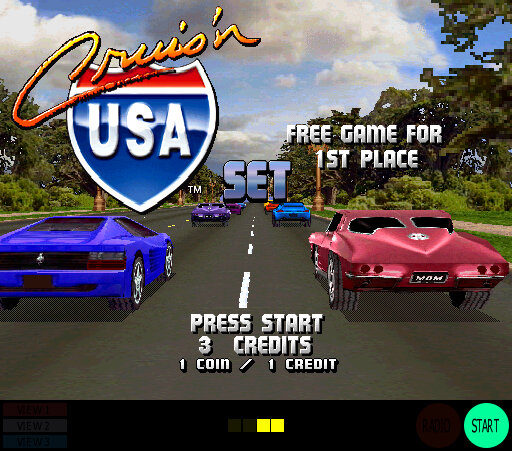
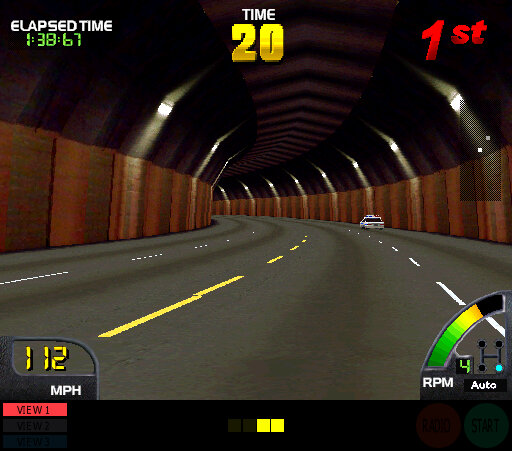
Graphics-wise its similar in vein to the other arcade racers of the time, Ridge Racer and Daytona USA, however this is clearly running on lower-end hardware with the framerate and resolution being reduced. Winning first place nets you a free race (adjustable in the games test modes) otherwise you will need to add credit to progress onto the next track. Completing the game gives you an ending cut-scene set on top of the White House.

Nintendo 64 Versions

Released early in the N64 life, Cruis’n USA took a downgrade in the resolution and censored a few aspects of the game. The former caused critism since this was one of the first racing games on the Nintendo 64, and the game was promoted as being built on Nintendo 64 technology, so it was expected to be a perfect port of the game. Meanwhile the PlayStation enjoyed a satisfactory port of Ridge Racer, however by that point it was already two years old by the time it was released in 1996, had the N64 came out in 1995 as originally planned, the port may have been better received.

NTSC

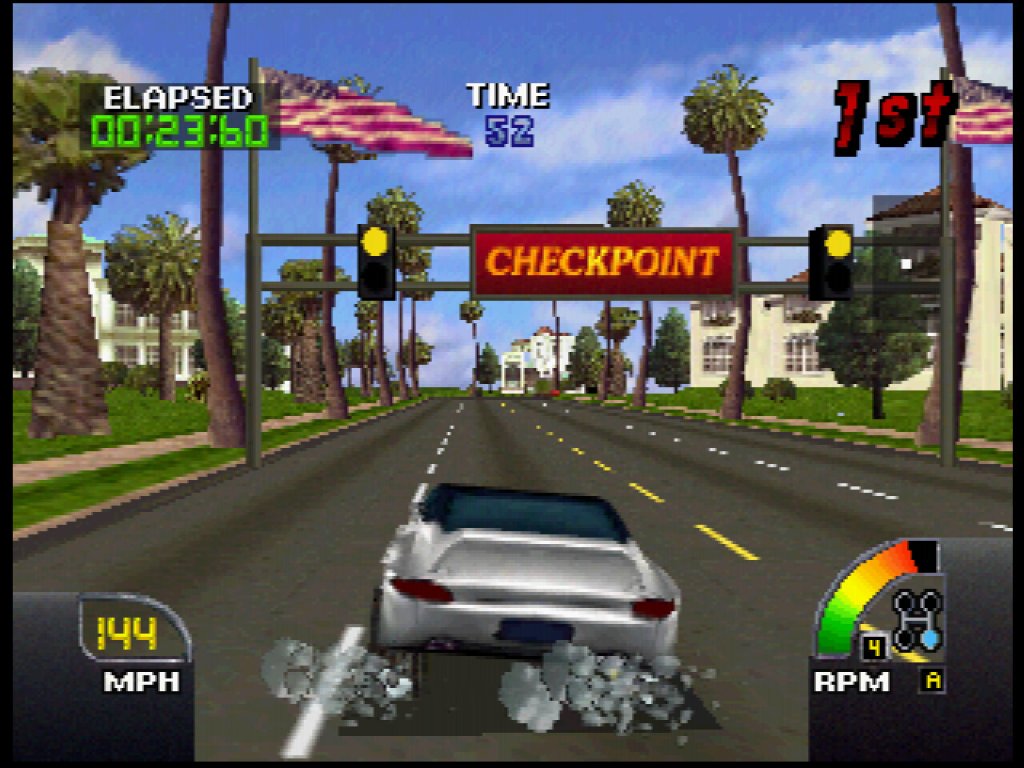
Graphics took a reduction in this version with the textures being downgraded to fit into the Nintendo 64 memory limitations. The framerate is also inconsistent, since having many cars and track objects on screen to reduce it to a crawl, which can frequently happen when you crash into another car, CPU cars will also crash into you and have no awareness of the track, often resulting in a slideshow when there are a lot of cars and track objects on screen. Saying that, the N64 does benefit from perspective correction, which means no warping polygons or textures, and there is also bilinear filtering for the textures, although for this game the arcade unfiltered textures look better.

The sound has also been altered, since the Nintendo 64 didn’t have a dedicated sound processor and had to render the sound on either the CPU or the reality co-processor, depending on how the game was designed, the arcade version has extra fidelity since it was done using the Midway DCS sound system.

One other thing to mention was the saving issues on the Everdrive64, as the game uses the gamepak in order to save data, but upon starting the game it complains about the pack being corrupted/invalid and will not start, removing the gamepak results in another error messages instructing you to insert the pak back into the controller. The only was to start the game was to boot without the controller-pak connected, which results in the game saving to the cartridge memory, which the Everdrive can emulate.

Comparison

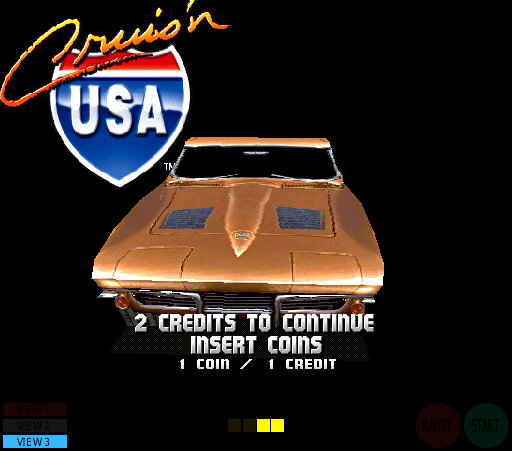
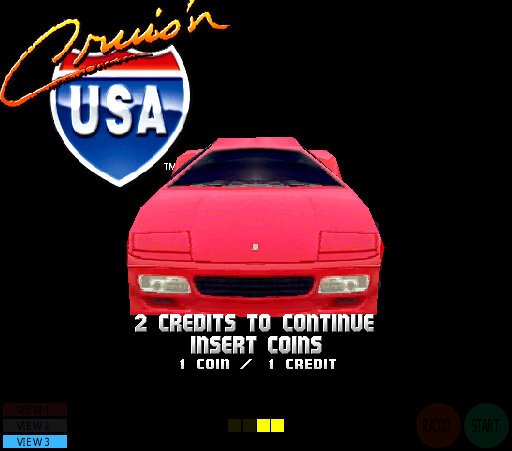
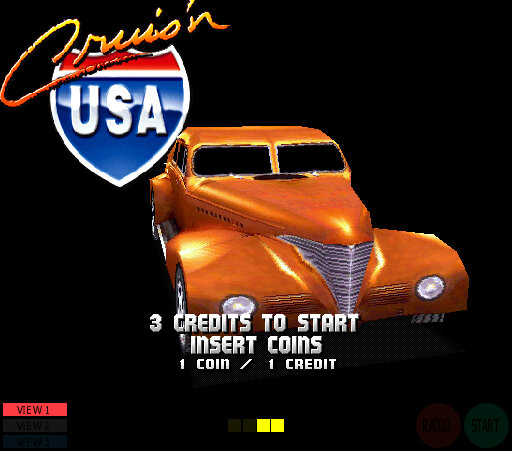
Left: Nintendo 64 – Right: Arcade, which has the indicator on the bottom

Textures are generally more detailed on the arcade release, but the Nintendo 64 makes use of texture filtering with the arcade being unfiltered.

N64 version looks more blurry, whilst the arcade version looks sharper.

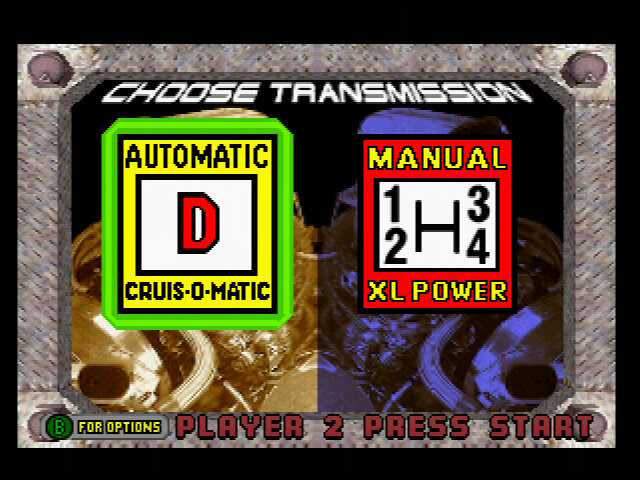
Transmission select screen

Heads up display of both versions, the N64 compensates of the PAL/NTSC overscan by creating a buffer for the HUD design. The arcade cabinet has illuminated lights which indicated the games status which MAME emulated as an on screen display which can be seen at the bottom.

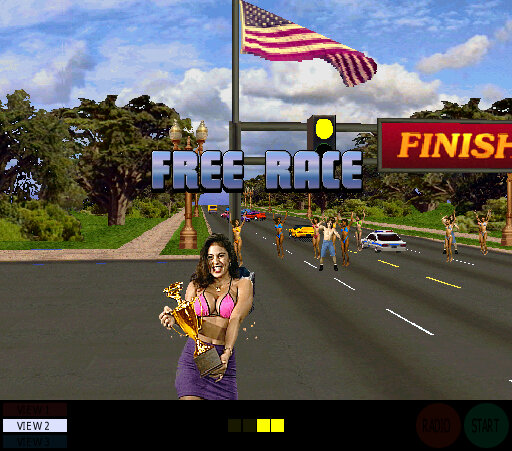
An example of censorship of the N64 version, either that or the woman must have felt cold. A nice feature with the arcade version was you got a free race if you came in first place (dependant on that feature being enabled in the games settings)

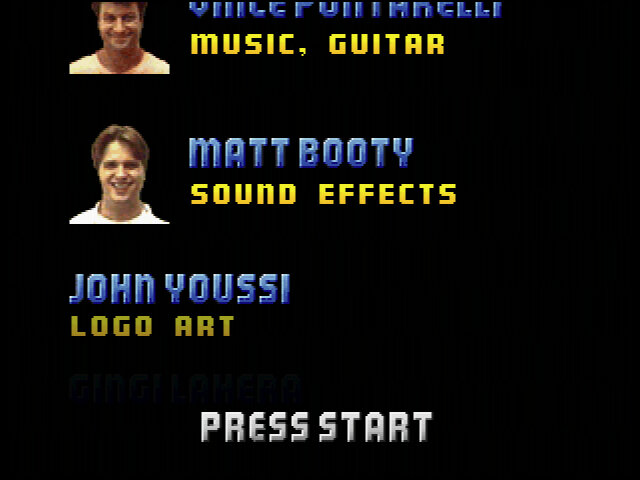
I wonder if that’s the same Matt Booty at Microsoft Studio’s?

Ridge Racer

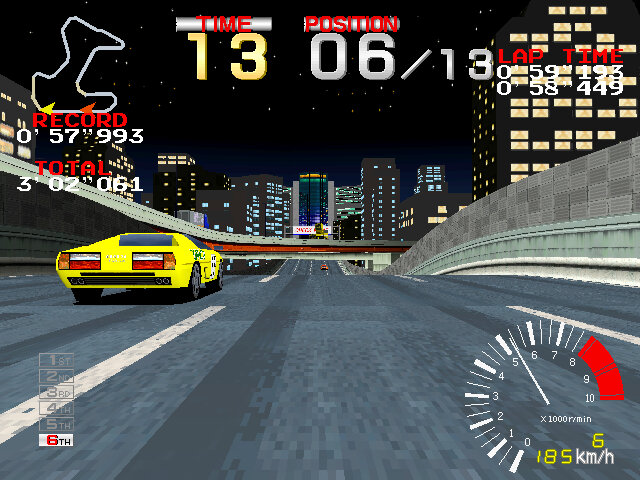
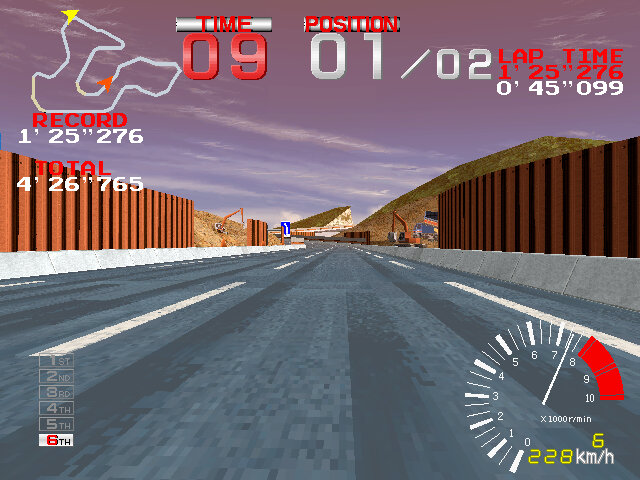
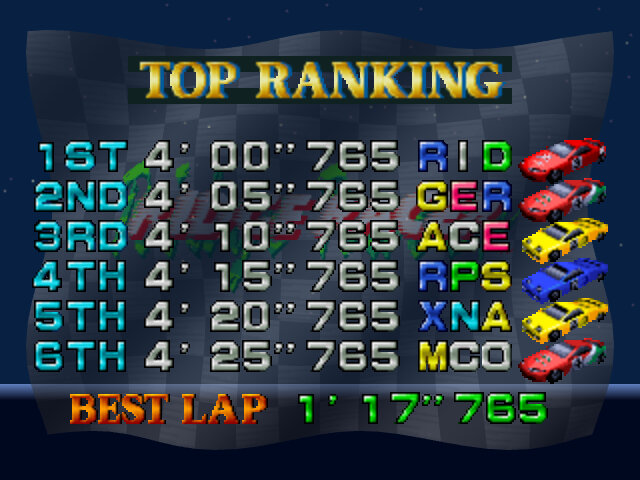
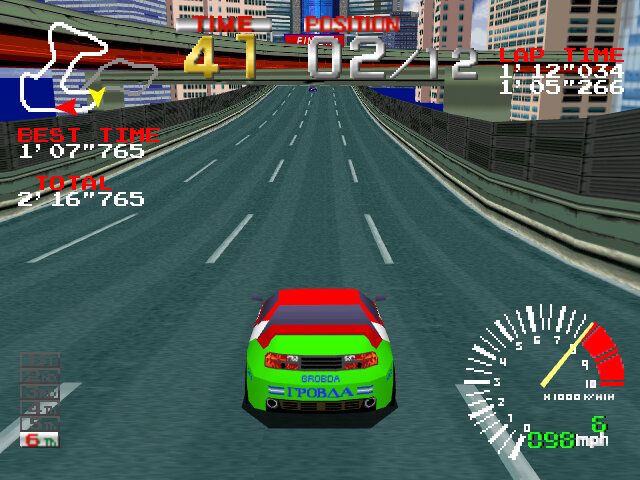
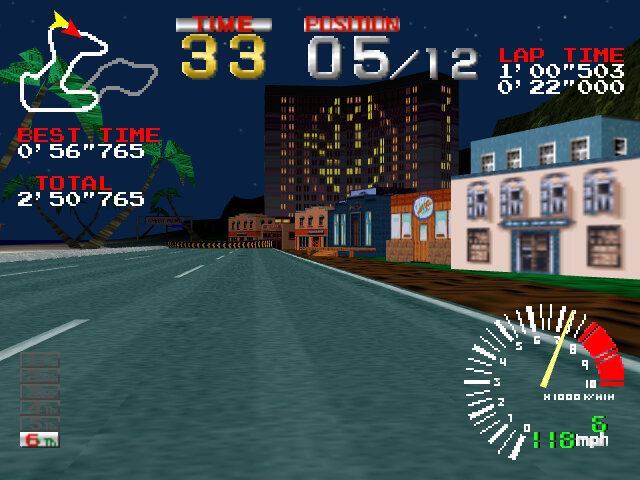
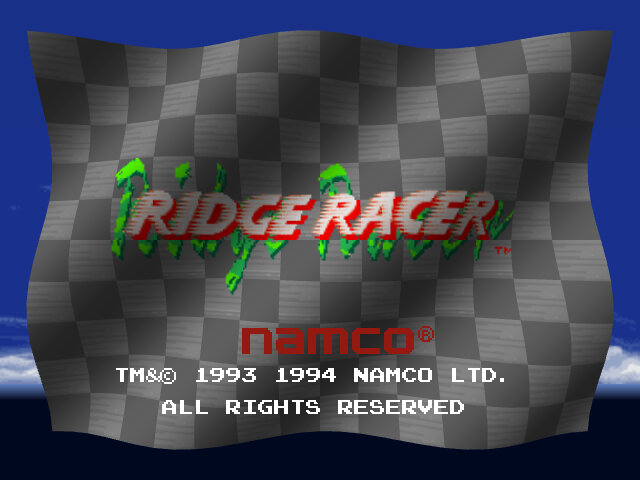
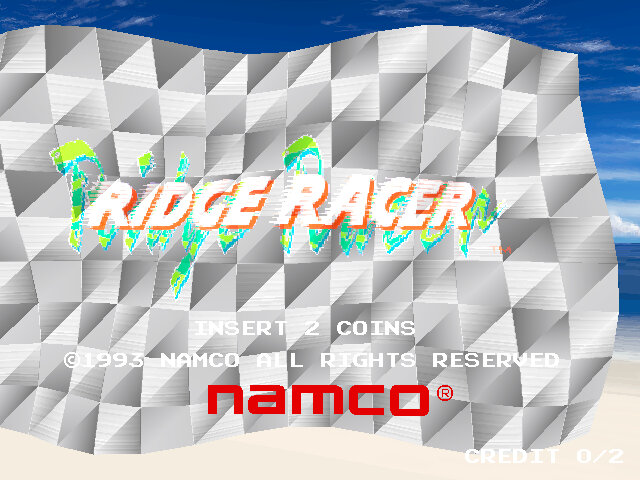
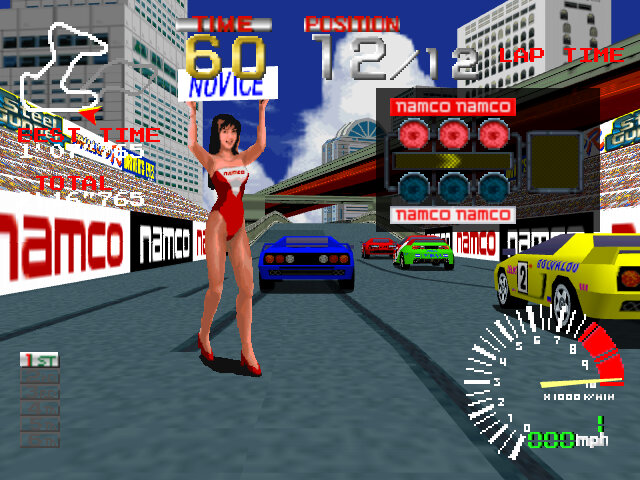
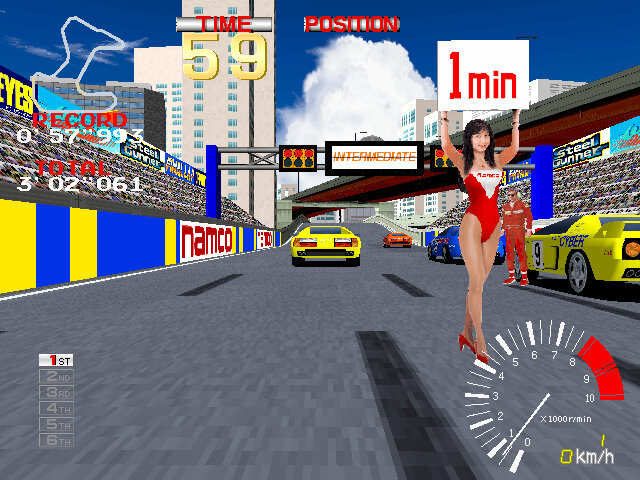
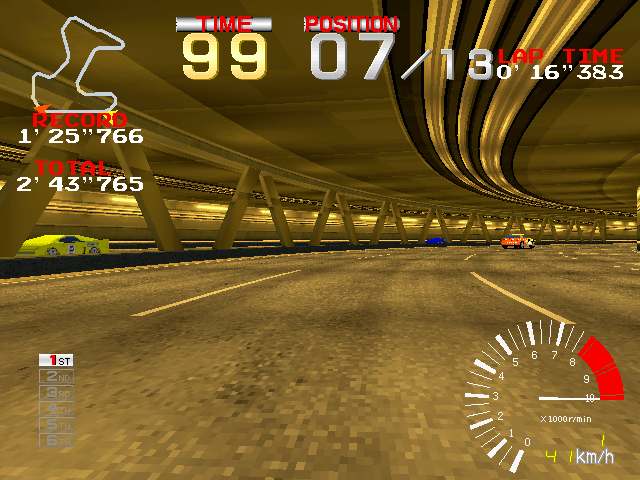
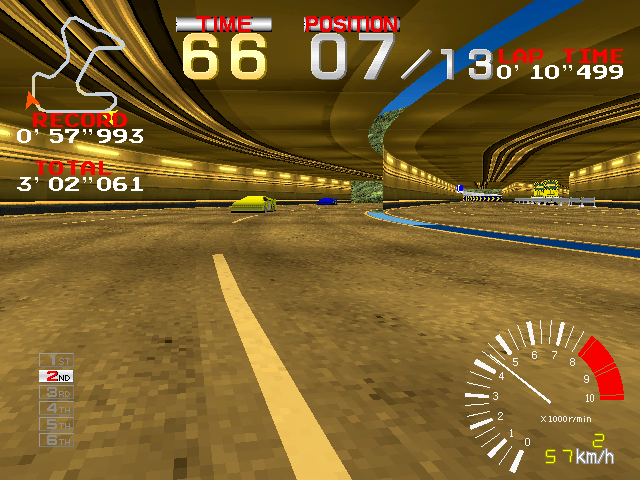
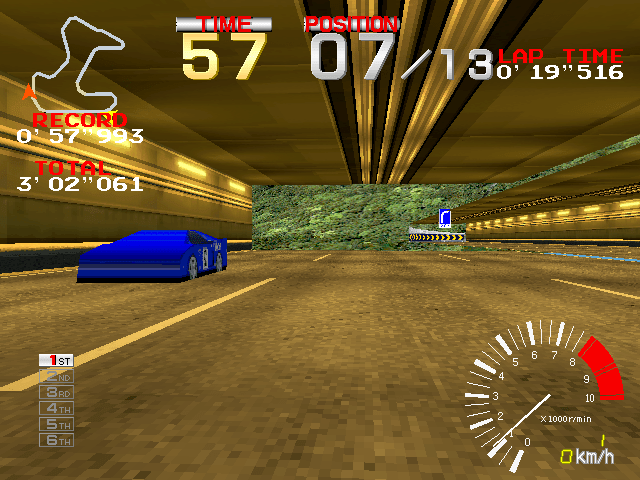
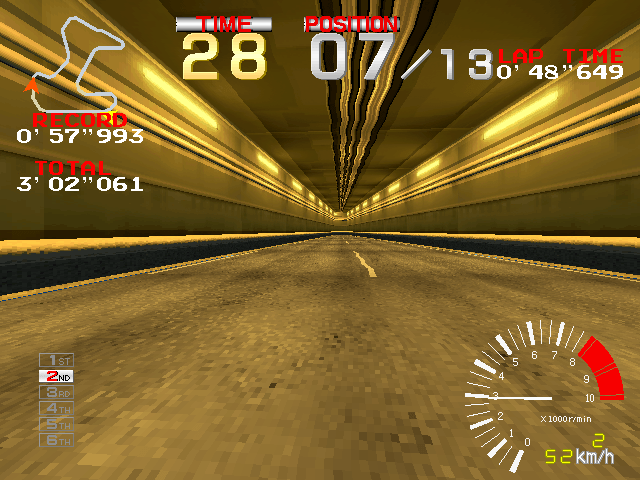
One of the first textured 3D racing games, and mostly known of being a launch title on the first PlayStation console. However it appeared a year earlier in the arcades. The arcade version runs on much more powerful 3D hardware, runs in a higher resolution, a higher framerate (60fps vs 30fps on the PS1) thanks to it’s Evans & Sutherland 3D hardware, which was previously used to power their simulations and CAD hardware.

Arcade

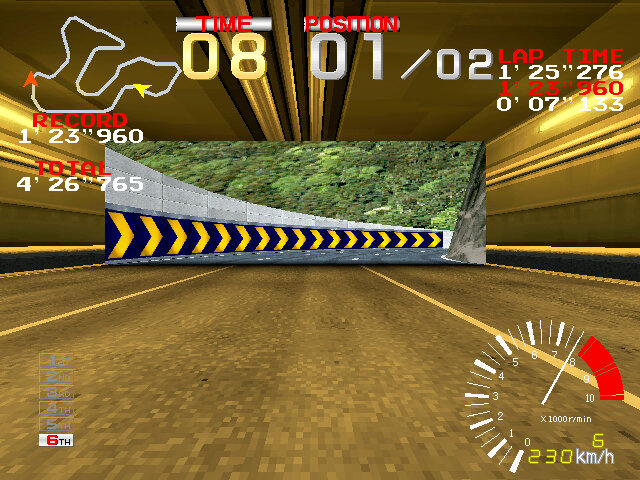
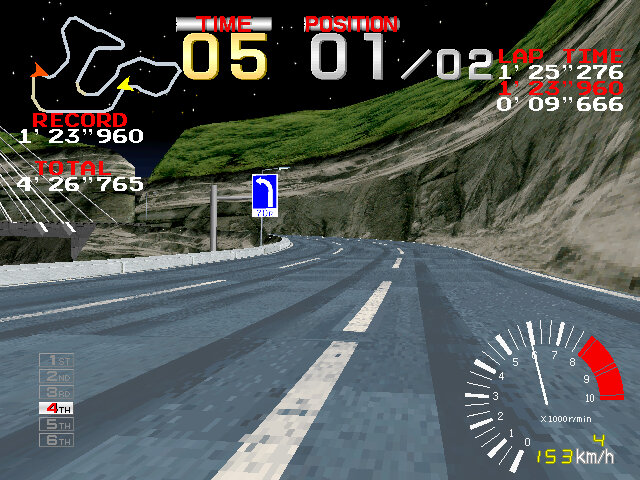
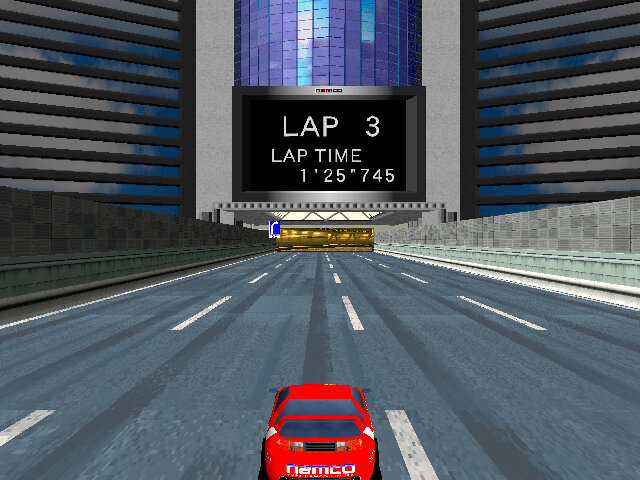
Released to the arcades in 1993 and running on the System 22 hardware, which was in direct competition with Sega’s Daytona USA and Midway’s Crusin USA.

PlayStation

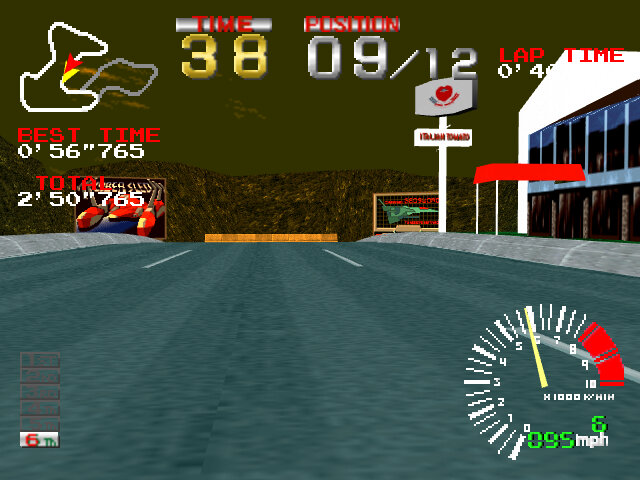
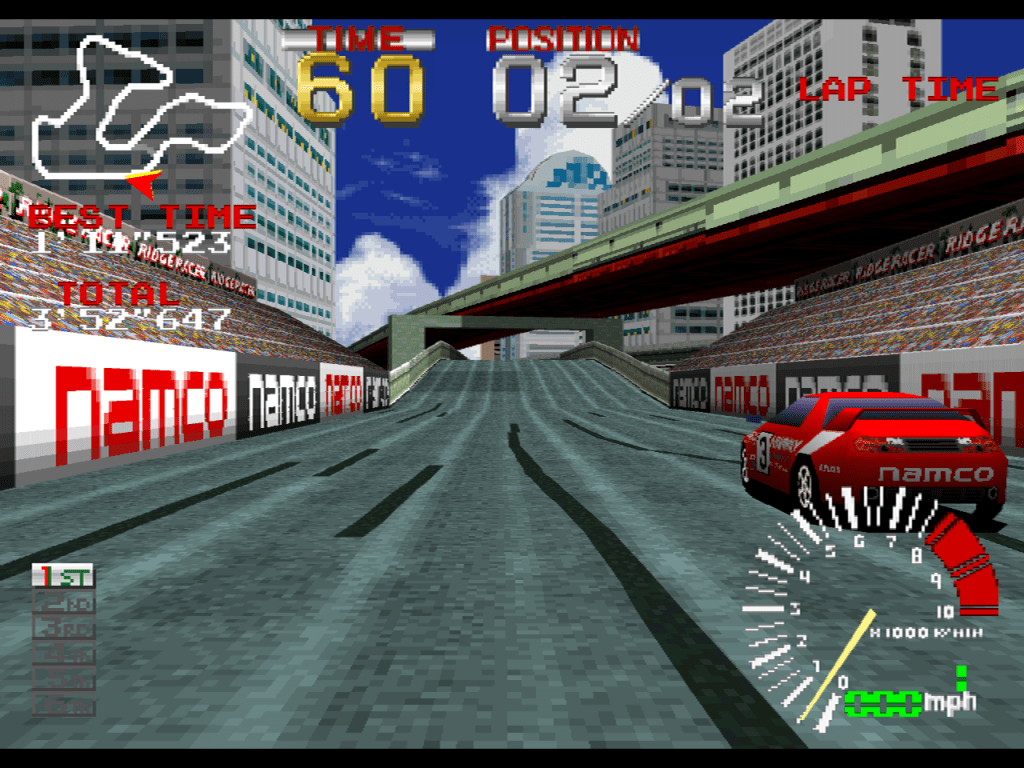
The game was ported to the original PlayStation in 1994 as a launch title, and was considered to be an acceptable port of the arcade despite the downgrade made in order to run on the PlayStation hardware. The PlayStation port has support for the Namco neGcon controller, that allows the player to replicate analogue steering by twisting the controller as at the time the dual analogue controller wasn’t available.

Ridge Racer Hi-Spec

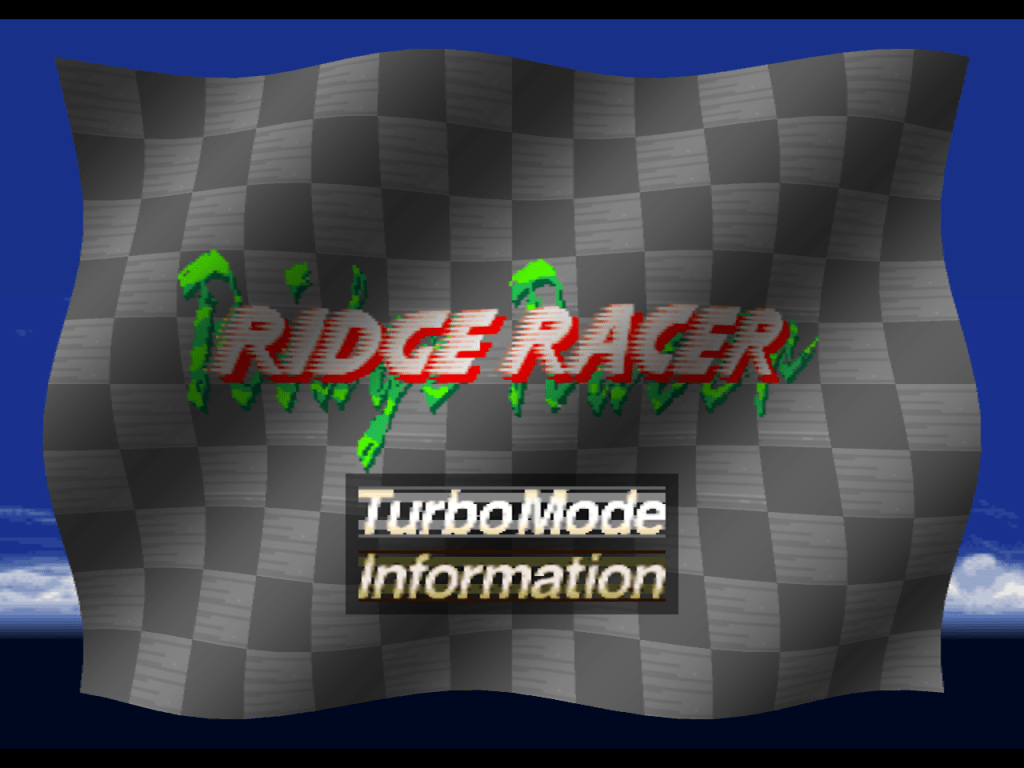
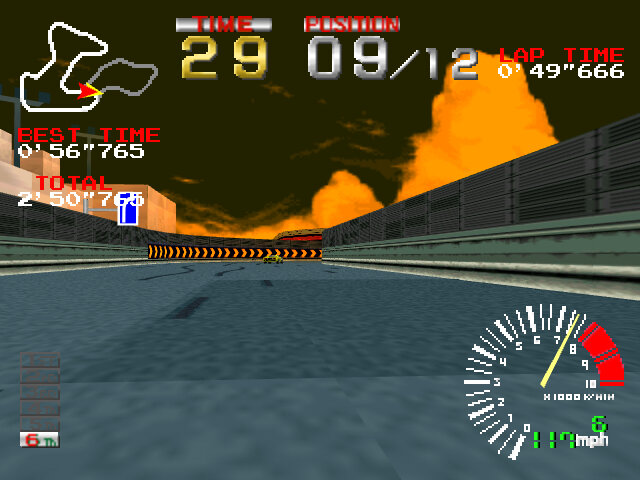
Runs in a resolution of 320×480 which is higher than the original release but less than the arcade version. The main attraction to this version is the 60fps upgrade and the gouraud shading, which enhances the graphics greatly. However there are only two cars on the track, with only 1 in time attack, and the texture quality has been reduced slightly. I had to disable texture filtering and display then unfiltered since it just looked like an N64 game. The polygon count of the cars and track may also have been educed, since the guide mentions optimised textures and polygons.

This build of the game was bundled on the Ridge Racer Type 4 bonus disc, and was not a standalone version of the game. It was meant to showcase a 60fps game on the original PlayStation hardware, and what sacrifices were needed no be made, as Namco were keen for later Ridge Racer titles to be running in 60fps. Ridge Racer V for the PlayStation 2 would be the first home game to be running at 60fps.

Zeebo

The game was ported to the Zeebo, a home console released in Brazil by TecToy and QUALCOMM, graphics have been slightly altered and the music is rendered entirely in MIDI.

Comparison

PSone on the left, using moderate enhancements in the Duckstation emulator with the Mame emulation of the arcade in the middle and the Hi-Spec version on the right, I wanted to see if I could get the PSone version to match the arcade in terms of image quality by upping the resolution to 640×480 and enabling texture filtering, something with System 22 lacked.

Arcade emulation seems to have issues rendering the flag, which is supposed to flap freely, maybe a physics issue with one of the Texas Instrument DSP?

The game isn’t a straight port and some design changes had to be made, the HUD has been changed around and the track objects have also changed. Some buildings have also been changed to be in line with the PSone limitations. On the right you can see the effects of the shading which affects the art style slightly, giving a more realistic look. The ground textures have also been altered.

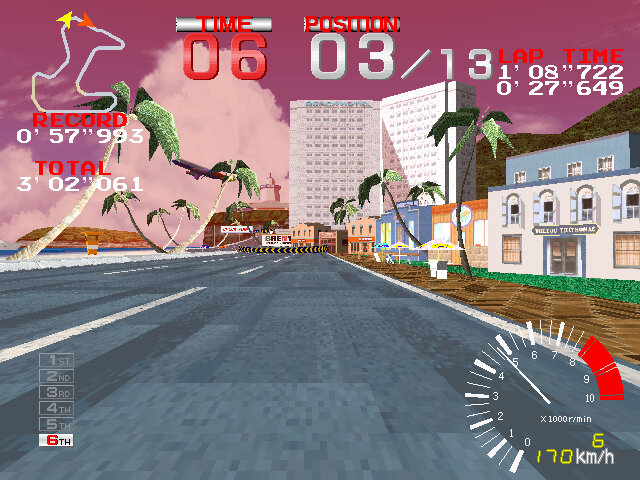
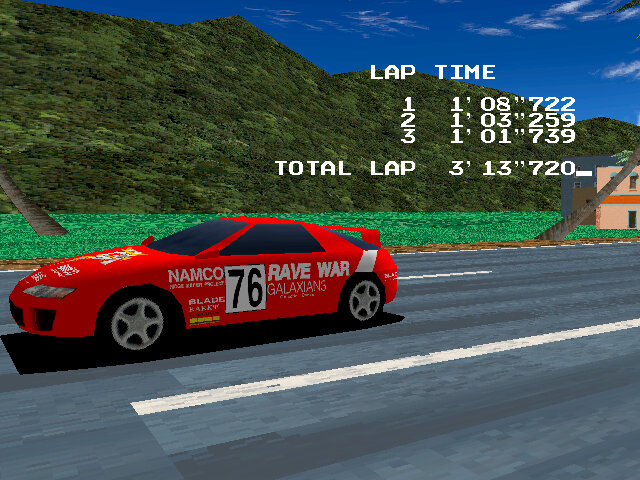
It’s worth mentioning that System 22 also supported gouraud shading, but Ridge Racer did not utilise it until Rave Racer in 1995.

Sunset differences between the two ports, The Hi-Spec mode does not have a night time version.

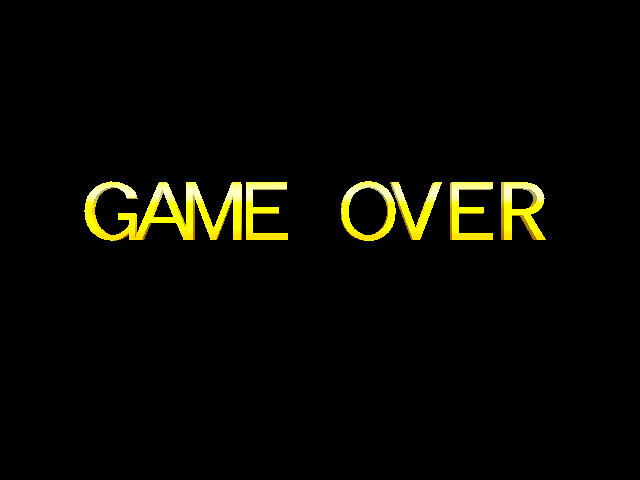
Game over is rendered in 3D for the arcade version, a static image on both PSone versions.

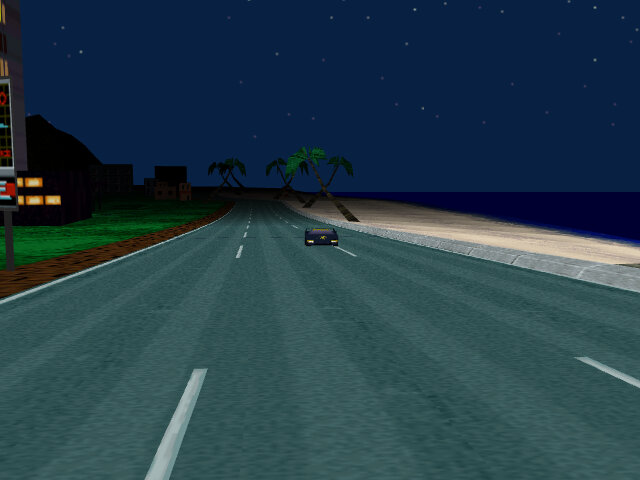
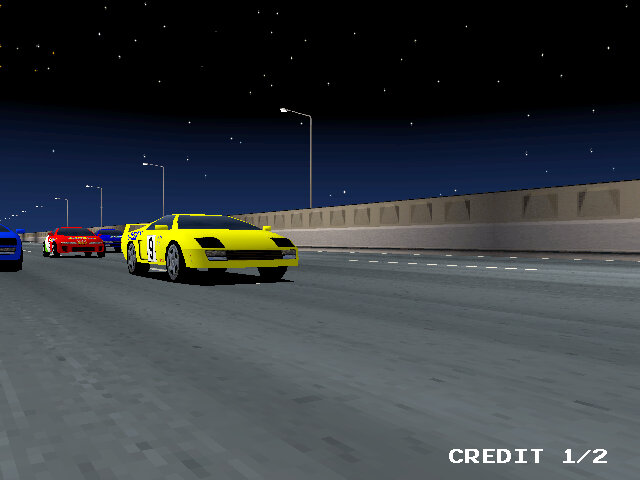
Comparison of the night sky, In the middle of a race the sun will set on the intermediate and time trials courses, to simulate a Le Mans race, the arcade shot is taken from one of the attract demos.

Boundary Break (Arcade)

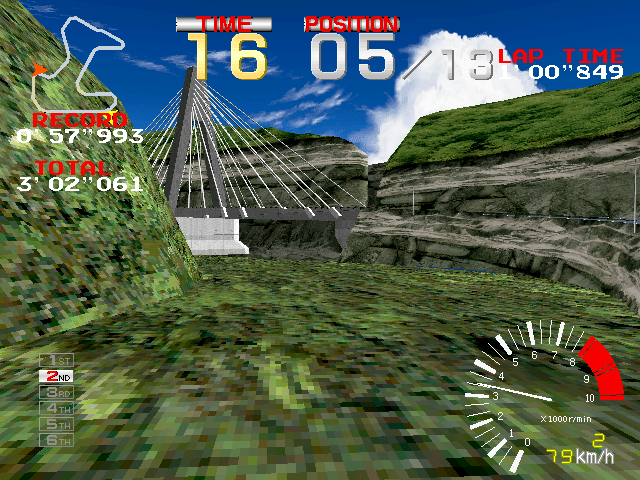
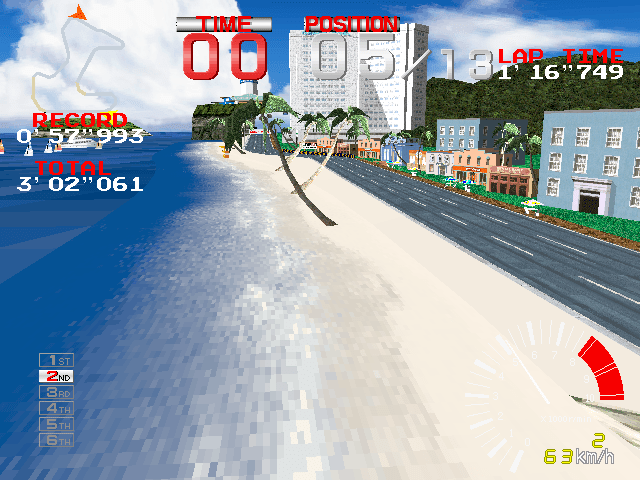
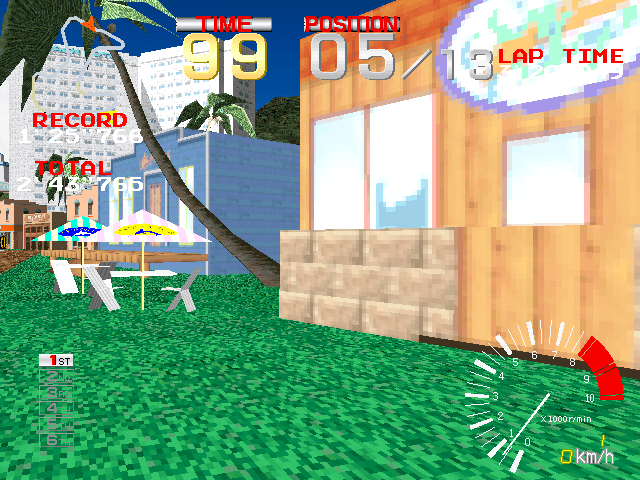
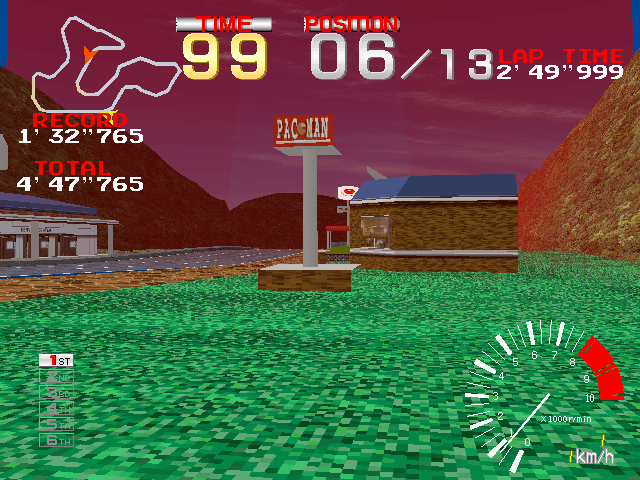
With the help of some cheats in MAME, we are able to disable the collision detection, allowing us to move outside of the track. This gives some interesting close ups of some in game environment buildings.

Ridge Racer System 22

A look of the city from a different angle

Ridge Racer System 22

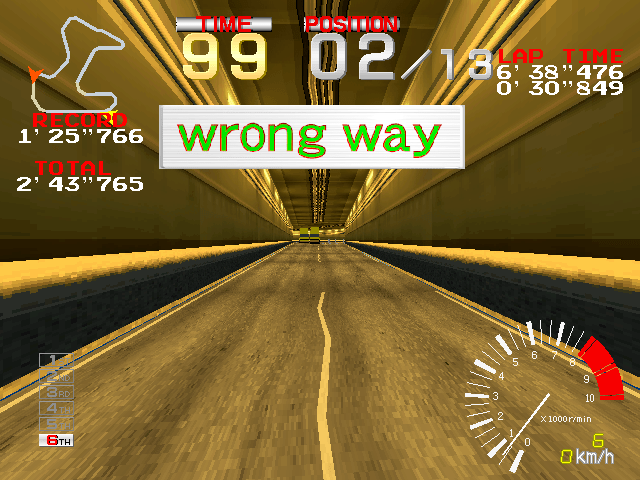
In the first tunnel, there is a path that is blocked off and is inaccessible

Ridge Racer System 22

A closer look at the other tunnel, with a view of the cars, normally these aren’t directly accessible. Namco used lower resolution models of the cars, since you typically see these driving in a distance.
Ridge Racer System 22

Another closer view of the cars, the tunnels ends abruptly to the outside, and the cars just disappear, and respawn at the other side after a few seconds.

Ridge Racer System 22

Before the end of the tunnel, theirs an intersection to another tunnel, which leads to a dead end

Ridge Racer System 22

The ground near the bridge, you can see the low detail textures, since System 22 didnt support texture filtering, giving a minecraft appearance

Ridge Racer System 22

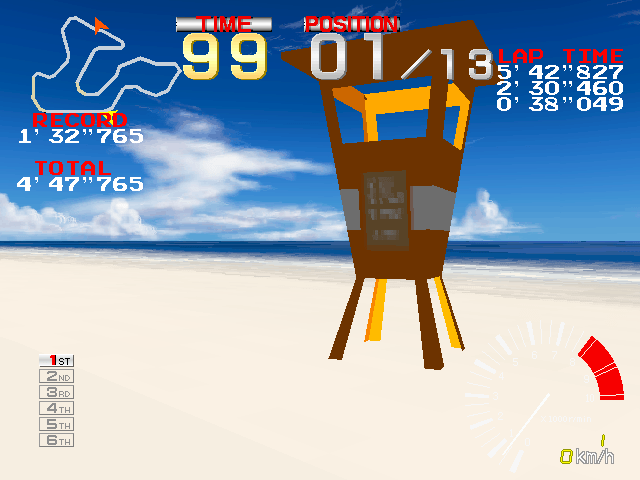
Another shot of the beach, sometimes if you break out of a track early on, your car remains on a higher evaluation allowing for a top down view for later sections of the game

A look at the buildings near the beach

Ridge Racer System 22

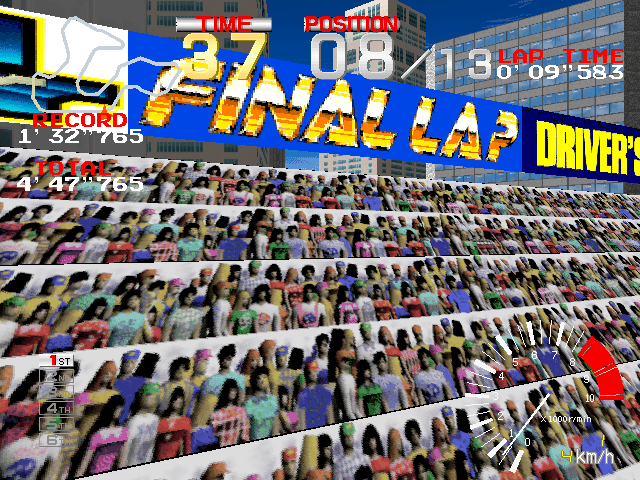
A closer look at the crowd at the start of the game

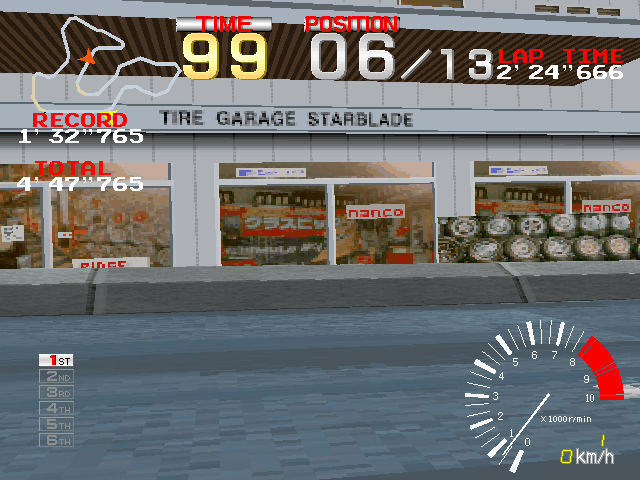
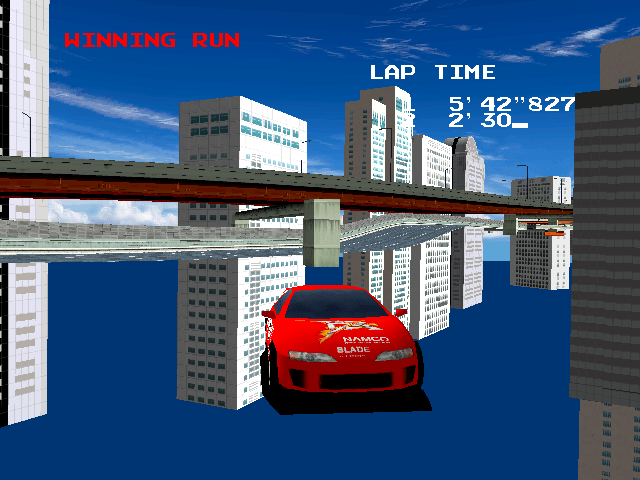
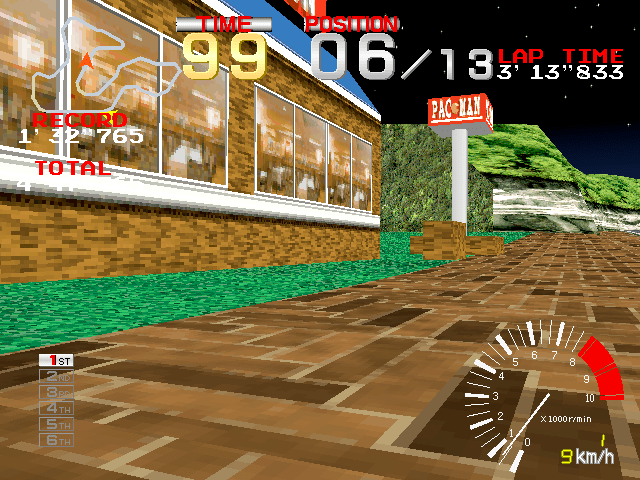
Tire Garage Starblade, one of the shops near the overpass. Starblade was a 3D rail shooter

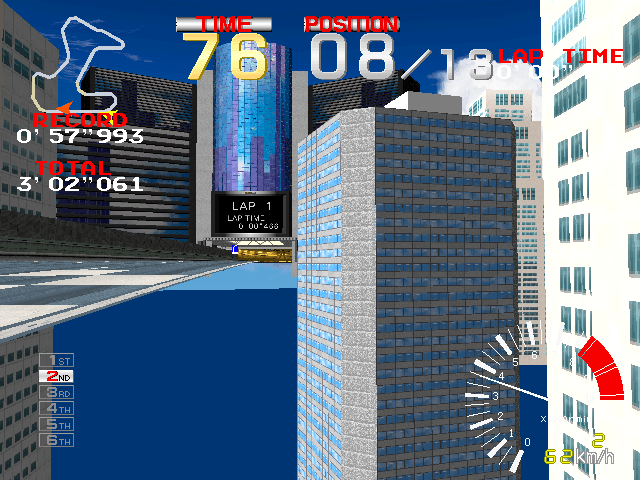
The buildings lack modelling towards the rear, since this view would not be available normally in the game. Also note the gap in the Sky where a bit of the blue sky is visible. Seems Namco displayed an overlay across the sky when it was night time, something the MAME emulator has issues replicating accurately.
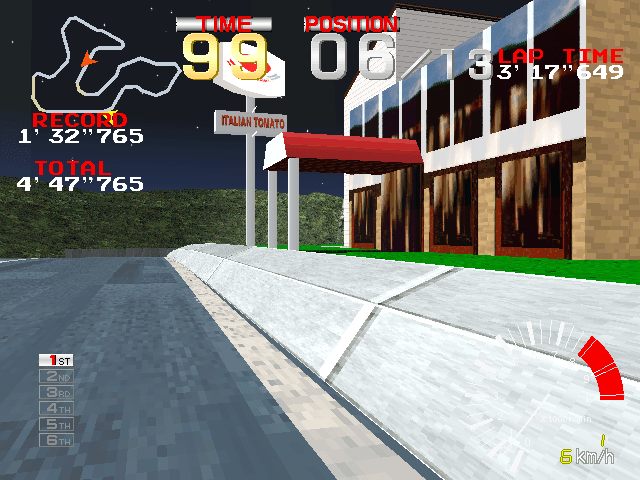
Italian tomato, some sort of resturant or obscure namco game?

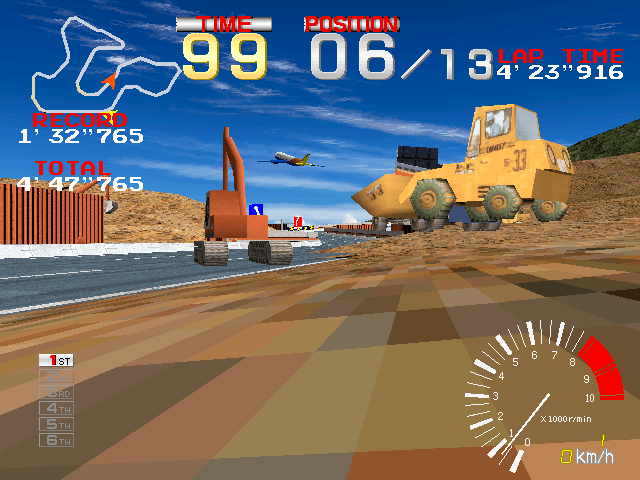
A closer view of the construction site, the trucks are levitating…

Ridge Racer System 22

View of the city, some of the building’s are quite long

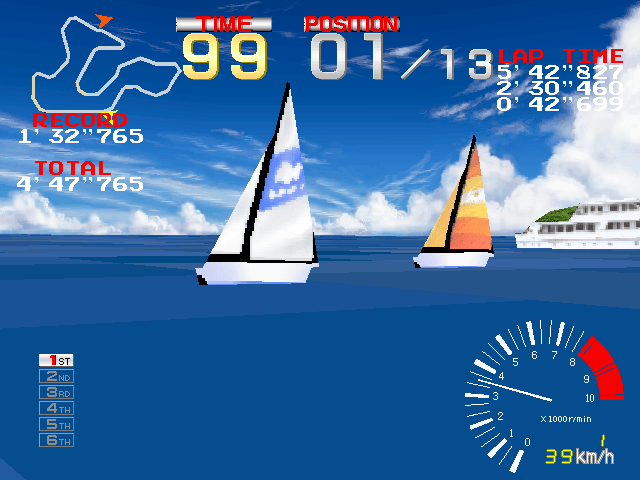
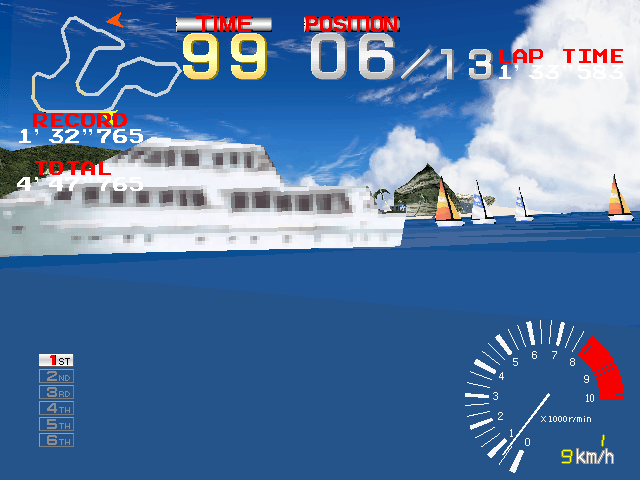
The boats in the beach section

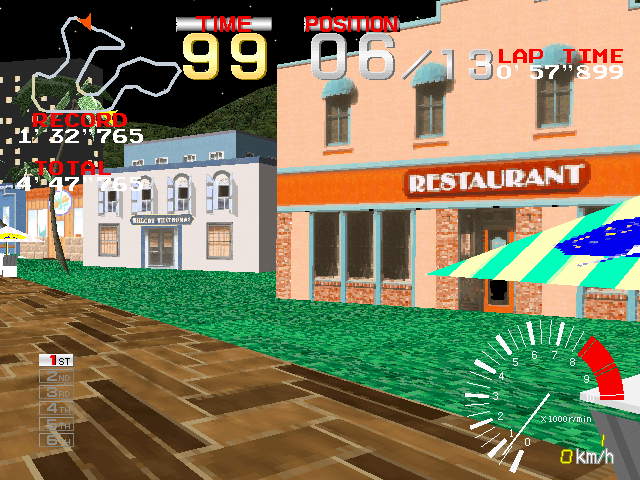
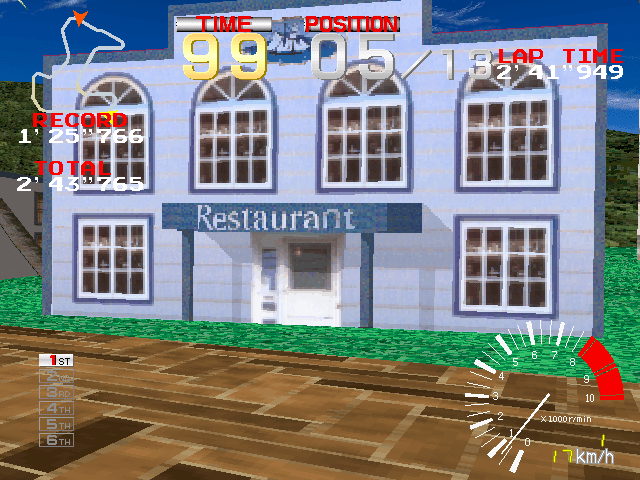
One of the many restaurants near the beech, this building appears multiple times. Also this game predates lightning effects, as the game is supposed to in night time mode but the building appear as if its daytime, however in the starting section, the buildings do change to a night time effect.

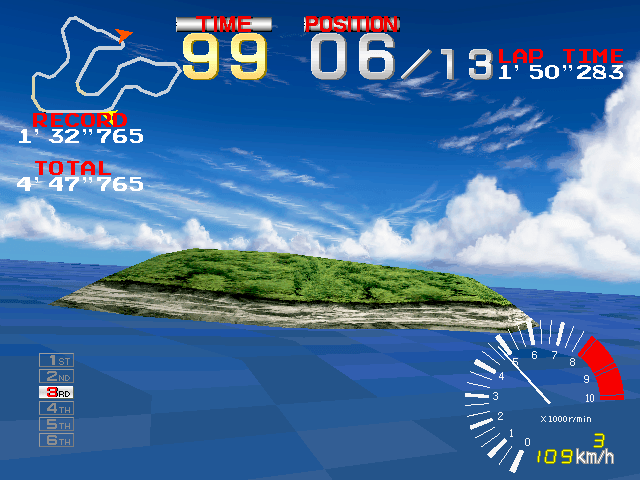
A distant island, near the marina

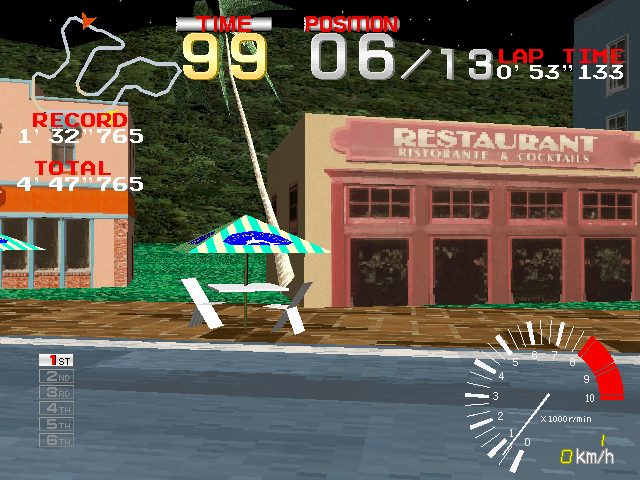
Another restaurant building

Ridge Racer System 22

Alternative view of the dead end tunnel, I’d like to try and do this to the PSOne version.

Todo: Mjlonir emulator was capable of running the system 22 versions of Ridge Racer with graphics acceleration, but as it was based on an older version of MAME it suffered from a lot of emulation and graphics issues, and uses an outdated rom set. Vivanonno was another emulator that was worth a look at.