Tag Archives: 1997

House Of The Dead

A mid-90s arcade rail shooter that takes the Virtua Cop formula and puts a horror spin on it, giving birth to a new franchise.
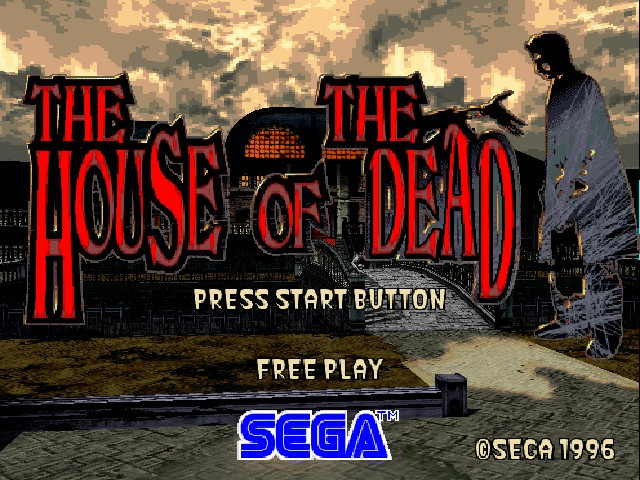
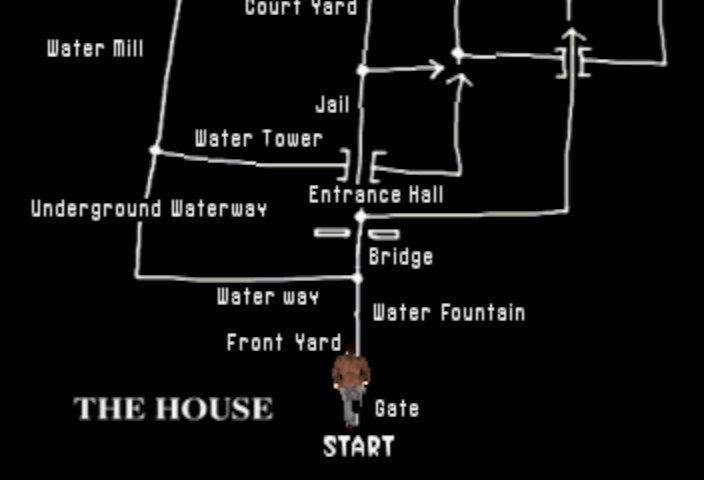
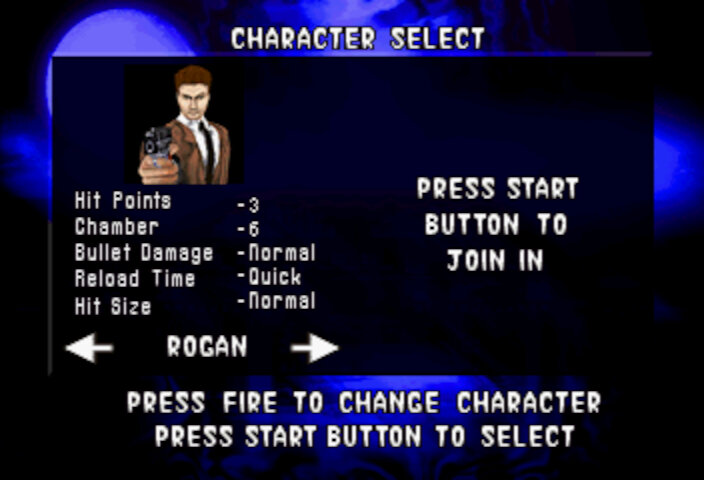
In House of the Dead, the main characters are two AMS agents named Thomas Rogan and G (Yes, just G). They are sent to investigate a mysterious outbreak at the DBR Corporation’s genetic research facility, which has been overrun by hordes of undead creatures. Throughout the game, the player controls either Thomas or G as they fight their way through the facility and uncover the truth behind the outbreak. Along the way, they encounter various other characters, including DBR’s CEO, Caleb Goldman, and his assistant, Dr. Roy Curien, who is responsible for the creation of the undead creatures.
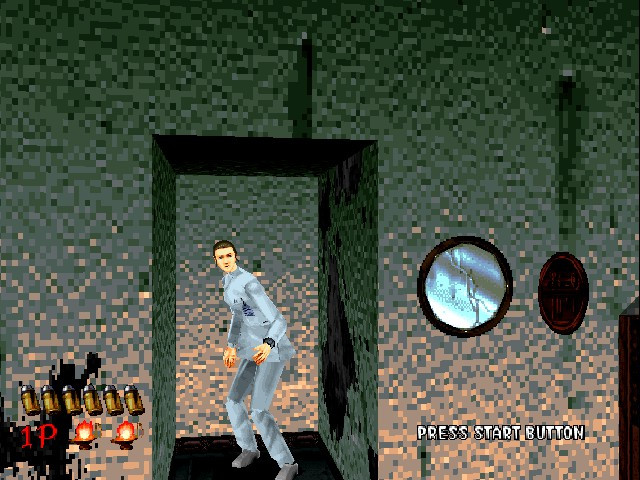
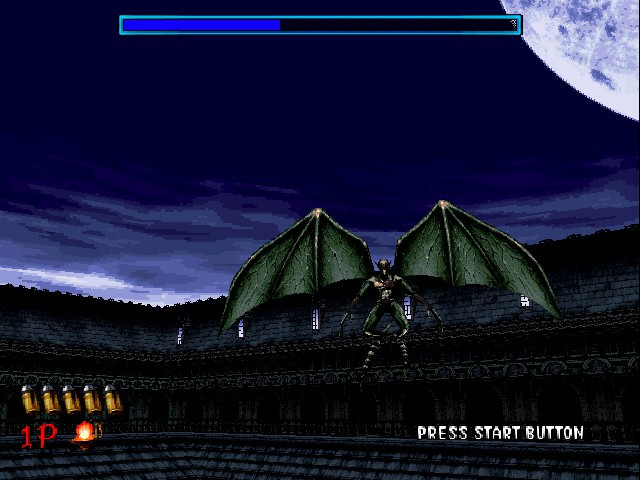
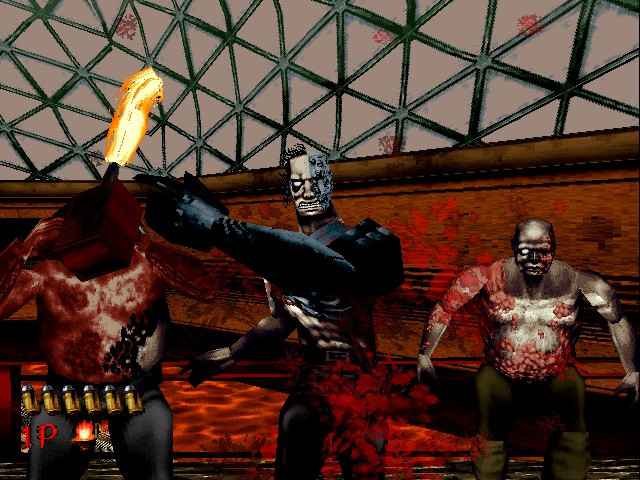
The gameplay of House of the Dead is simple, you’re armed with a light gun and tasked with shooting your way through levels filled with zombies, mutants, and other monstrous creatures. The gameplay is fast-paced and requires quick reflexes, as enemies can come at you from all angles in the form of jump scares. The game also features branching paths, which add some variety to the levels and encourage replayability as many of these will affect the ending sequence.

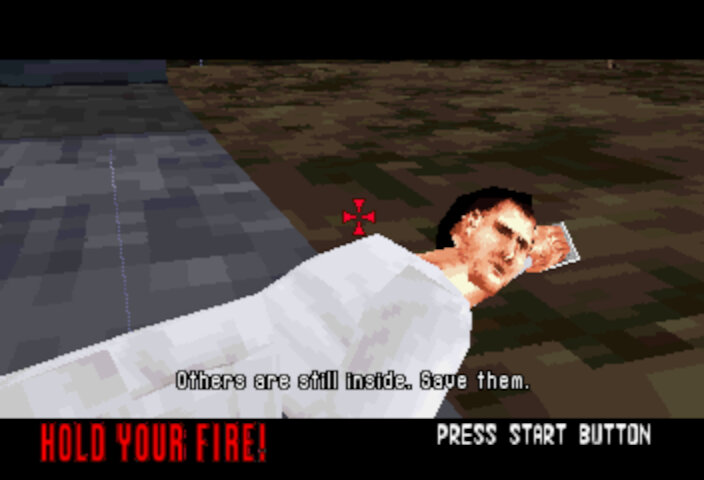
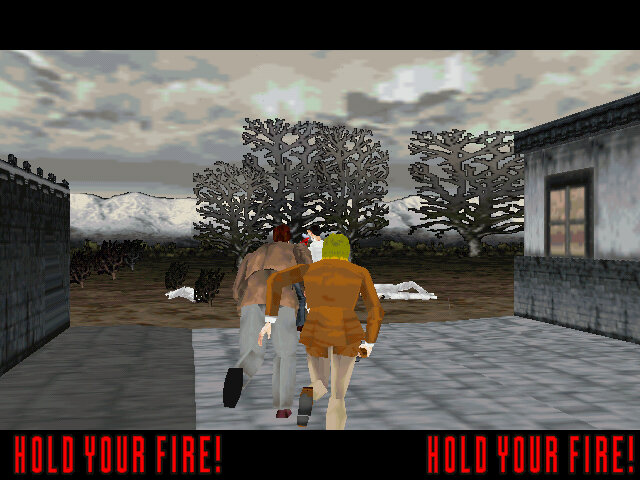
Some items can be shot at, typically pots, and will reveal additional lives. There are also opportunities to save scientists, who will sometimes reward you with an extra life or will direct you to another path.
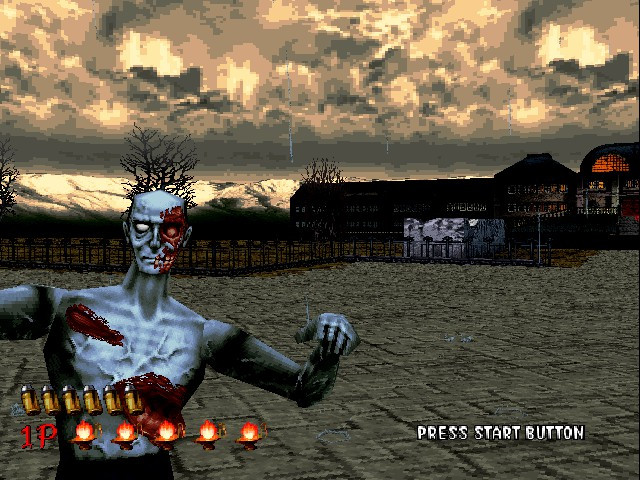
There are a few boss battles, each with a different way of defeating them. These occur at the end of each chapter. The Chariot is a large, armored zombie and appears at the end of Chapter 1 with the goal to target its weak spot in the armor to damage it. The final boss being the Magician serves as a challenging and memorable boss battle. He is able to create multiple illusions of himself, making it difficult for the player to determine which one is real. Additionally, he has powerful psychic attacks that can drain the player’s health and make it more difficult to aim. Defeating the Magician requires careful observation, quick reflexes and a lot of coins.

Versions

The game was somewhat popular and prompted Sega to port it to their Saturn console, it also get a Windows PC port similar to Daytona USA and Manx TT Superbike.

Arcade
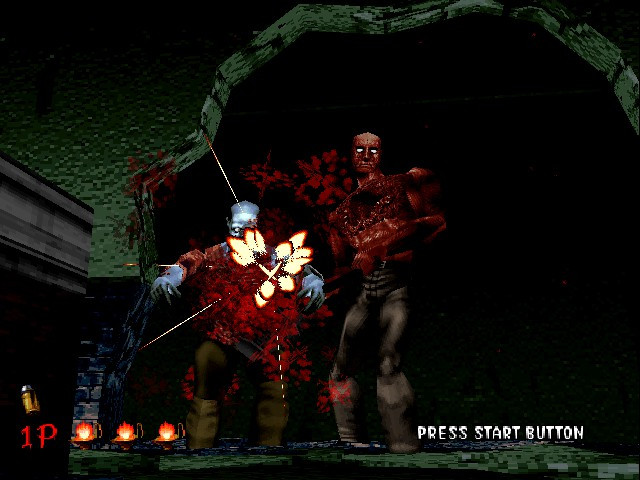
The arcade version of House of the Dead is considered a classic and is highly regarded by many gamers and fans of the shooter genre. The game was initially released in arcades in 1996 and like other Sega arcade titles of the era, it ran on the Model 2 arcade board.

This version of House of the Dead was popular due to its use of light guns, which allowed players to aim and shoot at enemies on the screen. Reloading is done by shooting outside of the screen, In contrast to Namco’s Time Crisis where you have to release the pedal to enter cover to reload.

Sega Saturn
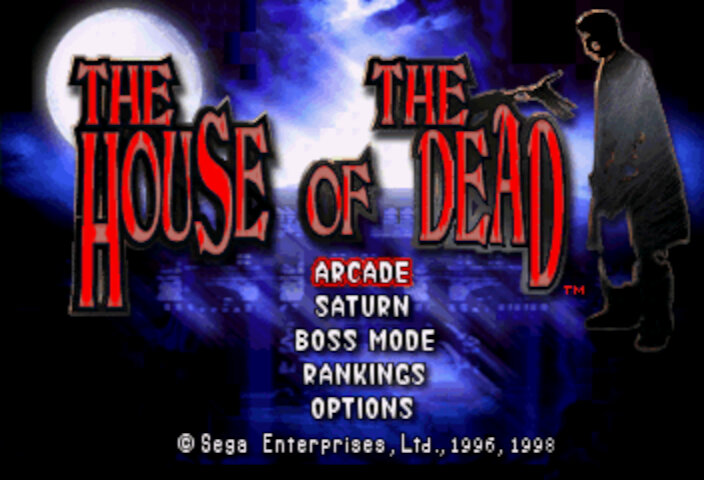
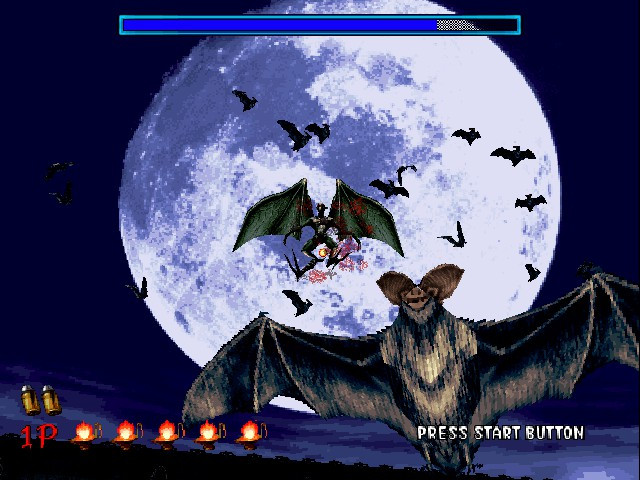
The Sega Saturn version of House of the Dead was a faithful recreation of the arcade version’s gameplay mechanics, graphics, and sound effects. However, the game’s performance on the Saturn can be a bit sluggish, with some frame rate drops and occasional slowdowns during intense action sequences.
The Saturn version also supports use of a light gun controller that was intended to give more precise aiming. Unfortunately this does not work well on modern LCD displays leaving the traditional controller as the only form of input.

You do have the ability to play as different characters, either ‘G’, Sophie or one of the Scientists which will affect the cutscenes as they are rendered in engine. Compared to the arcade version, the graphics takes a downgrade but you do get the benefit of high quality sound.

Still there’s no option to revert to the arranged arcade soundtrack, odd because both the Saturn and the Model 2 have the same sound processor (SCSP)

Microsoft Windows
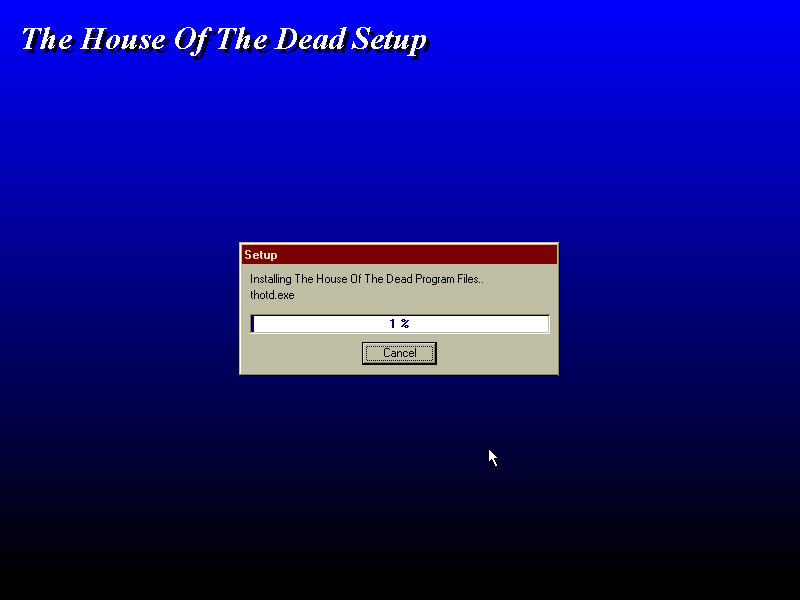
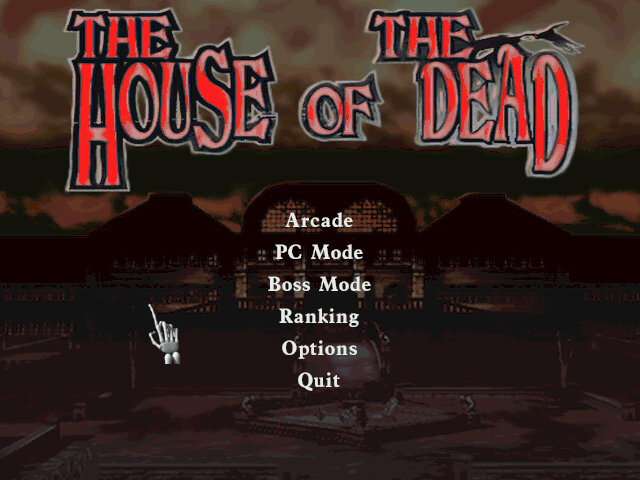
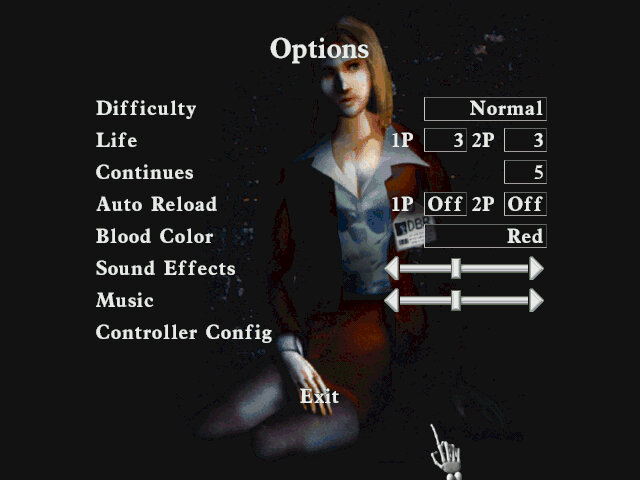
The game was initially released for PC in 1998, It offers several enhancements over the arcade version, including improved graphics and higher resolution support. Additionally, players have the option to use a keyboard and mouse or a controller for more precise aiming. Some parts of the Mansion have been retextured, likely to give it a more colder atmosphere and due to differences in how Model 2 and DirectX games handle textures.

For video cards that don’t support Direct3d, the game can run in DirectDraw mode instead. The 3DFX Voodoo card is capable of Direct3D acceleration and is supported in 86Box.
Conclusion

House of the Dead is a classic arcade game that still holds up today. Its addictive gameplay, impressive graphics, and horror-themed setting make it a must-play for any fan of arcade shooters.
Theme Hospital

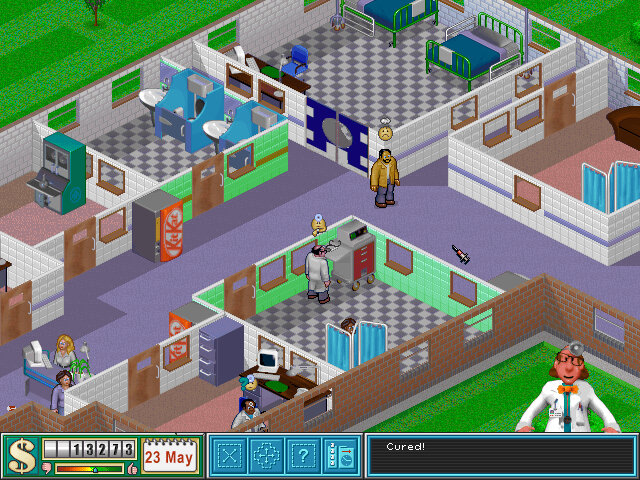
A hospital simulation game from The makers of Theme Park. Whilst its not an accurate simulator like Sim Healthcare, its still a lot of fun and has a lot of Bullfrog-type humor.

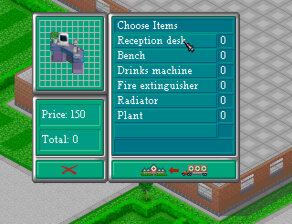
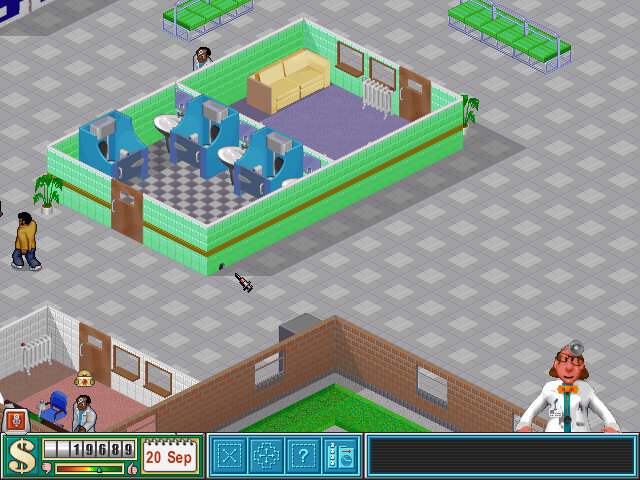
You start off with a blank empty hospital building, First thing to pop down is the reception desk, which is where patents will flock to when they first enter your hospital, of which they are then referred to the GP’s Office. Here you will want to build further diagnosis and treatment rooms as the patents demand for them.

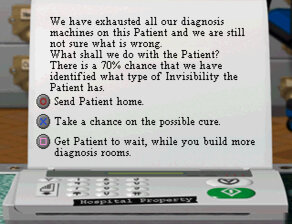
GP’s Office: Used to find out what’s wrong with the patent. Usually a doctor in the GP’s office will be able to diagnose the patents depending on their skill set, but some will require the patient to refer to another diagnosis room to find out what type of illness the patient has. This room gets very busy as patients will return to this room until they are diagnosed, but not when they are cured. A good tactic is to build one near the diagnosis rooms like the X-ray or Scanner to help deduce the load. If you have a consultant doctor, you will want to place them in the GP’s Office as they are better at diagnosing illness than a regular or junior doctor.

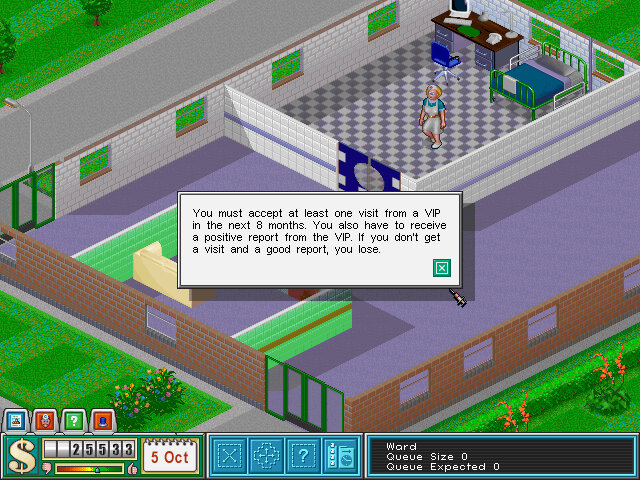
Ward: Used for both diagnosis and treatment, this is managed by a Nurse. Wards can be sized quite large, and more than one bed can be placed. Patents will also rest here before entering the Operating Theatre. Beds can only be placed at a specific angle, so don’t make the room too big otherwise its wasted space.

Pharmacy: Used to administer a wide range of drugs used to cure patients. Operated by a nurse, you will need to build multiple Pharmacy’s later on in the game since this will cure a majority of illness.

Psychiatric: Like the ward this is also used for diagnosis and treatment. Requires a doctor with the Psychiatrist qualification. Bookcases and a skeleton can be added, not sure if this has any affect on the diagnosis?

Further diagnosis rooms consist of the Cardiogram, Scanner, X-Ray and Ultrascan, these are unlocked after research and require regular maintenance by an handyman. These machines get better through further research and can withstand multiple usage cycles and earthquakes. Since these rooms are only used to cure a single illness, you probably only need one per hospital, but in the case of emergency’s where up to 14 patients can arrive at the same time with the same illness, you may need to build another to satisfy demand.

Clinics are also treatment rooms that use machines to cure patients, again these are also unlocked as you progress through the game, the the inflation clinic being unlocked from the start. Slack Tongue Clinic and Fracture Clinic are two examples that are used to treat specific illness.

The Facilities are rooms that help your hospital to function and are required to progress to the next level: Toilets are used to stop patents from making a mess in your hospital, of which multiple toilets will need to be placed in larger hospitals. Usually one toilet per building is needed. A staff room allows staff to relax and replenish their energy with further objects being able to be researched like an arcade video game that reduced the time needed for staff to stay in the staff room. The Research Dept, unlocked from level 3 onwards allows your hospital to unlock new illnesses, rooms and machines, along with improving the effectiveness of your drugs which helps prevent accidental death by your staff. There is also an autopsy function that requires a sacrifice of a patient that will boost research for that illness, but carry’s a risk of a reputation drop if this is discovered.

Lastly there is a training room that allows doctors to learn new qualifications by a consultant level doctor. A problem here is doctors in training can also become consultants, which prevent them from learning new skills. This can be annoying when you are in the middle of training a new surgeon, only for him to become a consultant which stops skill progression.

Micromanagement

As you run your hospital, there are several elements that you need to manage

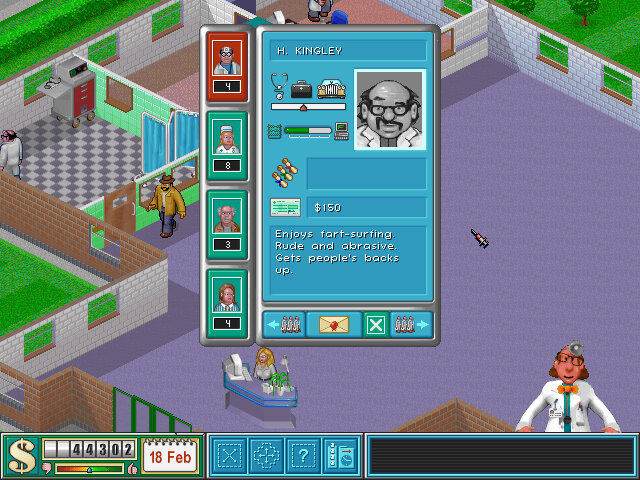
Staff Happiness: How happy are your staff, placing them in larger rooms with plants and heating will make them happier, otherwise they may demand a salary increase

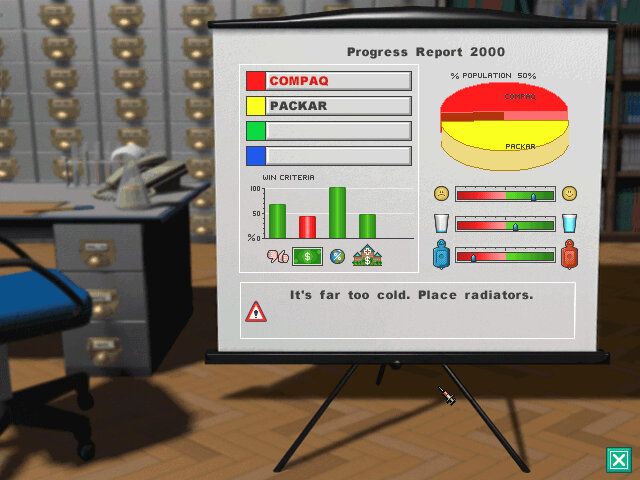
Heating: Radiators need to be installed and set to an acceptable level, cold hospitals can affect the reputation and happiness of staff

Upkeep: Patients will litter the hospital as they remain in your hospital, ensure you have Handymen to clean up after them. Plants also require watering by handymen. Lastly, rats can infest the hospital and can be shot by quickly placing your mouse cursor over a moving rat.

Emergency’s: These start to appear from level 3 onwards, you must cure the specified amount of patients within the time limited to earn the bonus.

Research: as you build the first Research Department, you can monitor and focus on different aspects of research, if you prefer to have a focus on drug effectiveness or for diagnosis machines

Epidemics: These start to occur past level 6 and require you to treat all patients with the specified illness before the health minister arrives at your hospital.

Earthquakes: These can actually happen which results in the screen shaking rapidly, patients may fall to the ground but I don’t believe they die. The main issue is the damage to the machines, make sure they have been repaired by the handyman and they have adequate strength or the machines will be destroyed, rendering the room to be useless. I recommend replacing machines that have less than 5 units of strength.

Network Play

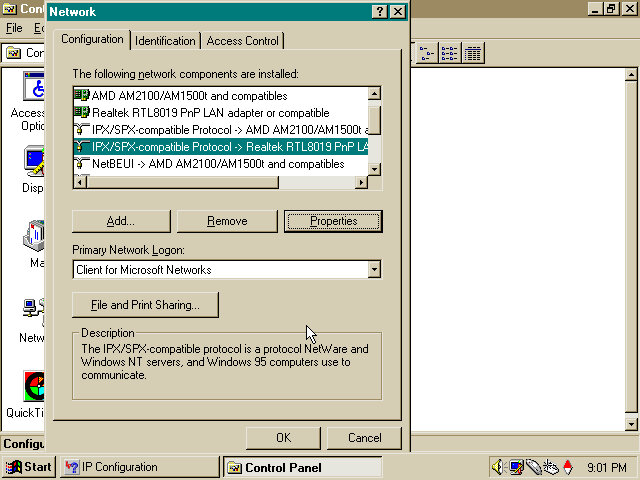
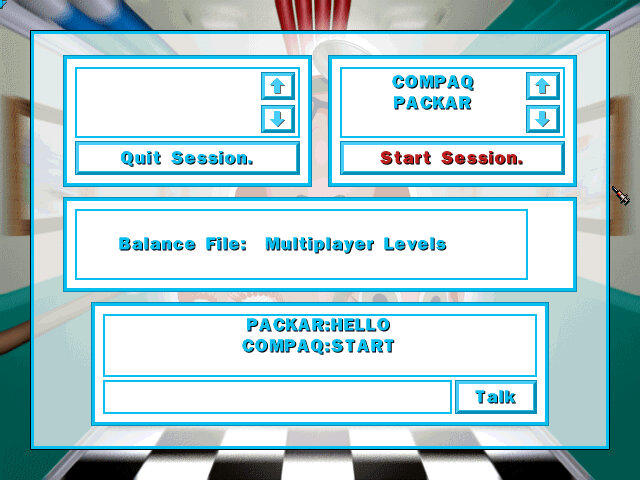
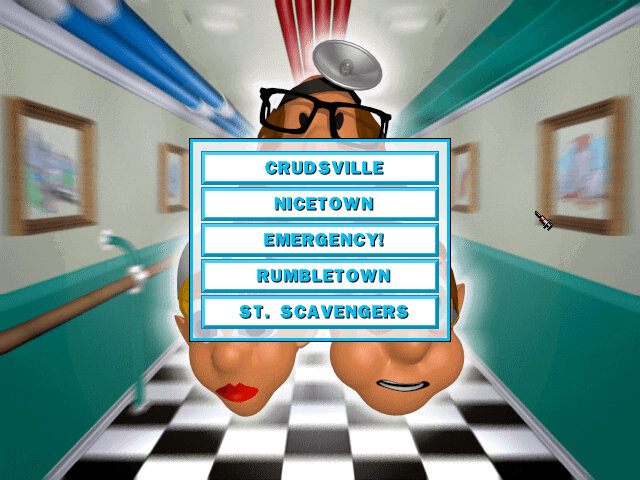
This requires a patch to be installed which adds network play support to the game which can then be accessed by choosing the middle part of the skull in the menu. The game is reliant on IPX or serial protocols to communicate with another player. For Windows 95/98 you need to ensure the IPX protocol stack is installed and enabled, which isn’t done by default. You can install it by clicking on the ‘Add’ button and selecting the Protocol, then IPX Comparable Protocol from the Microsoft group. You will have to reboot your system and might need the Windows 9x install CD to finish install.

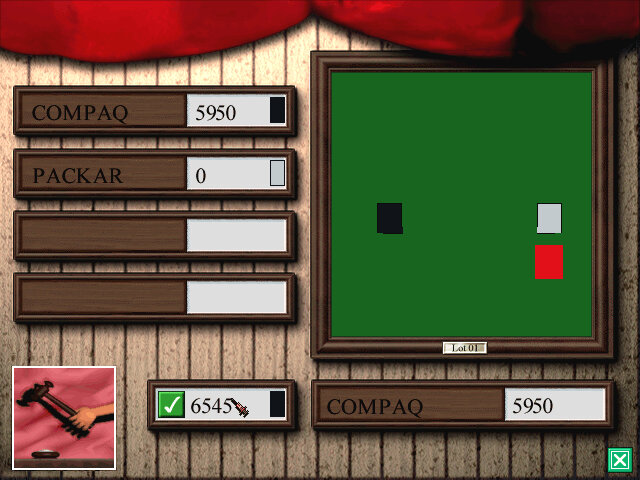
I was able to get this working over 86Box using a PCap configured network using two 86BOX VMs, setting the VMWare network adaptors seemed to work the best. Both players have access to the same map and must complete with each other for land, when purchasing land a bidding war is started between all players on the map. Objectives are given every six months which determines who wins the game, the game continues until one player loses.

Original PC MS-DOS/Win32

A hybrid DOS/Windows 32bit game which can run under either environment. Whilst designed for Windows 95 it will happily work under Windows 98 and ME.

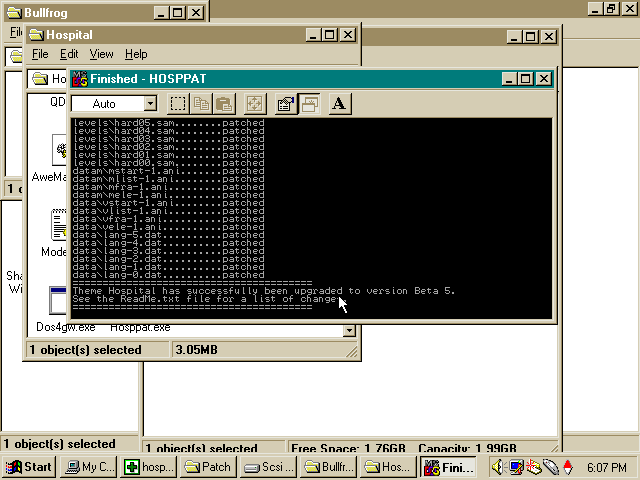
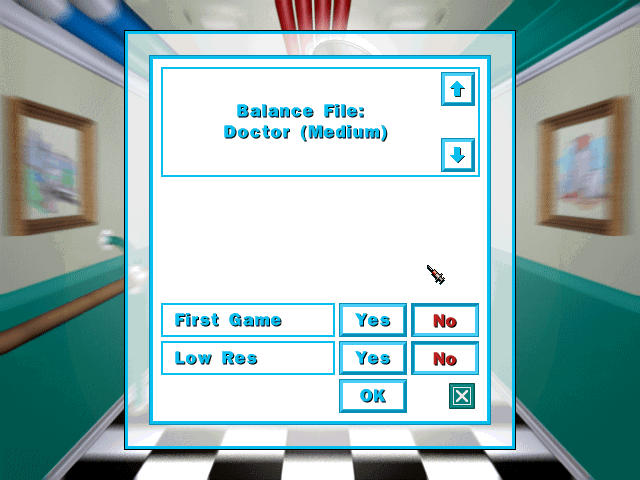
A patch was released for the game which fixes a few bugs, adds a difficultly level adjusted and support for IPX network play.

The game is also capable of running under DOS, which might be useful for low end PCs since its not reliant on Windows 95 running in the background.

No Macintosh version was release for this game, which is odd for a simulation game released in this era.

CorsixTH

This is a remake of the original game using a custom engine designed for more modern Windows operating systems, and has been ported to Linux based operating systems. Highly recommend as this allows the game to un in higher resolutions (tested up to 2560×1440) and fixes a lot of bugs that plagued the original game.

Sony PlayStation

The game was ported to the Sony PlayStation shortly after the PC release. Running in a lower resolution and missing the background music which removes a lot of charm to the game. Its also a bitch to play since the game has poorly adapted the user interface from the PC version. You have to use the controller to navigate the cursor onscreen to select the dialog boxes, instead of just mapping them to the PlayStation face buttons which makes it time consuming to perform simple actions.

Rooms are also fixed in size, which does make it easier to play via the controller.

This was also related as a PSone classic for the PlayStation 3 and PlayStation Portable.