Tag Archives: DirectX 3

Wipeout XL / 2097

Wipeout XL is a high-speed, futuristic racing game that was originally released in 1996. It was developed by Psygnosis and published by Sony Computer Entertainment. The game is set in the year 2097, where players compete in anti-gravity ships across a variety of tracks and modes.

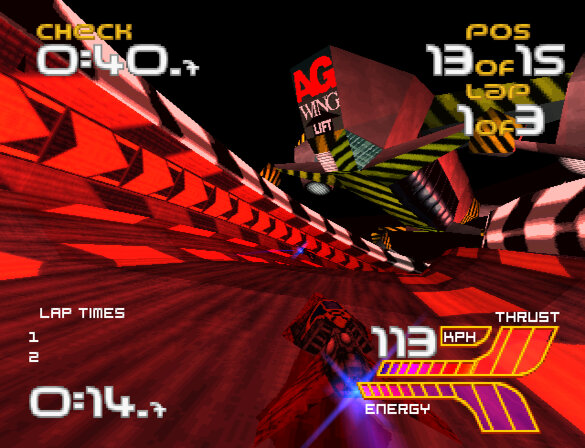
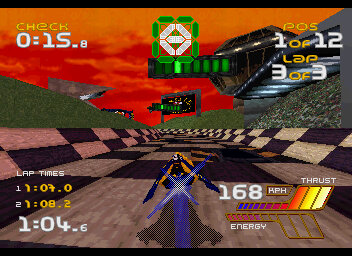
One of the first things you’ll notice about Wipeout XL is its incredible sense of speed. The game’s visuals are still impressive today, with a smooth frame rate and a futuristic art style that holds up well. The sound design is also fantastic, with a thumping techno soundtrack that perfectly complements the game’s high-octane racing.

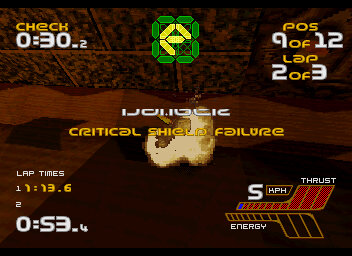
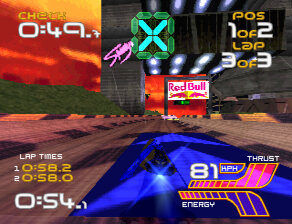
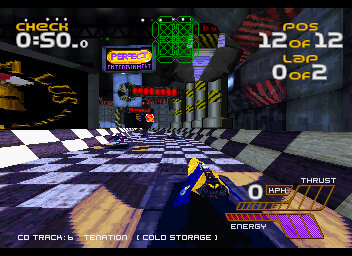
The weapon system has been improved, now your ships have a health meter that depletes upon impact with a weapon, or with another ship or track. Energy can be replenished by using the designed pit area’s that restores the ships energy. When you ship runs out of energy, the game is over.

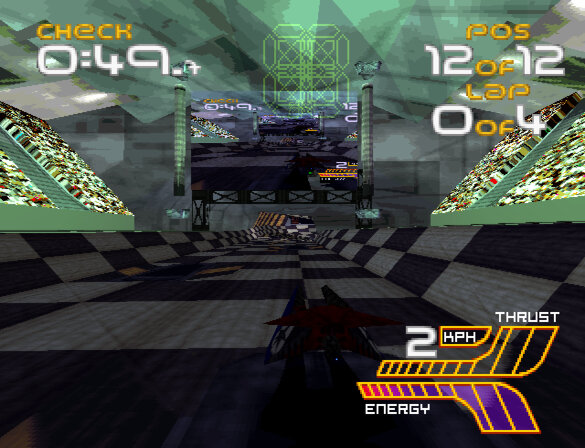
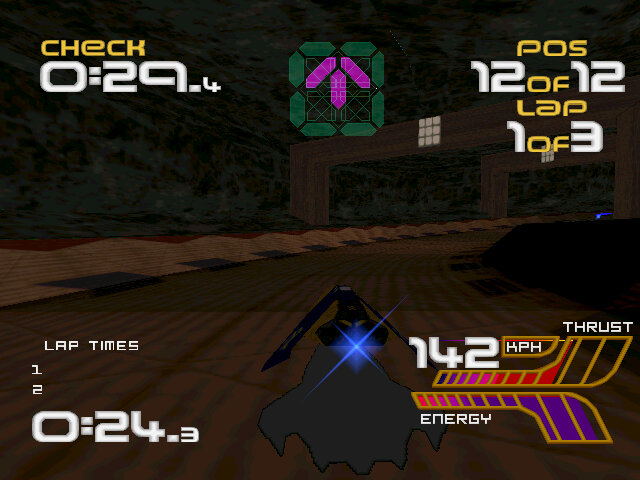
Also there is a countdown timer that depletes until you reach the next checkpoint, giving an arcade feel to the game though its a bit redundant, since if you run out of time, chances are you are already well behind in the race.

The gameplay in Wipeout XL is intense and challenging. The ships handle well, but require precise control at high speeds. The game has a steep learning curve, and it can take a while to get the hang of the tracks and the various weapons and power-ups available. But once you do, the game is incredibly rewarding, with tight races and exciting finishes.
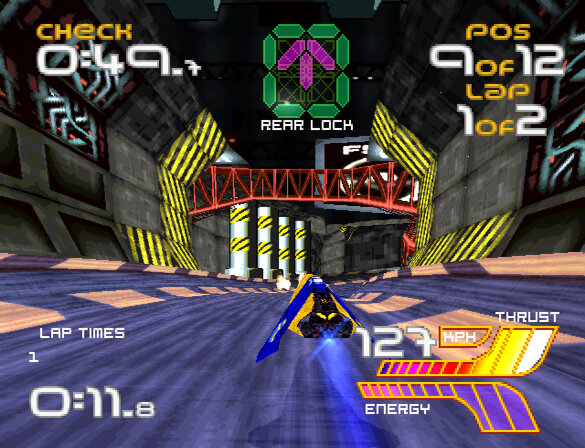
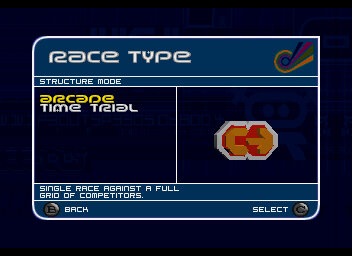
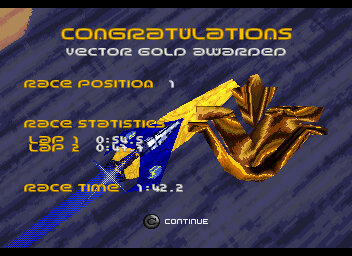
One of the features of Wipeout XL is its variety of modes. The game offers a campaign mode, where you compete in a series of races and unlock new ships and tracks. There’s also a time trial mode, where you can compete against your best times or the times of other players. And of course, there’s a multiplayer mode, where you can race against your friends.

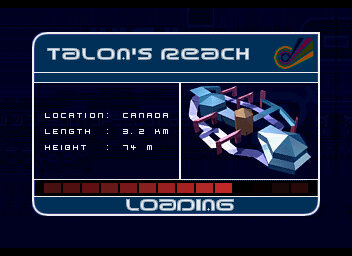
  • Talon’s Reach: This is the first level of the game and serves as an introduction to the basic gameplay mechanics. It’s a relatively simple track with a few jumps and turns, but it’s a good warm-up for the more challenging tracks to come.
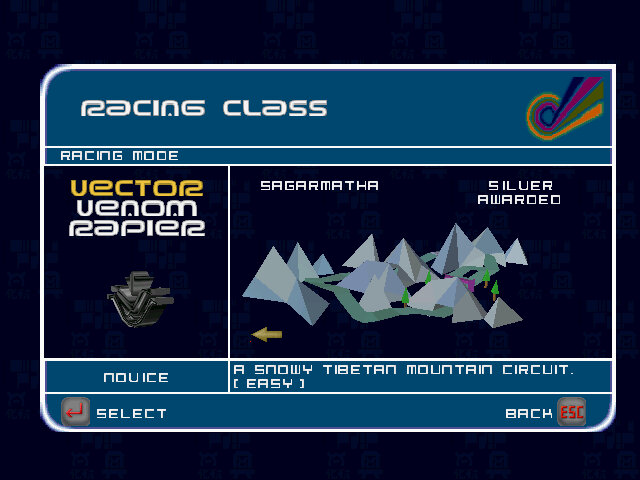
  • Sagarmatha: This level takes place on a track set high in the Himalayas. It’s a visually stunning track with steep drops and sharp turns that require precise timing to navigate.
  • Valparaiso: This track takes place in a futuristic version of the Chilean port city. It’s a challenging track with tight turns and narrow sections that require careful control of your craft.
  • Gare d’Europa: This level takes place in a futuristic version of the train station in Paris, France. The track is fast and has a lot of straight sections, making it a great level to use your craft’s top speed, also has a few lightning effects.
  • Odessa Keys: This level takes place on a track set in a futuristic version of the Black Sea. It’s a challenging track with tight turns and narrow sections that require precise control of your craft. The track also features a large jump that can be difficult to navigate.
  • Other tracks include Vostok Island, Spolskinanke & Phenitia Park.
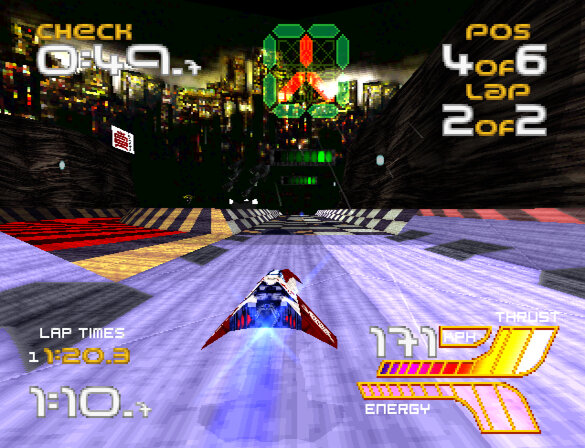
Teams Included

  • AG Systems: This is one of the default teams in the game and is a good choice for beginners. Their craft is well-balanced and easy to control, making them a great option for players who are still learning the game’s mechanics.
  • Qirex: This team is known for its high speed and power. Their craft is one of the fastest in the game, but it can be difficult to control at times. This team is a great choice for experienced players who are looking for a challenge.
  • Feisar: This team is known for its agility and handling. Their craft is one of the most manoeuvrable in the game, making them a great choice for players who value control over speed.
  • Auricom: This team is known for its all-around performance. Their craft is well-balanced and can perform well in any situation. This team is a great choice for players who want a versatile craft that can handle any track.
  • Piranha: This ship has the highest stats nut cannot use any weapons.
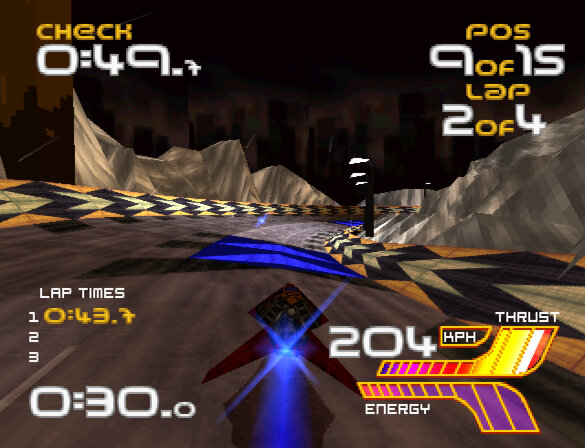
Versions

Wipeout XL is the most accessible version of Wipeout to date and was ported to over 4 platforms.

PlayStation
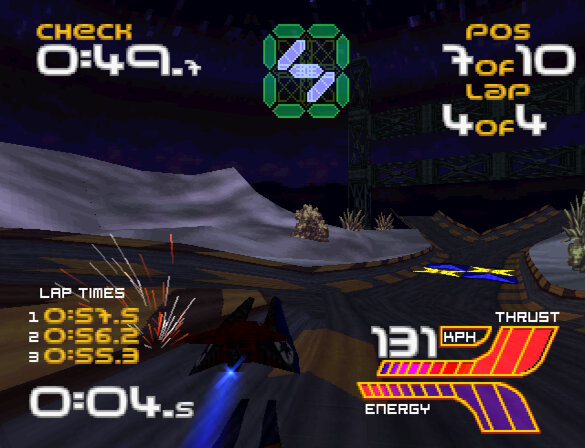
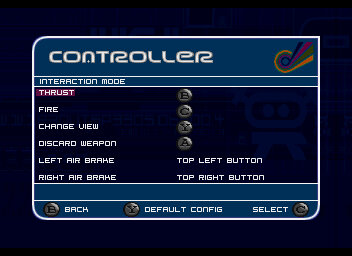
The lead platform and the best way to play, One advantage of playing the PlayStation version is that it was specifically designed for the console, so the controls were optimized for the PlayStation controller. Some players may find it easier to control their vehicle using the PlayStation controller rather than a keyboard or other input device on the PC. Overall it appears to be the most polished version of the game.

Additionally, the PlayStation version of Wipeout XL had support for the serial cable which allows two consoles to be linked together to provide two player support.
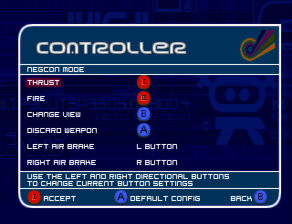
Another nice feature is support for the NeGcon controller which provides analogue steering support, as this game predated the Dualshock controller.

Windows

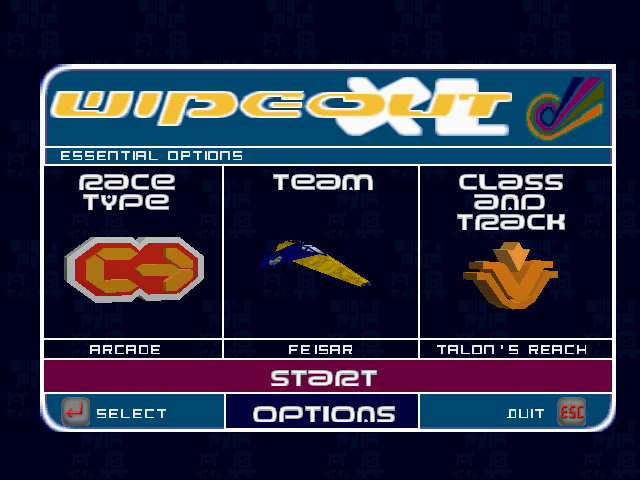
The PC version of Wipeout XL features improved graphics over the PlayStation version and features higher resolution textures, improved lighting effects, and smoother frame rates but has issues running at refresh rates higher then 30hz, causing the game to run too fast. This breaks the game entirly as its difficult to play at effectivly twice the speed.

It has native support for DirectX 3 or PowerVR graphics cards. The readme file also mentions official support for the Rendition, ATI RAGE and Matrox graphics cards.
Sega Saturn

The graphics and sound of the Sega Saturn version are generally considered to be inferior to the PlayStation version. The Sega Saturn version features lower resolution textures, less detailed backgrounds, and reduced visual effects. The sound quality is also less impressive than the PlayStation version, with lower quality sound effects and music. The loading screens are different in this version and there is no multiplayer support.

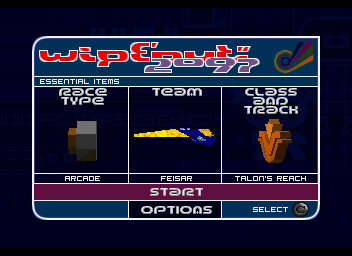
The gameplay of both versions is largely the same, with fast-paced anti-gravity racing across futuristic tracks. However it suffers from slower frame rates and occasional glitches, which can make the game feel less smooth than the PlayStation version. It does have support for the 3D control pad which provides analogue control.
MacOS

There was also a release for PowerPC based Macintosh computers released in 2002, a few years later. Unfortunaly I cannot get his version to run on any Mac that i own, either on a PowerMac G4 running Mac OS 9.2 with a Radeon video card or an iMac running OS X Snow Leopard.

Daytona USA

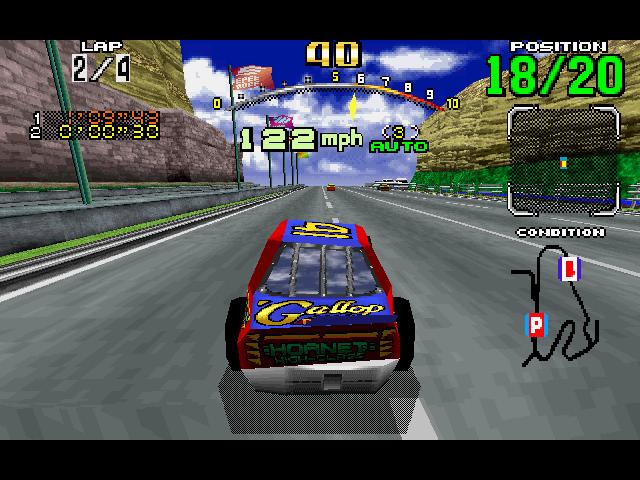
Sega’s hit racing game and part of the new generation of 3D arcade titles. Here we are introduced to texture mapped polygons, an upgrade from the flat shaded graphics from Virtua Racing. Daytona would be in prime competition with Ridge Racer, which was released by Namco.

Tracks

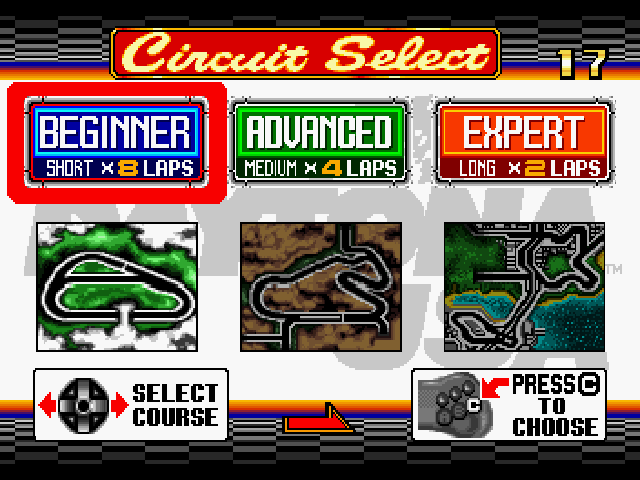
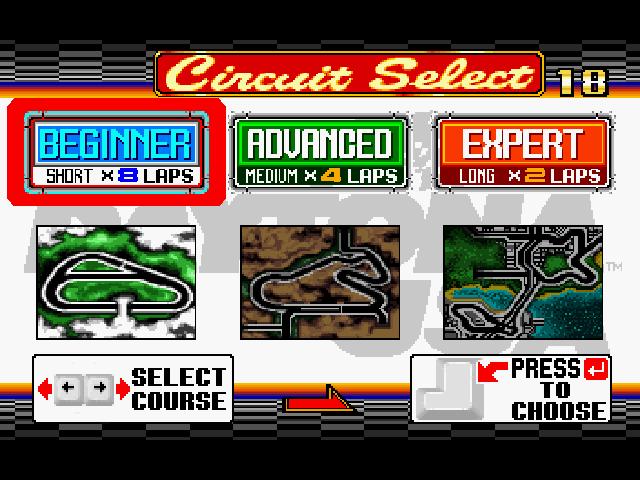
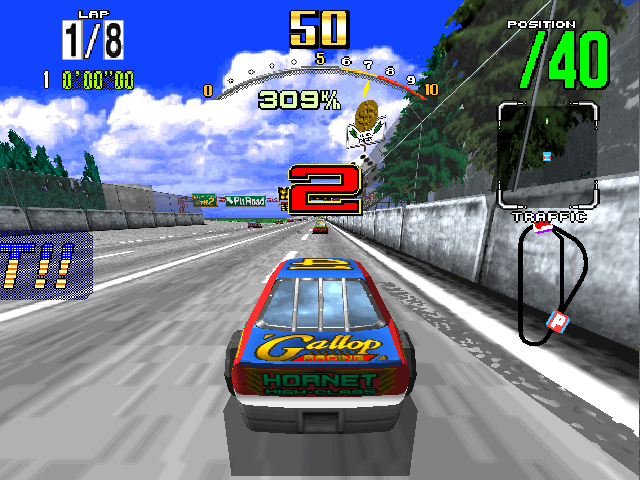
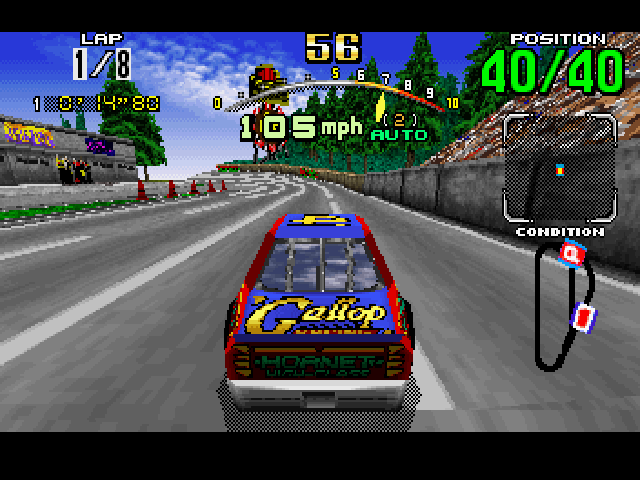
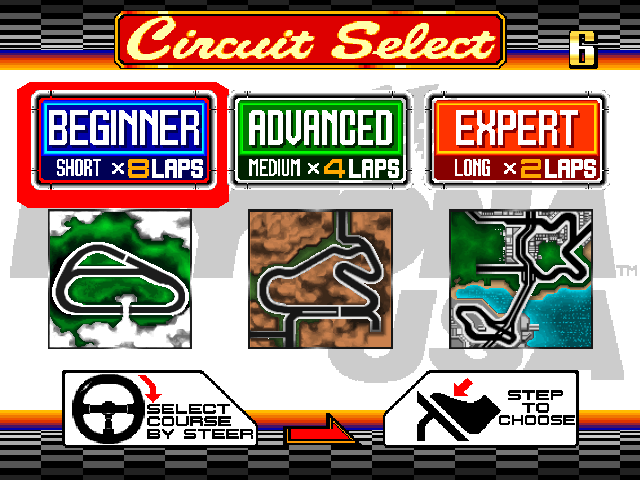
Beginner: A simple track but has 40 opponent cars, this track can get crowded in places. The only track on the game that begins with a rolling start and features a pit in area. There are 8 laps to race in total, but this can be extended to 20 or 40 with the Grand prix or endurance modes.

Advanced: A regaular track but has a couple of sharp turns. ‘Lets Go Away’ is the song that plays for this track, which a portion also plays during the games attract mode. Theres a few hidden messages in this track that appears in the grass during the race.

Expert: The hardest track with frequent sharp turns and a couple of obstickles in the track, Thankfully these don’t affect your cars speed and are mostly for visual effect. Powersldiing is reccomended to get the best lap times.

The tracks would be renamed in later releases after further tracks would be added.

Modes:

These can be set in the options menu (Test mode on the arcade release)

Standard: The default option with 8 laps for the beginner track, 4 for the advanced and two for expert

Grand Prix: Addidtional laps are added which expands the game’s length, with 20 laps for the beginner, 10 for advanced and 5 for the expert. With these laps you will want to use the pit stop to replace the cars tyers.

Endurance: 80 laps for beginner mode, 40 for advanced and 20 for expert mode.

There is also a time attack mode which can be accessed by holding down the 1P Start button on the arcade version whilst choosing transmission.

Releases

Arcade

Where it all started, running on Sega’s Model 2 hardware. This was initially released in 1993, and a updated version came out in 1994 to promote the Sega Saturn version. This version also amended the HUD elements slightly. 3 tracks are present in this version and lcoal multiplayer is avalible by linking the arcade machines together. This version of the game runs at a constant 57fps and a higher resolutiob compared to the Saturn, but lower then the PC version.

Can be emulated using the Nebula Model 2 emulator, or recently MAME. However the Model 2 core is still under development and there has been some improvements to the MAME core.

Daytona USA Arcade had three releases, all of which run on the original Model 2

  • 1993 release that was exclusive to Japan
  • 1994 release that was worldwide that amended the on screen counter display
  • Sega Saturn update that added adverts for the console, for before and after the consoles release (Changeable in the games test mode the Model 2 had no RTC clock)
  • There were a couple of unofficial modifications that were done by a few third party programmers that added RPG like elements to the game, known as GTX edition and To the Maxx

The game was only compatible with the original Model 2 board.

Sega Saturn

The first version that was ported for the home market, this was a rushed port due to wanting to be a Saturn launch title and the difficultly of the Saturn’s hardware for the developers. Also, its no secret that 3D wasn’t the Saturn’s strong point, being built primarily as a 2D sprite scaling system, and Daytona USA being designed for the 3D model 2 arcade board. The music is altered in this version, taking advantage of the red-book CD audio.

There are two game modes, an arcade mode which plays the same as the arcade original, and a Saturn mode which gives the option of selecting a car. Mirror tracks are also selectable for all tracks in the game and a 60 lap endurance mode. This version has no support for multiplayer.

Sega would later release a revised version for the Sega Saturn that corrected a couple of issues that the original port recieved.
Windows

Very similar to the Saturn version, the game is designed to run on Windows 95 but features little graphics acceleration, rending entirely in software mode (on the CPU). The game uses DirectX 2 which limits it to Windows 95, although it will work on later Windows 9x releases, things start to break on more modern systems.

This release is not recommended since a better version was released a few years later, and the limited resolution and graphics settings this game offers. There’s also black bars at the top and bottom which makes it feel like I’m playing an ported PAL game, either that or they thought Daytona PC needed to be cinematic?

Comparison

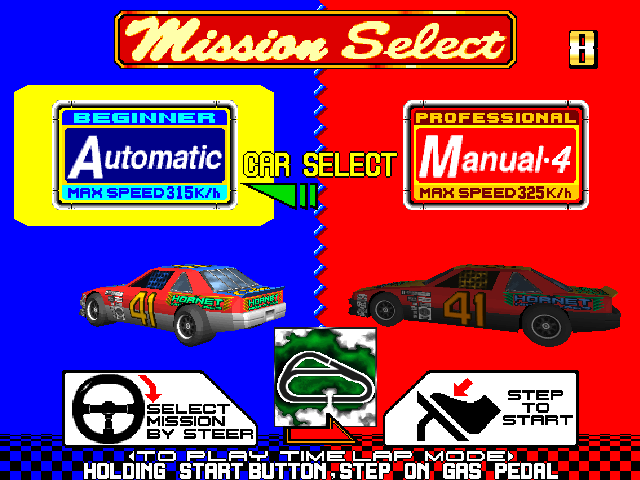
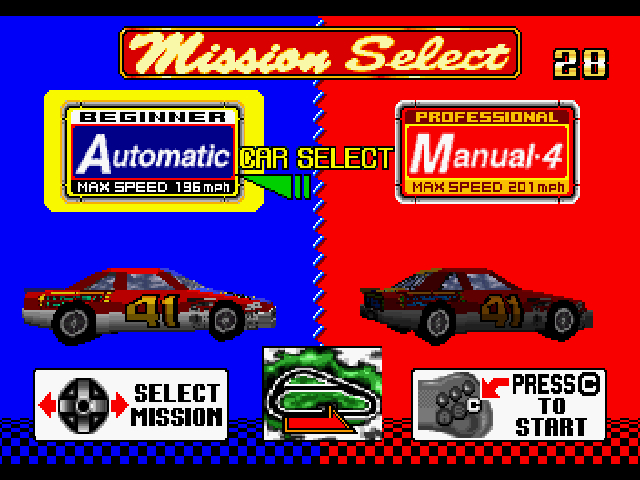
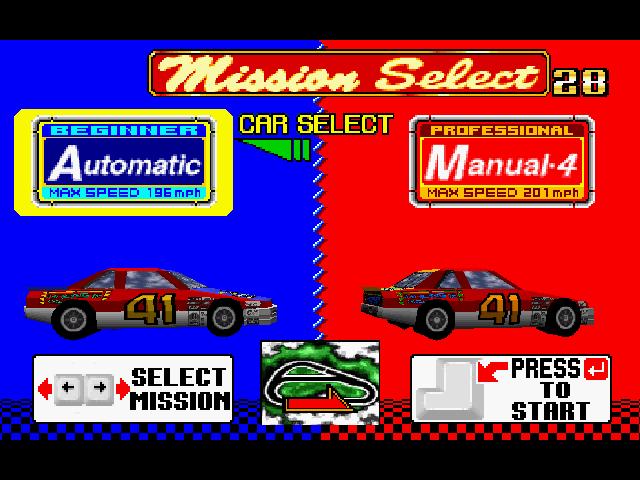
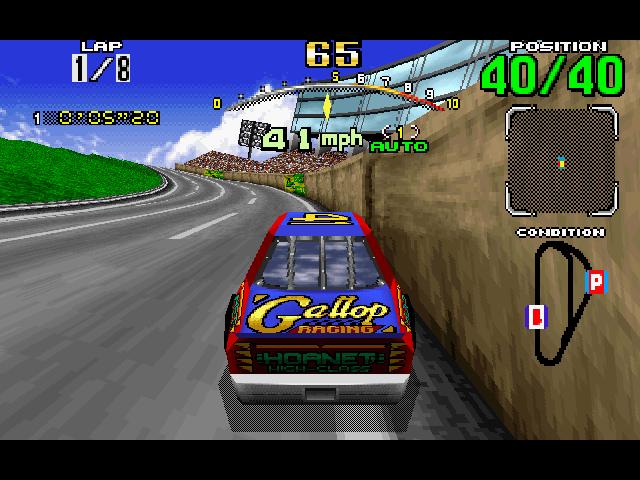
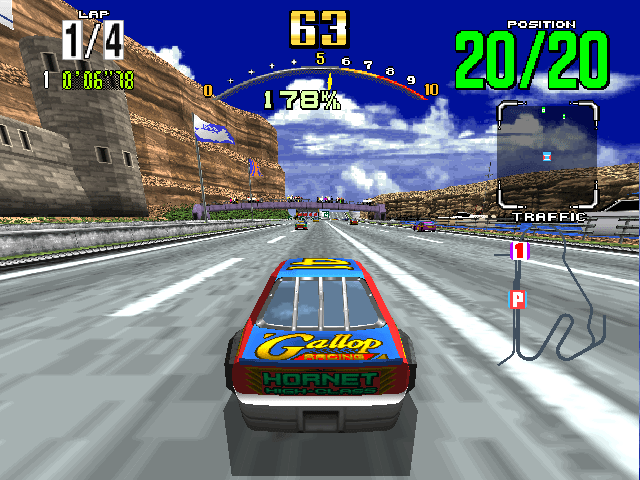
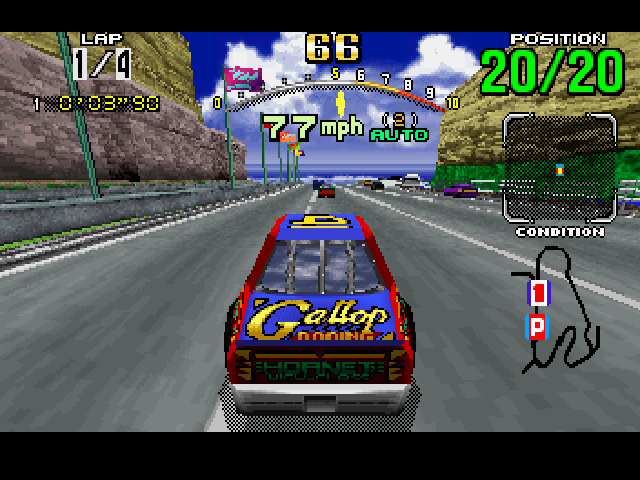
Arcade version is running in the Nebula Model 2 emulator with default settings, Saturn is running the NTSC build in Retroarch Beetle Saturn, Windows is running in a PCem virtual machine running Windows Me.

Arcade

Saturn

Windows

The home versions remain very faithful to the arcade original when it comes to the menu layout

Car transmission selection

Saturn version has the worst draw distance, to the extent that some background elements don’t appear fully and look like they are floating

Only major difference being the lap time dispay, with other HUD elements remaining consistant.

Conclusion

Daytona USA would go on to become very popular in the arcades thanks to the pioneering 3D graphics technology, despite the high price of the Model 2 hardware. The home ports were not greatly recieved, with the Saturn port having a negative reception in comparision to Ridge Racer, which was also ported from the arcade to the Playstation and was considered a bettrer adaption.

Sega would later release newer home versions of Daytona USA, being the Champtionship edition which helps fix the issues of the initil Saturn port and was ported to the PC shortly after. It was released again for the Sega Dreamcast in 2001 with slightly remastered graphics.

In the arcades, Sega would follow up with Daytona USA 2, being a showcase for the Model 3 platform.

The Simpsons: Virtual Springfield

A look at Springfield in 1997

Simpsons Virtual Springfield

Released for both Mac and PC in 1997, Virtual Springfield puts you directly into Springfield where you can freely explore the Simpsons town, Springfield. Whilst promoted as being a 3D game, it’s actually 2D with a 3D-based perspective, using an engine built by Vortex Media Arts. This isn’t the first Simpsons game released, with previous titles being released on the NES and the Sega MegaDrive, and it wouldn’t be the last either.

Simpsons Virtual Springfield
Launcher where you can start the game

This game was an interesting look at Springfield since in the show, whilst there was never any continuity of the town itself, buildings would come and go and the layout of the town never remained consistent, not helping was the change of animation studio from the first few seasons. Still, a lot of references to the early seasons of the show are present.

Simpsons Virtual Springfield
Marge cooking the cat

The main object of the game is to collect all 74 of collector cards, which are hidden across 17 different locations. Some locations are locked and can be unlocked by collecting specific items. The game’s HUD is designed around the player wearing a VR headset and using it to navigate Springfield.

Simpsons Virtual Springfield

The game runs slowly on PCem when running it directly from the CD-ROM (being played from an external Blu-ray drive) so it’s usually based to create an iso image of the game, then mounting it into PCem. (Update: It seems that I had set the CD-ROM speed in PCem to 4x, which wasn’t fast enough for the game, since increasing it to 16x the stuttering issues have reduced, but you still get the odd delay, defiantly dump to BIN/CUE when running in PCem)

Simpsons Virtual Springfield

The game is navigated using a point-and-click approach, moving your mouse cursor to a specific area lets you either select or interact with an object or if it turns to an arrow, lets you move in that direction. If the game is left idle, random animations are played out.

Simpsons Virtual Springfield
Milhouse had a growth spurt

Some buildings (Like the Simpsons house) can be entered some have multiple rooms that can be navigated through. Some rooms/buildings are blocked and require an item to be in the inventory before it can be accessed, these can be obtained by picking up the item by clicking on it.

Simpsons Virtual Springfield
Who shot Mr. Burns – Part 3
Simpsons Virtual Springfield
Aye Caramba
Simpsons Virtual Springfield
RIP Krusty
Simpsons Virtual Springfield

It’s not really a game in the traditional sense, there’s no fail state or any challenge, except for collecting cards. It’s more of an application like the previous Simpsons Cartoon Studio. Nowadays you could probably build the same game within a modern browser, like Bing maps but for the Simpsons universe, and maybe leverage a VR headset for full immersion.

Simpsons Virtual Springfield
Sappy and Pelma

Being a long-time fan of the show (For seasons 1-9) and an obvious target for this product, my only gripe is that there weren’t more things to interact with per location. Sure the game will have a limited scope, imposed by the technology of the time.

There are the occasional mini-games featured in the Noiseland Arcade, but certainly more activities like this could have been sprinkled into the game.

Simpsons Virtual Springfield
Thought this was a banjo at first

Quite a few locations are missing like the Springfield dog track where they adopted Santa’s little helper, Krusty Burger (appears in-game but cannot be entered), Department of Motor Vehicles, Police Station (again cannot be entered)

Macintosh

Virtual Springfield uses a hybrid disc that allows the PC copy of the game to run on a Macintosh system. To get the game up and running, you simply insert the CD into the Mac and click on the Virtual Springfield icon on the desktop, the game will launch, providing you set the colour depth to 256 colours. No installation is required.

The game will run on a G4 PowerPC-based Mac, running on OS 9.2.2, but you must change the display colour depth to 256 colours, otherwise, the game will crash the system upon startup. Virtual Springfield will not change the display automatically. It also works by changing the resolution to 640×480 since the game will not scale for a higher resolution, resulting in the game being displayed in the center of the screen with black borders around, if run at a higher resolution. What annoys me is the game does not give an error message informing you of this, just crashes the Mac instead.

The classic environment on Mac OS X does not seem capable of playing the game, this was tested on both OS X Jaguar and Panther classic modes.

External Links

FOX Interactive

Virtual Springfield Technical Info

Super Puzzle Fighter II Turbo

What a mouthful

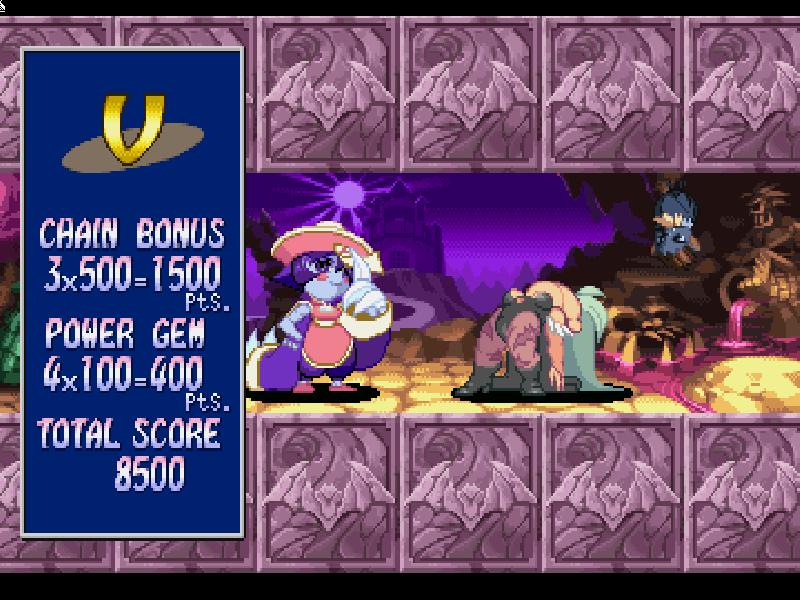
A gem based puzzle game, soft of similar to columns, but instead of matching 3 of the same colours, you have gems and crash gems which are used to destroy a gem of the same colour, and sends a counter gem to the rival player. The game does feature various Capcom characters but they are not directly controllable, merely appearing as avatars. The game is over when the players gems reach the top, similar to Tetris.

Arcade

Arcade version uses an arbitrary resolution. One nice feature is when the blocks are beginning to stack up, the music starts to speed up. As the arcade was the original released, the console and PC versions are based on this version.

PlayStation

Supports both memory cards, Seems to have some overscan (Could be due to the emulator), this can be adjusted in the game settings

Sega Saturn

Saturn version seems to run in a higher resolution compared to the PSone version (Could also be emulator related), also in the Saturn version, Dan randomly interrupts a match in arcade mode, which I have never encountered in the PSone version. The loading times are faster compared to the PSone and Windows version.

Microsoft Windows

The game was ported to the PC. The specs required are higher than I thought, which might be an indicator of a poor port. When running on a PCem based Pentium MMX 100Mhz, there was notable slowdown at 640×480 (not the lowest resolution supported) The graphics card was an ATI Mach64 VT2. Running at 800×600 was near unplayable. A Pentium 2 with a S3 Trio64 gave better resolution.

A nice side effect is the music of the game can be played in any media player, since they are wav files, even the sound effects, They are located in the BGM folder. There is also an EMI folder that contains a bunch of files with the EMI extension, which I’m guessing relates to the background and sprite graphics. There is also a goodies folder which contains images that are also in the goodies section of the game, plus a zip file with a Windows theme. The PlayStation also appears to use the EMI format, but the Saturn does not.

There’s an exe file in the movie folder on the PlayStation version, but trying to run it on windows 98 results in an invalid Win32 application error, trying tor un it from does gives a ‘Program too big to fit in memory’ error

Desktop Theme

Desktop theme

A desktop theme comes bundled in the GOODIES folder which can be installed

Comparison

Saturn version (middle) is run on the RetroArch Yabause core with default settings, PlayStation (left) is using the BeetlePSX HW core which also with default settings, the arcade version is on the right.

The graphics are mostly the same across the different versions, with the PC version having the ability to run at a higher resolution.

Score Ranking

Main Menu

Demo

Gameplay