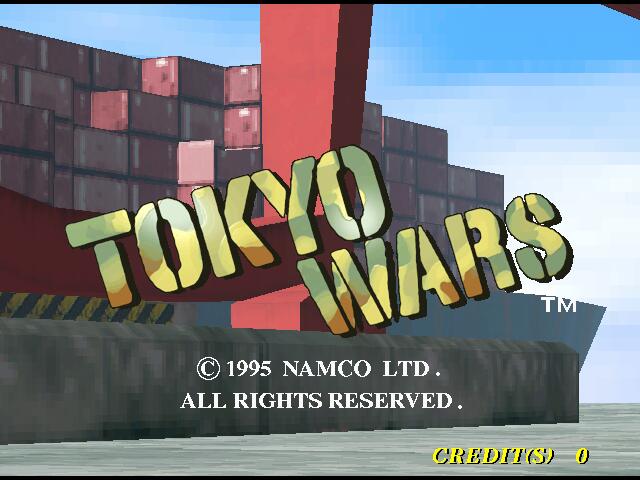
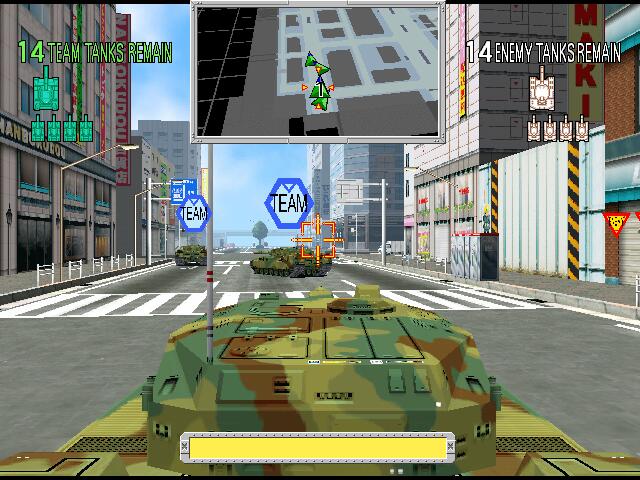
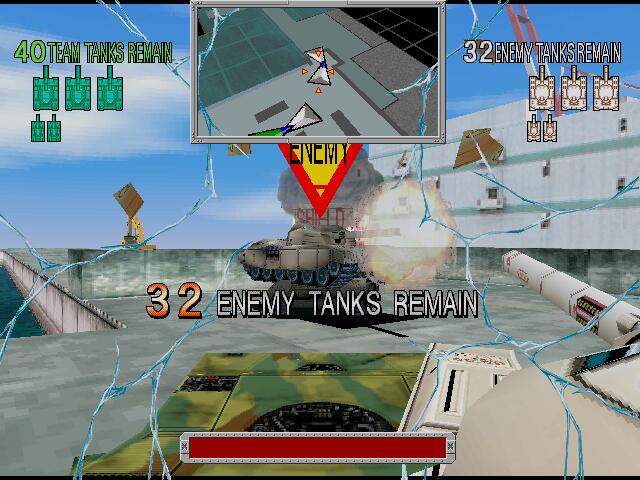
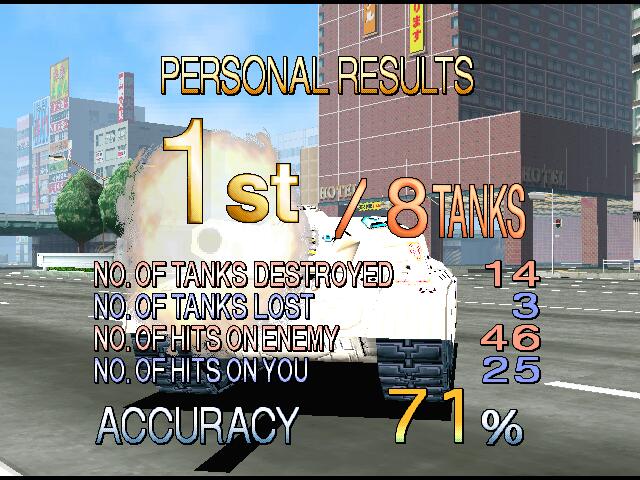
Namco’s first person tank shooter game, here you are split into two teams with the goal being to wipe out your enemy’s tanks. Running in beautiful 60fps in 640×480 resolution tanks to the powerful System 22 hardware, something that PC 3D accelerator software the era had difficulty achieving.
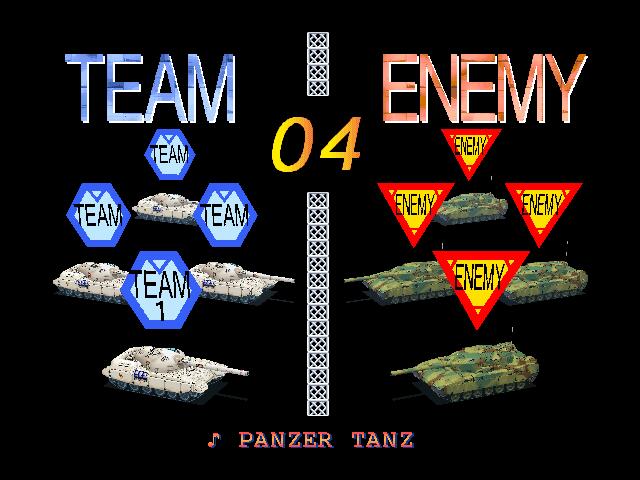
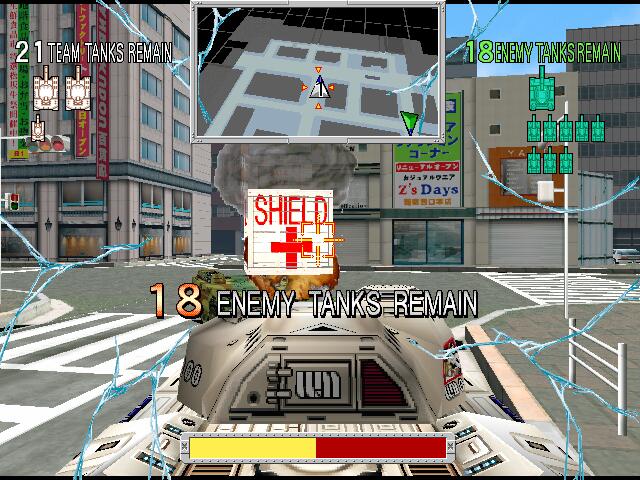
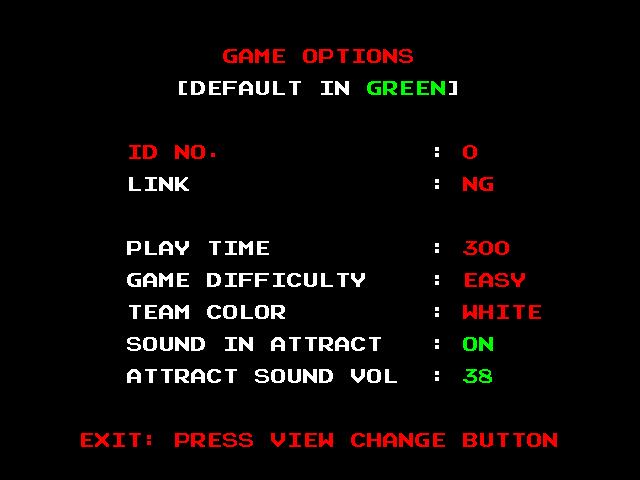
You join either the Green Force or White Force and battle opposing tanks in large 3D arenas. Matches last up to 15 minutes or until one team is wiped out – depending on the arcade operator settings. Destroying enemy tanks will give you a small shield boost that you have to pick up, which gives you more health.
You’re limited to just two stages, the Downtown street level and the docks stage. Certain elements of the level are destructible like cars, rails and even the on-ramps for the parking lot. The Bay Area (Bayside Dock), This is the training ground of the game. It is a massive, relatively flat shipping yard and dockside area. Because there aren’t many places to hide, the enemy teams usually meet in the middle for a massive battle. Despite the amount of tanks on screen, the frame rate never seems to dip.
The Downtown Tokyo, This is the more famous of the two levels and is significantly more complex. It represents a dense city center filled with narrow streets and intersections. A maze-like grid of streets that provide a quick hiding place from other tanks. It features elevated expressways (overpasses) that you can drive under or around, and tight alleys that allow for flanking maneuvers. There is no overall story or plot to the game, just seems like Tokyo crashed out and decided to have a tank battle.
Tokyo Wars comes close to a 3D arena shooter for the arcades in concept, but the tank controls limits your movement somewhat compared to the nimble movement that Unreal and Quake offer. The decision to use tanks as players was possibly done to avoid any controversy with the game. Arcades in the mid-90s were often in malls and family venues, so avoiding realistic human blood/gore (like in Mortal Kombat or Doom) was smart business in general. The game is still very much a high-octane, competitive war game but avoids having any serviced violence like gore or blood being sprayed around. Still the game provided an impressive amount of detail for an 90s arcade game thanks to the capabilities of Namco’s System 22 hardware, offering detailed buildings and animated billboards, many of which feature references to Namco’s other games of the era, especially when you compare it to other games that feature an urban city setting like the original Driver.
Now it’s easier to play Tokyo Wars, you can emulate it on MAME on a reasonable capable hardware. And as of 2026 it has been released as part of the Arcade Archive series that I recommend and is available to the PS5, Xbox Series X/S and Switch 2. These versions are accurate to the arcade original.
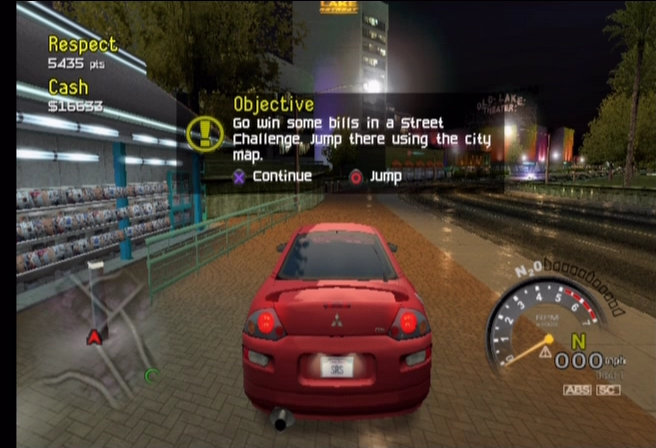
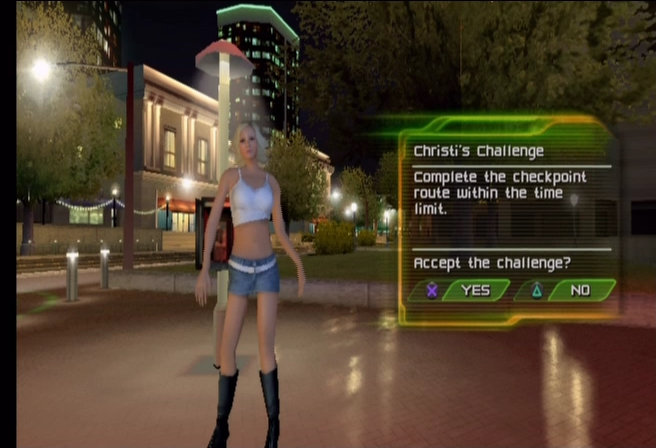
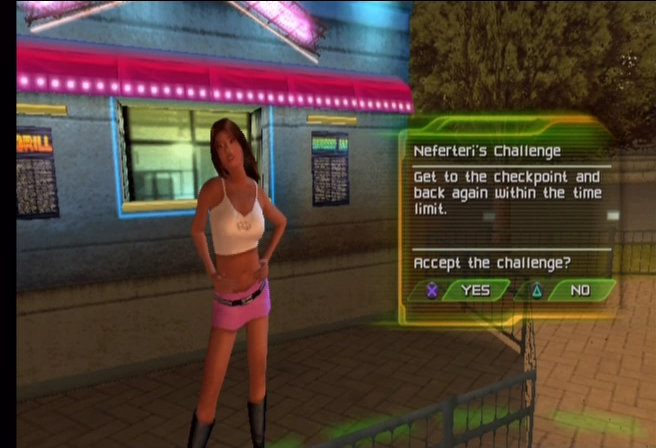
Street Racing Syndicate is like the mixture of The Fast and the Furious and a Hot Import Nights car show. Released in 2004 by Eutechnyx and Namco (who developed Ridge Racer), it’s you against the underground racing scene in cities like LA, Miami, and Philly. Your goal? Stack cash, earn respect, trick out your ride, and—get this—charm virtual models with your sick drifts. It has that weird 2000s vibe where winning races unlocks videos of real-life models. It’s cheesy as hell but you have to love it.
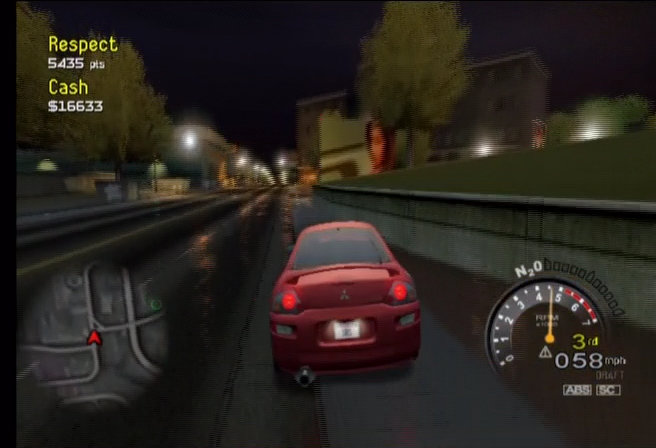
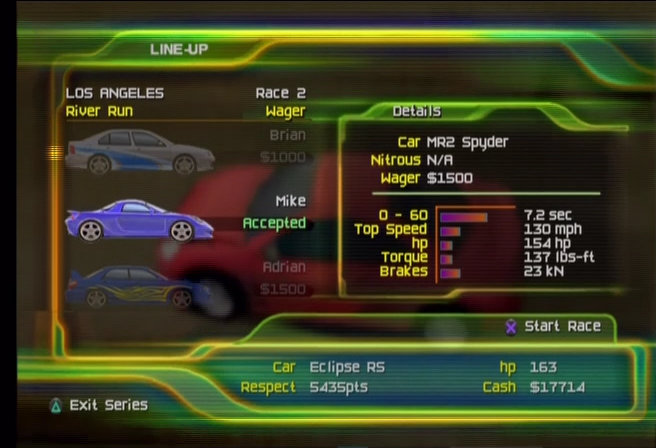
Gameplay’s where this game revs its engine. You’re dropped into an open-world hub—way ahead of its time for 2004—cruisin’ between races, respect challenges, and pink slip bets where you can win or lose your car. The Street Mode is the meat of it: race through city streets, day or night, dodging traffic and pulling stunts like drifts or two-wheel driving to rack up respect points. The damage system is legit—smash your ride too hard, and it handles like a shopping cart, plus repairs hit your wallet like a bad night at the casino. It’s not just “go fast, turn left”; you gotta think about not wrecking your bankroll. Arcade Mode’s got quick races, checkpoint runs, and speed trials if you just wanna jump in, and the console versions had online multiplayer back in the day—though good luck finding a server now, unless you’re time-traveling to 2004.
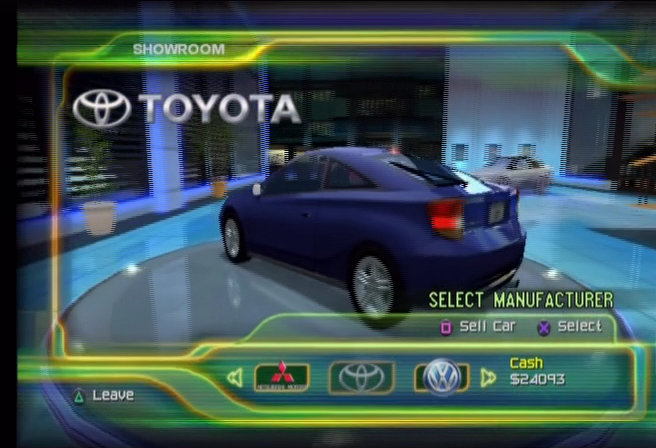
The car roster? Solid. Over 50 licensed rides from Nissan, Toyota, Mitsubishi, Subaru, and more. You’re tuning up Skyline GT-Rs, Supras, and RX-7s with real-world parts from brands like AEM and Sparco. Customisations deep for the time—think engine swaps, body kits, and neon lights that scream “I watched Tokyo Drift too many times.” It’s not quite Need for Speed: Underground’s level of polish, but it’s got enough to make you feel like a street mod god. The controls are arcadey but tight, with a weighty feel that makes drifts satisfying, though it ain’t as forgiving as Underground or as sim-heavy as Juiced.
Visually, SRS holds up… kinda. The cities look alive with neon glow and traffic, but the graphics are a bit rough compared to Underground’s slick sheen. Cars look dope, especially when you’re rocking custom paint and rims, but the environments can feel blocky, like someone forgot to polish the backstreets. The soundtrack’s got that early 2000s energy—think Chingy, Xzibit, and some generic hip-hop beats. Sound effects are decent—engine roars and tire screeches do the job, though they don’t quite pop like Forza or even Midnight Club.
SRS is unapologetically 2000s. It’s got that Fast and Furious swagger, complete with the cringey girlfriend mechanic that’s so dated it’s almost charming. But that’s the appeal—it’s raw, it’s gritty, it doesn’t pretend to be high art. Compared to Need for Speed: Underground, it’s less polished but has a unique edge with the damage system and open-world cruising. Juiced feels more serious with its crew management, but SRS is just about living the street life without overthinking it.
Downsides? It’s not perfect. The AI can get in your way at time, and will either rubberbanding like crazy or drive like they’re on their learner’s permit. And while the open world was cool for 2004, it feels small compared to modern racers like Forza Horizon.
Versions
Gamecube: The NGC release is pretty basic, there no online or custom sound support that you would find on the other console releases but it does run at a stable framerate.
PlayStation 2: This version make basic use of the PS2’s capabilities, and lacks support for it’s progressive scan mode which would have been much welcomed for a racing game. There was online support if you had the required Network Adapter, or a PS2 slim that featured built in Ethernet. The online servers have since been shut down and there does not appear to be a community project to bring it back online.
Xbox: This port included support for custom soundtracks, so any music that you had saved to the Xbox hard drive could be played back in game.
Microsoft Windows: Street Racing Syndicate was also released for the PC, back in the Windows XP era, and appears to work fine all the way to Windows 10. You can even purchase It digitally online. Online play hs workable if you use OpenSpy
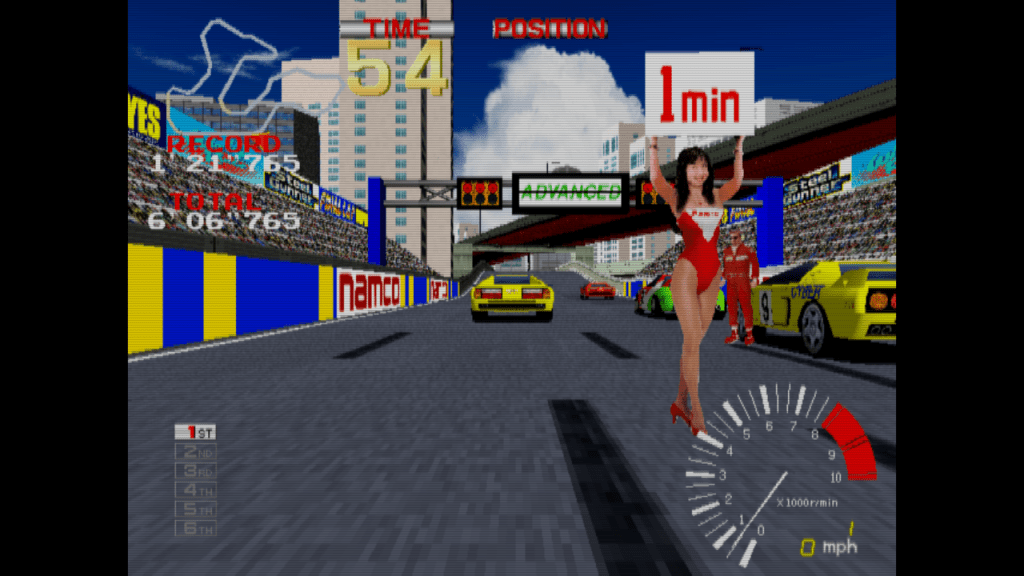
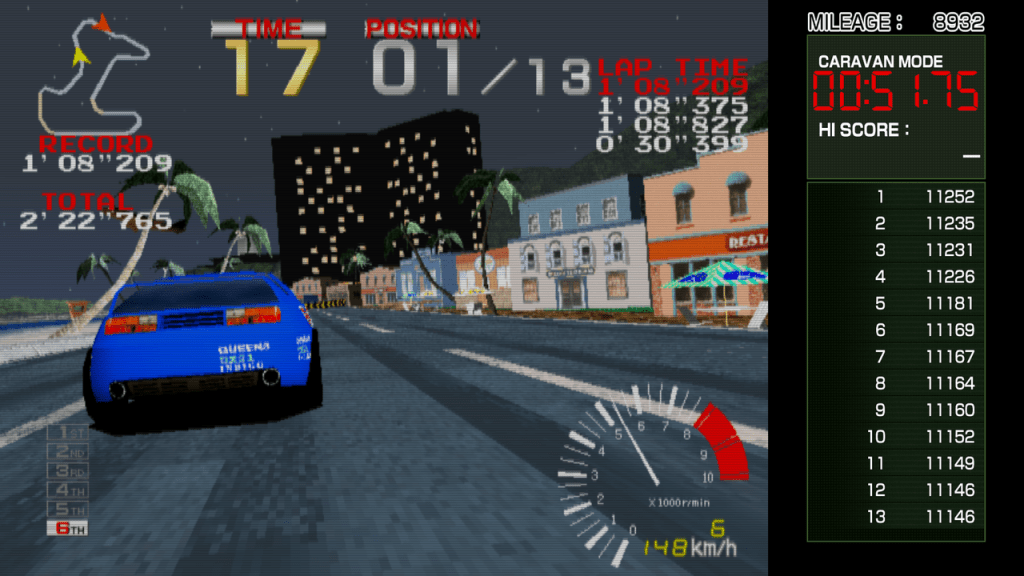
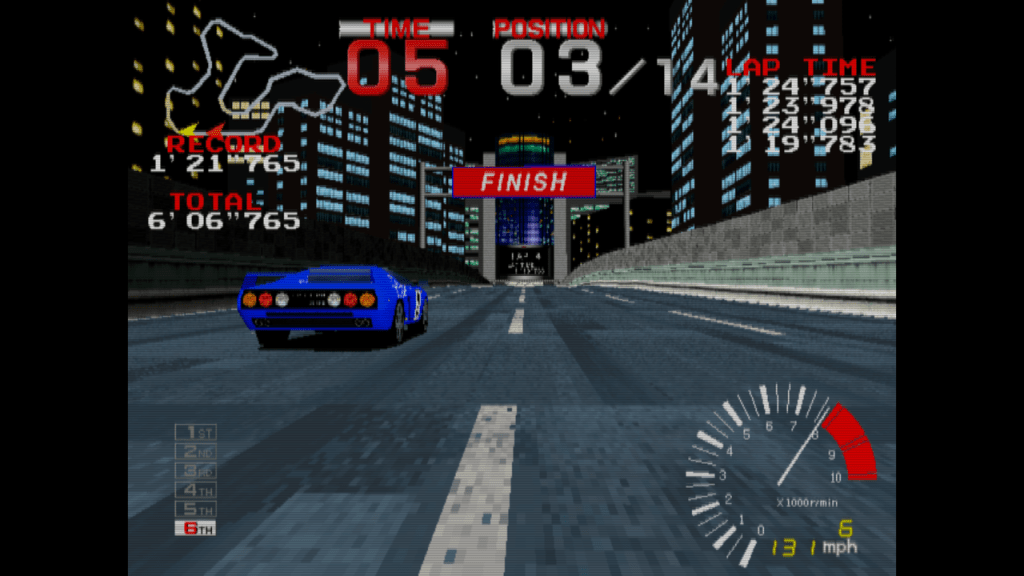
Ridge Racer—the granddaddy of drift-happy arcade racers—gets dusted off and slapped onto modern consoles like the Switch 2, PS5, and Xbox Series X|S. For 16.99, you’re getting the original arcade game—think one track, one car (that red Mazda MX-5 lookalike), and a whole lot of techno beats. No frills, or DLC’s, just pure arcade racing. We have seen a slight resurgance of Ridge Racer games with Type 4 and the PSP Ridge Racers 2 being rereleased on the PS4/5, making use of the consoles emulation, and as a fan of the aracde original I’m excited to see Ridge Racer ported to the home consoles… again.
Ridge Racer on the Xbox Series X
The game takes full advantage of the analogue controlls offered by the modern consoles, The drifting feels good—tight, responsive, and satisfying when you nail that perfect slide through Ridge City’s bends. You’ve got four modes: Novice, Intermediate, Advanced, and Time Trial, each tweaking the speed and lap count. Time Trial’s the real MVP, pitting you against a rival car in a one-on-one showdown. Two ROMs are offered, with the DX version using an H-shifter and clutch. It’s cool, but good luck finding a controller that makes it feel natural.
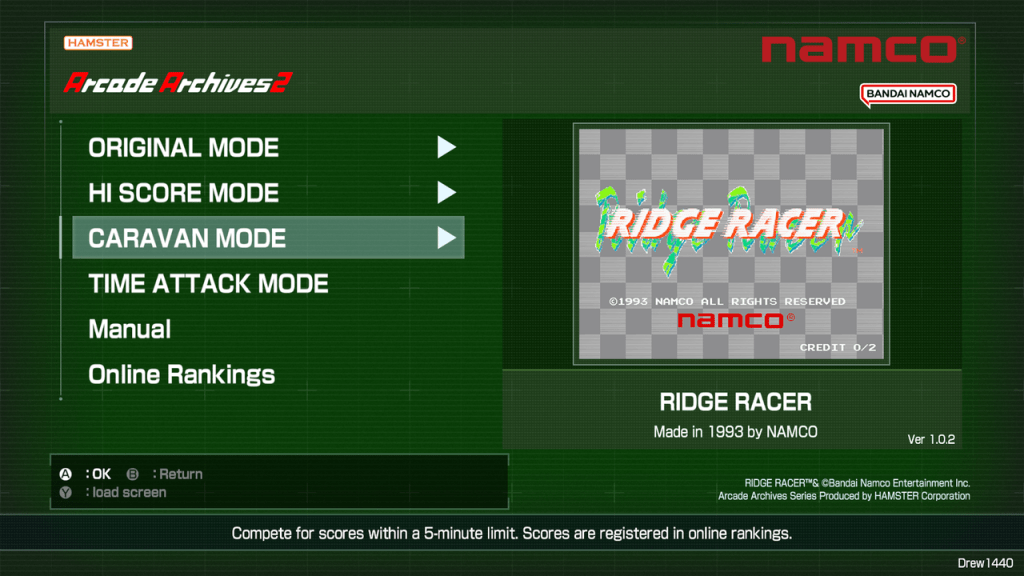
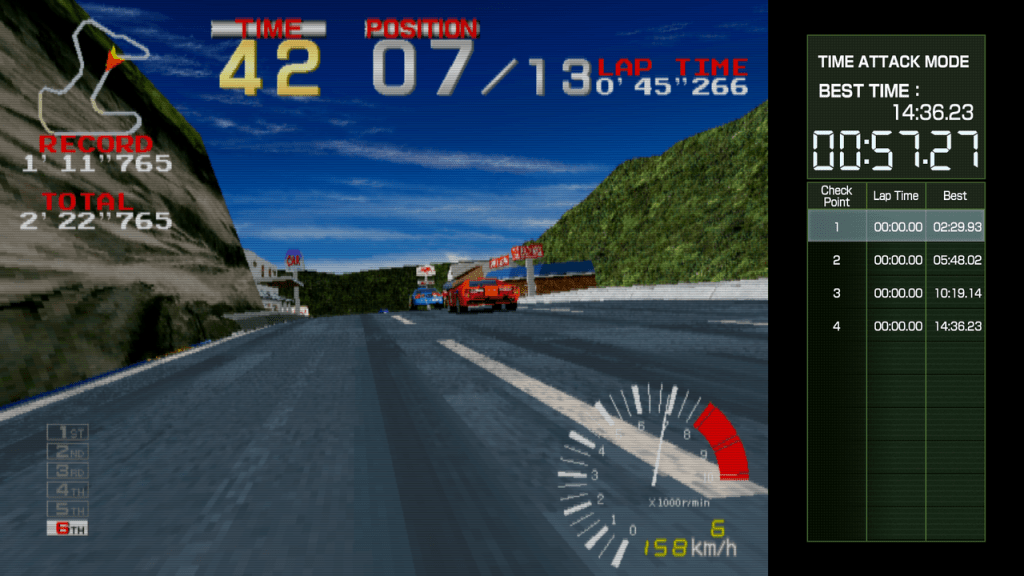
Hamster didn’t just add the arcade ROM and call it a day. They included in some extra goodies: A proper Time Attack Mode, High Score and Caravan Modes for leaderboard chasers, and a rewind feature for when you make a mistake on that hairpin turn. Multiple save slots are nice, and the redesigned UI’s slicker than the old Arcade Archives setup. PS5 and Xbox players get trophies and achievements. The extra modes make use of save states which are transparent tot he user, and stats are recorder and shared online with other users.
But here’s the kicker: no multiplayer, no extra tracks, no car selection, and no third-person view like the PlayStation version had. It’s the arcade original, which is both its charm and its biggest middle finger. There isn’t enough content to justify the price, even if the game is accurate to the original ROM.
Still it’s a nice charming game, and a nice tribute to Ridge Racer. Hopefully we will see further System 22 releases ported to home console, mainly Rave Racer and Ace Driver in their glorious 60fps.
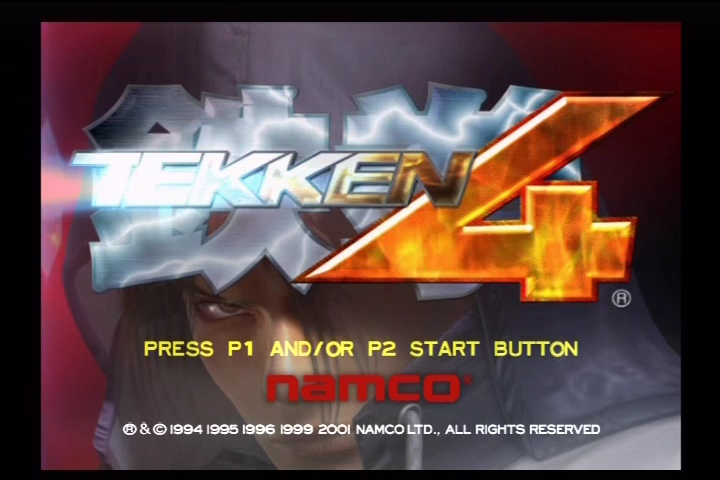
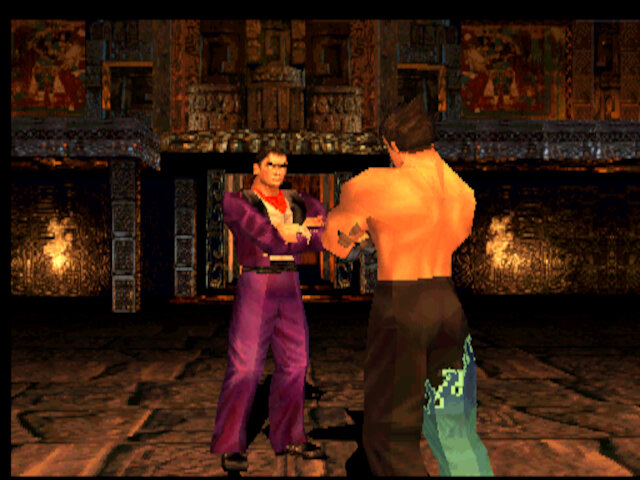
The first true next generation Tekken game, being released on the then-new PS2 hardware.
Fighting games have never been known for well-thought-out, let alone believable, story lines. Tekken 4 is no exception. Every fighter has their motivations, but the game really centers on the absurd relationship between Kazuya and Heihachi. At the heart of the story is the long-standing feud between Heihachi Mishima and his son, Kazuya Mishima, alongside the emergence of Jin Kazama and Jun, who is still missing as of the games release. A key element introduced more prominently in this game is the “Devil Gene,” a supernatural trait passed down through the Mishima bloodline, granting its bearers demonic powers. Kazuya and Jin both grapple with this curse, which plays a significant role in their motivations and the overall narrative.
Like previous games, the story is set around the King of Iron Fist Tournament, which Heihachi uses as a means to lure Kazuya out and to test Jin’s abilities. However, this time, the tournament has more personal stakes for the characters involved, especially with Heihachi’s plan to create the ultimate life form through the Devil Gene. Each character, especially Jin and Kazuya, has their own arc dealing with redemption or revenge. Jin, in particular, is driven by a desire to avenge his mother’s death and to confront his own heritage, while Kazuya seeks to overthrow Heihachi and reclaim his birthright.
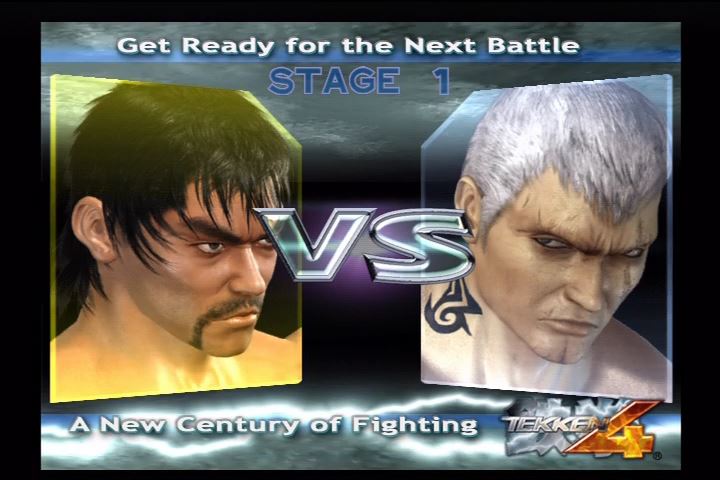
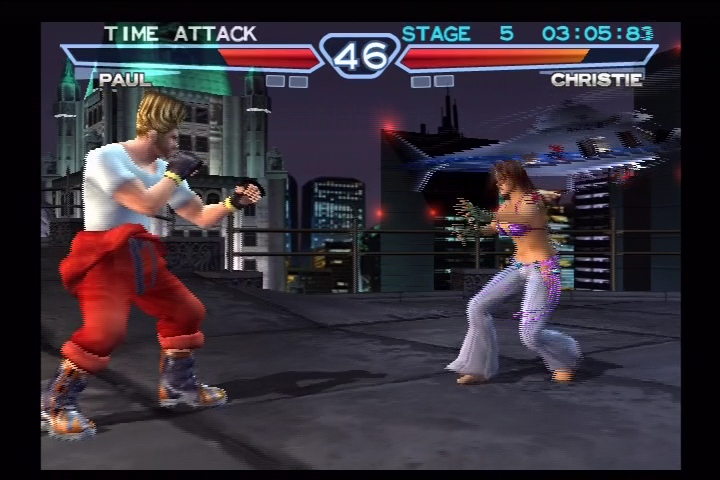
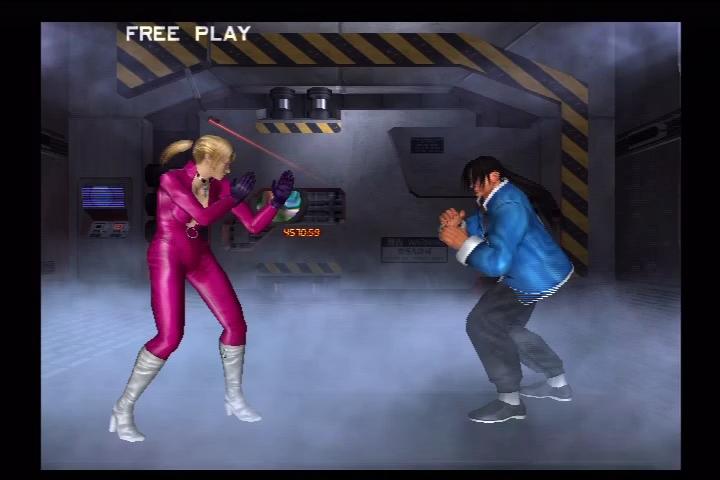
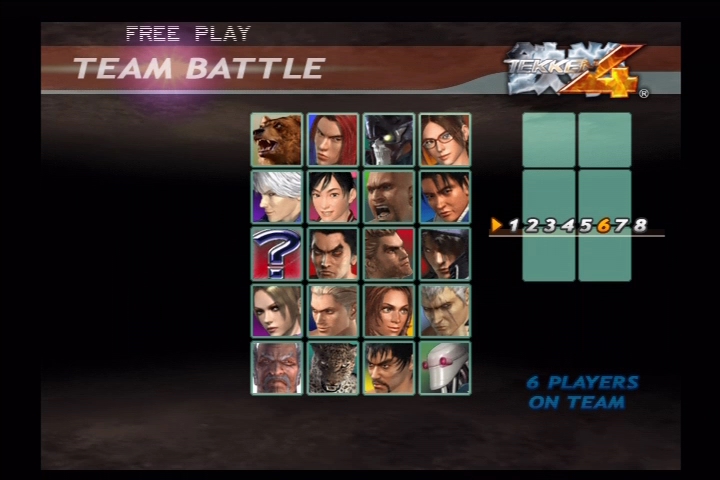
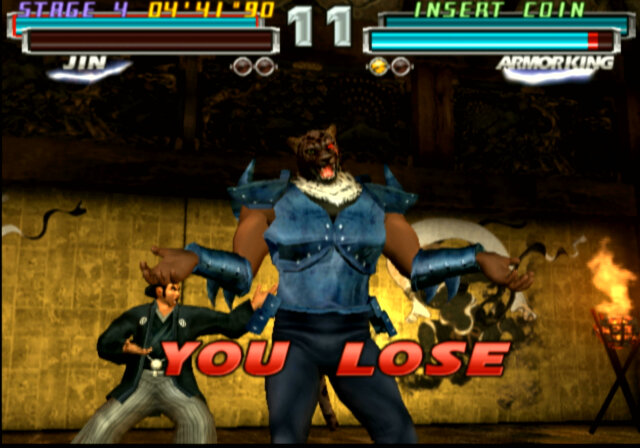
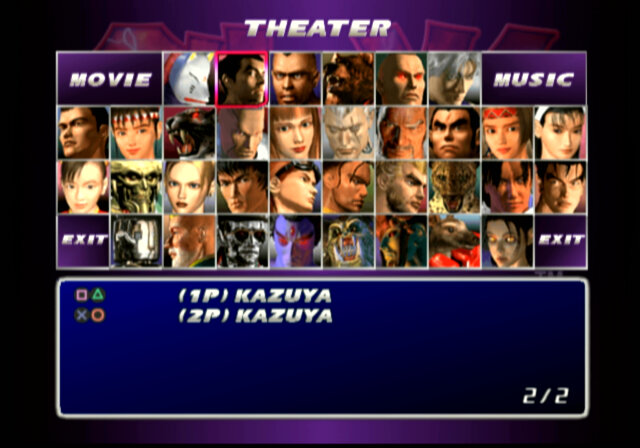
The game has 19 characters and a selection of modes. As with any fighting game sequel, a few new characters are mixed in with the core group seen in the previous installments. The new fighters are Craig, Steve, and Christie. Christie isn’t really a new character, being just a female equivalent of Eddy, the Capoeria specialist who is omitted from Tekken 4. Steve Fox, A British boxer with a mysterious past, later revealed to have a biological connection to one of the existing characters. Combot is meant to be a training robot, serving as a replacement for Mokujin. Despite the large character roster, half the characters still need to be unlocked by beating arcade/story mode.
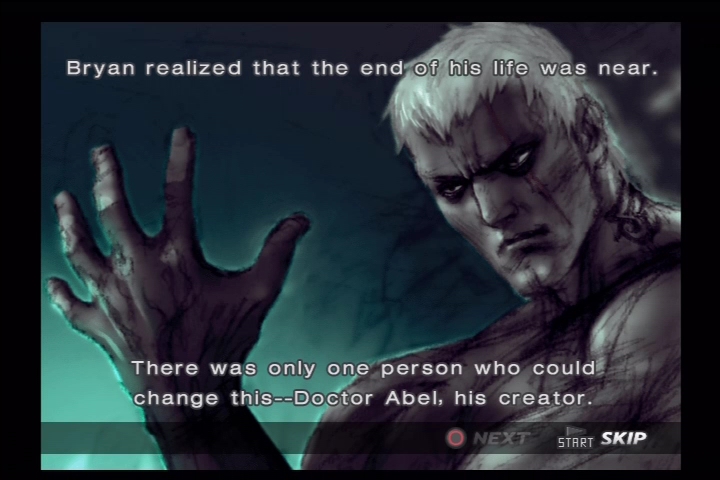
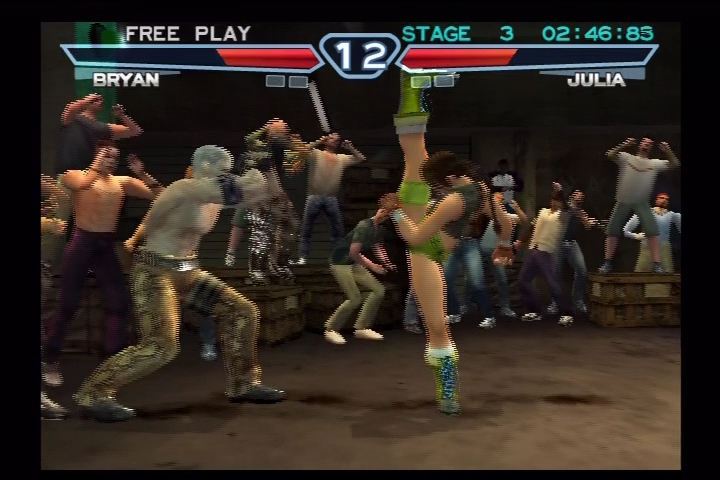
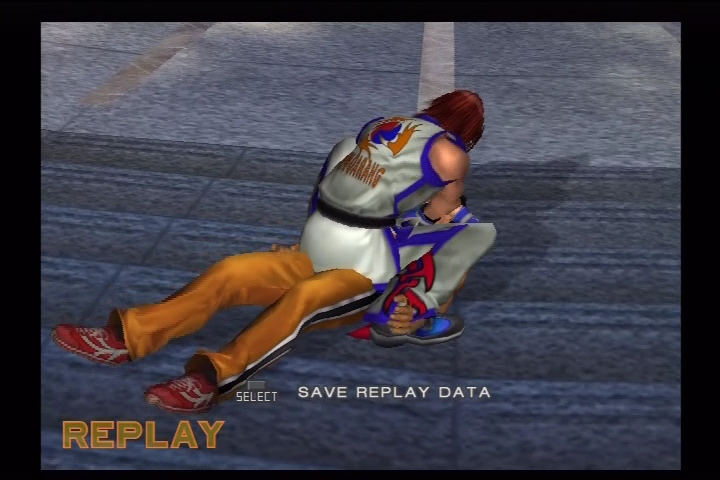
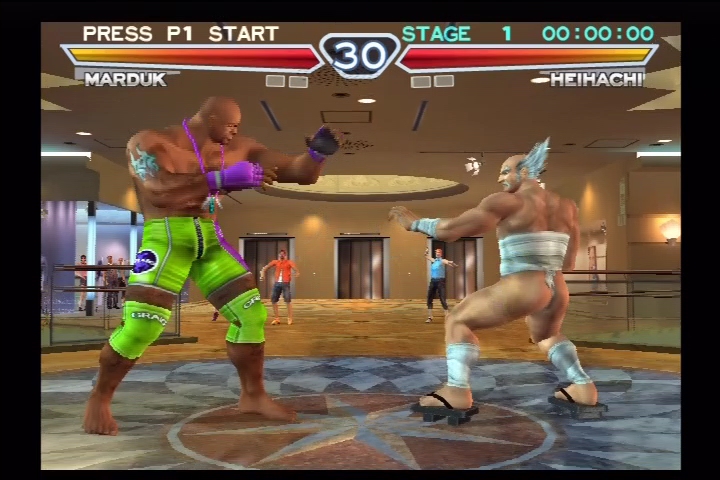
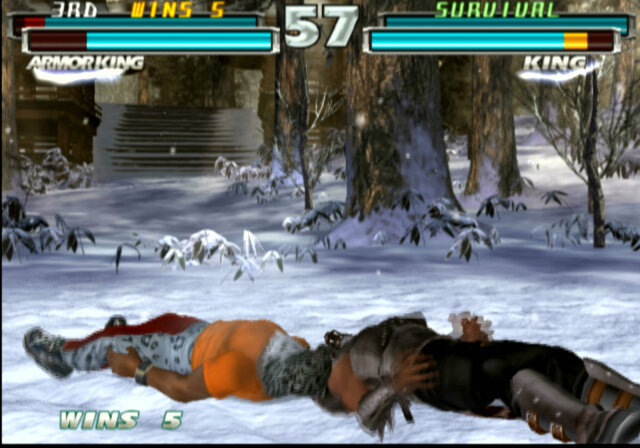
The game’s modes make up the typical fighting-game shopping list. These include practice, time-trial, and survival, as well as the expected arcade and story modes. Story mode is simply an arcade mode with still illustrations and FMV cut scenes that go into the chosen character’s plot, but lacks pre-match cutscenes that Dead or Alive 2 featured. A new feature in the series is the ability to save fight replays to the memory card, which will allow you to play them back at a later date. Some changes have been made since Tekken Tag Tournament, No more do the levels reach out endlessly on either side, Now you must consider obstacles such as staircases, walls, and breakable statues. This opens up a new element to the game as you now run the risk of getting cornered. You cannot break into different parts of the stage like Dead Or Alive 2, But the new mechanics with the arenas, where you can knock people into walls or off ledges? That’s cool and innovative.
The two new modes are Training and Tekken Force. Training doesn’t so much train you as require you to pull off a menu of moves. Tekken Force is a beat-‘em-up, You take a fighter of your choice through a gauntlet of baddies. Naturally you’re able to use the available moves of your character. Tekken Force also makes for a good diversion, especially for those who like the beat-em-up genre.
For Tekken veterans, the gameplay will feel very familiar. Two buttons control the fist attacks while the other two handle the legs. Side-to-side movement has significantly improved in Tekken 4, allowing for more movement. This helps add depth to a franchise that’s in trouble of getting stale. You can also assign combo commands to each of the L1 or R1 buttons.
Tekken 4 has graphically improved over Tekken Tag Tournament. That’s not to say the visuals are perfect — far from it. While the anti-aliasing is noticeably smoother since Tekken Tag Tournament, the Tekken character models look inconsistent. Sure, they might be detailed, but the actual character animations are very choppy. This is especially clear in Christie’s jerky Capoeira animation.
Tekken 4 is like that middle child in the family – not the favorite, but not the worst either. If you’re a die-hard fan of the series, you’ll enjoy the new mechanics and characters, but if you’re looking for the quintessential Tekken experience, you might find yourself missing what came before or waiting for what’s next. It delivers more of the same with slight tweaks in the character roster.
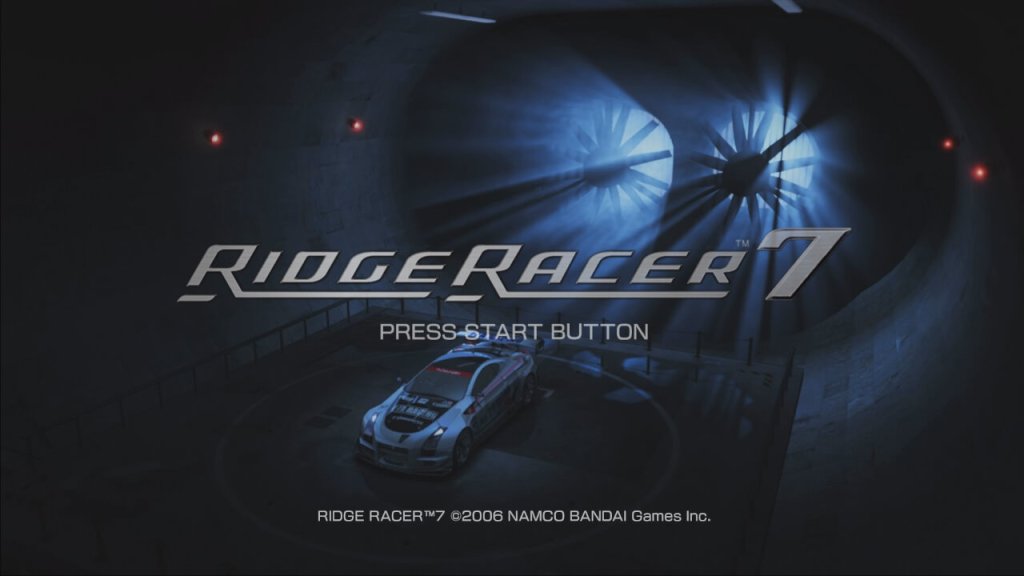
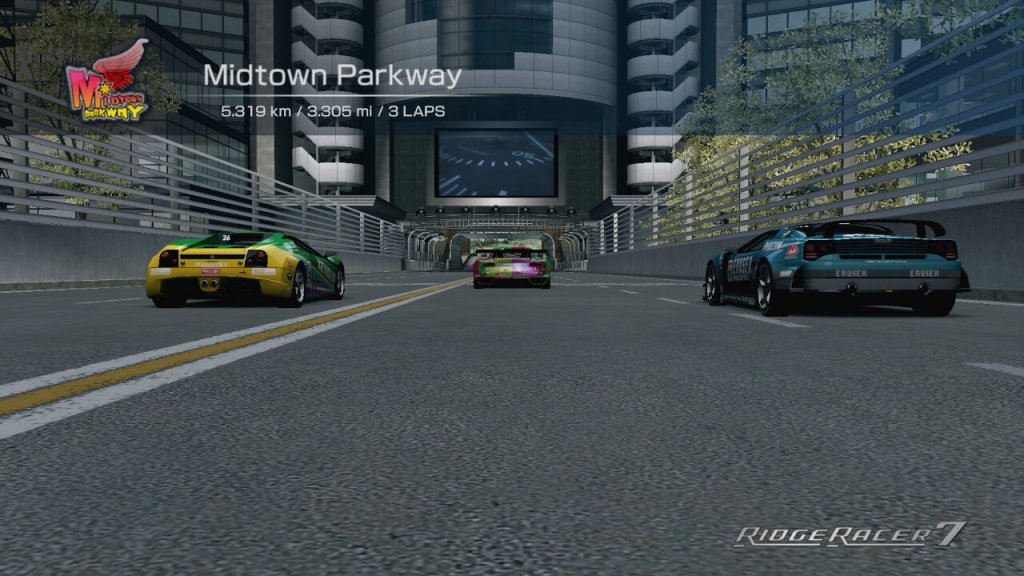
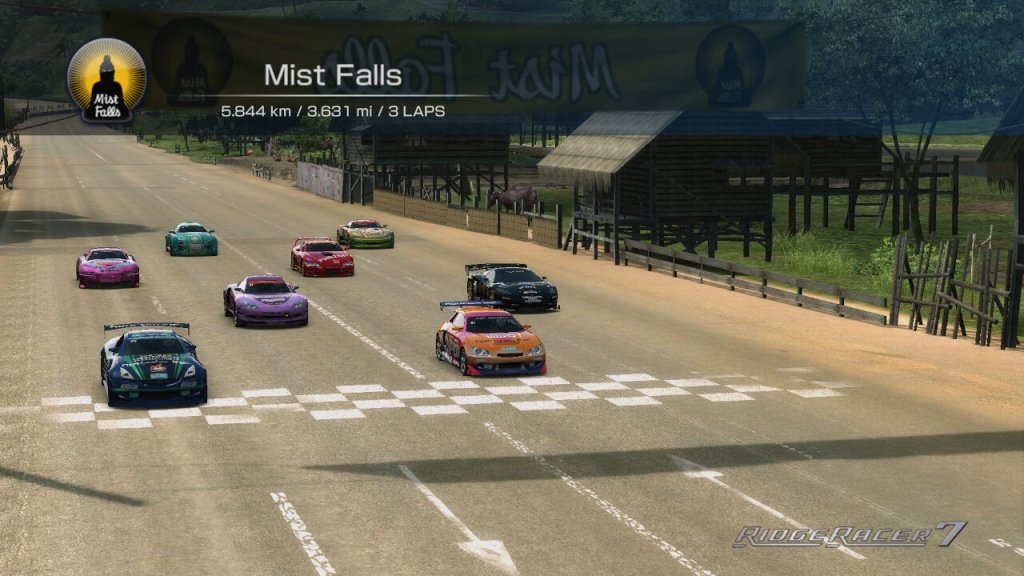
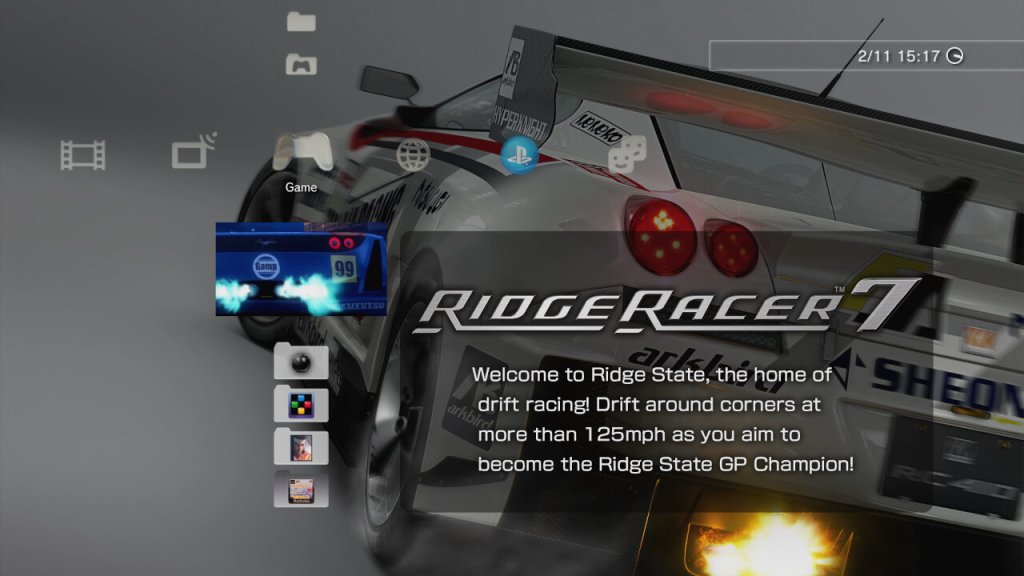
Released in 2006 as a launch titles for the newly released PS3, Ridge Racer 7 is known for its arcade-style racing with a focus on speed and drifting. The game features both solo and multiplayer modes, a first in the series for the PlayStation platform. It’s also one of the few PS3 games to run at 1080p 60fps. Ridge Racer 7 maintains the series’ core mechanic of high-speed drifting. Players who enjoy mastering the art of sliding through turns at breakneck speeds find this exhilarating, and is a nice alterative to racing simulation games like Gran Turismo or Forza.
In terms of gameplay, there isn’t much different with the Xbox 360 exclusive Ridge Racer 6, with some even calling 7 a directors cut with extra content. It defiantly feels like an improvement rather than a new title in the series. There is nice selection of tracks, but they are improved versions of Ridge 6’s tracks. There isn’t much from the previous installments of the game unless you count the original track from the first release, now renamed as
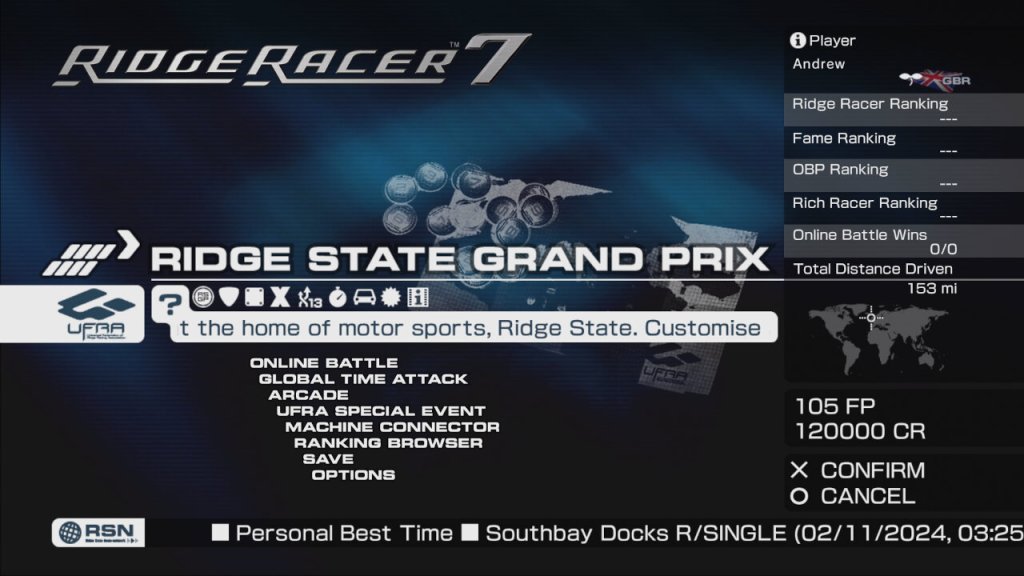
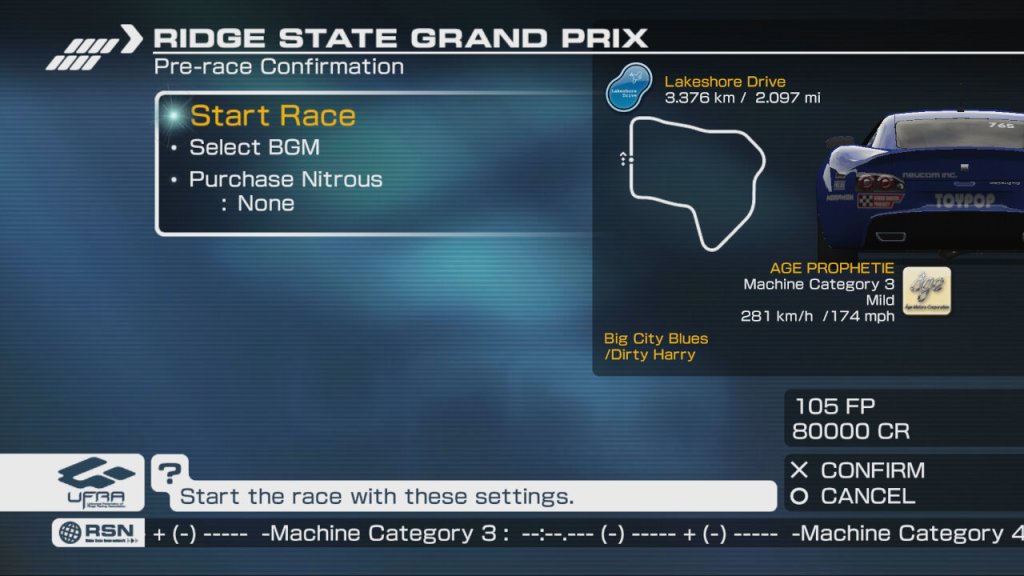
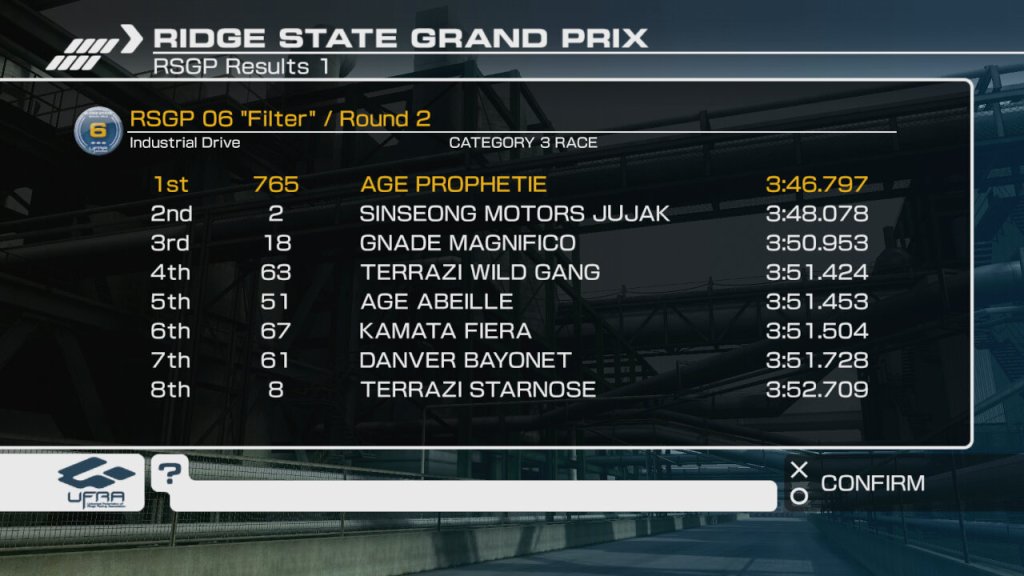
The user interface is a complete overall to what was seen in Ridge Racer 6, giving a more dynamic view. Gone is the hex-style design of the race tree, instead you select which race you want to start from a simple menu. Ridge State Grand prix is a series of races that can be completed in order to earn credits, that can be used to unlock and customize your machines for later races. These are treated as tournament where you have to race on three to five tracks, with your finishing position having an impact in your standing for the next race. Unlike previous games, you don’t have to win or finish in the top three, but you will have to try harder to compensate for the next race instead. Alternatively you have the option to replay the race gain, but you will be returned to the first race in the series.
There are also other races in the game, a Manufacturer’s Trial that lets you unlock specific machines when you win a specific race, or can unlock additional upgrades. There are also single events which are much difficult and can consist of time attack races, and regular races that have machine restrictions on them. There was also downloadable content which included a set of 25 UFRA Special Events. These events were known for their higher difficulty level compared to the standard game races, providing additional challenges for players even after completing the main content.
As always, there is a specific time attack mode which will compare your results with other players online, and multiplayer either through splitscreen or online.
The music in the game is as amazing as always with some good techno and electronica tracks to race to that Ridge Race is known for. Namco also provided previous tracks to download that featured from previous installments in the game, giving you a sense of nostalgia from previous tracks in the game.
Sadly this was one of the last proper Ridge Racer games to be released. There would be a follow up in the form of Ridge Racer Unbounded, but this is perceived by players to be a Burnout knockoff rather than an actual Ridge Racer game. Portable consoles did continue to see Ridge Racer releases, namely the Nintendo 3DS and the PSVita, even mobile devices like the iPod Touch had Ridge Racer Accelerated. New installments would be released for the eighth-generation consoles, and the Ridge Race franchise has since been abandoned, and arcade racers in general.
There seems to be a broader trend where simulation racing games are gaining ground over arcade racers on modern consoles. This might be attributed to the desire for more authentic and challenging gameplay or the growth of esports and the professionalization of gaming.
But these sorts of games do not age well thanks to music and vehicle licenses expiring, meaning racing games typically get delisted after a few years and gives an expiration date for thee games. Arcade racing games continue to hold a cherished place in gaming culture. They cater to a different audience looking for quick, adrenaline-fueled fun without the steep learning curve of simulations. There is no reason why both cannot coexist, and titles like Dayona USA, Cruis’n USA and even Burnout will always have a place on any consoles/gaming hardware, either in native or emulated form.
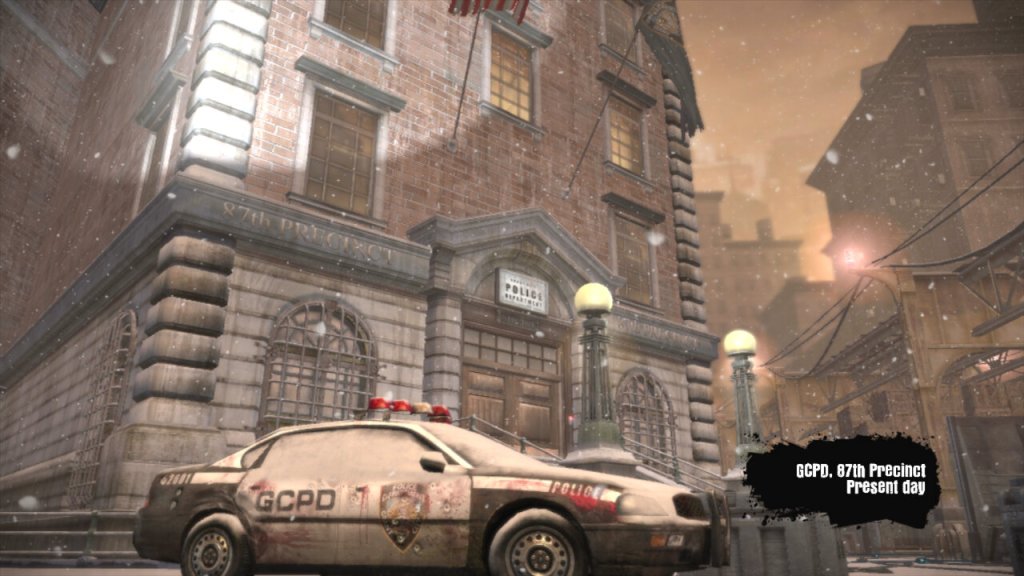
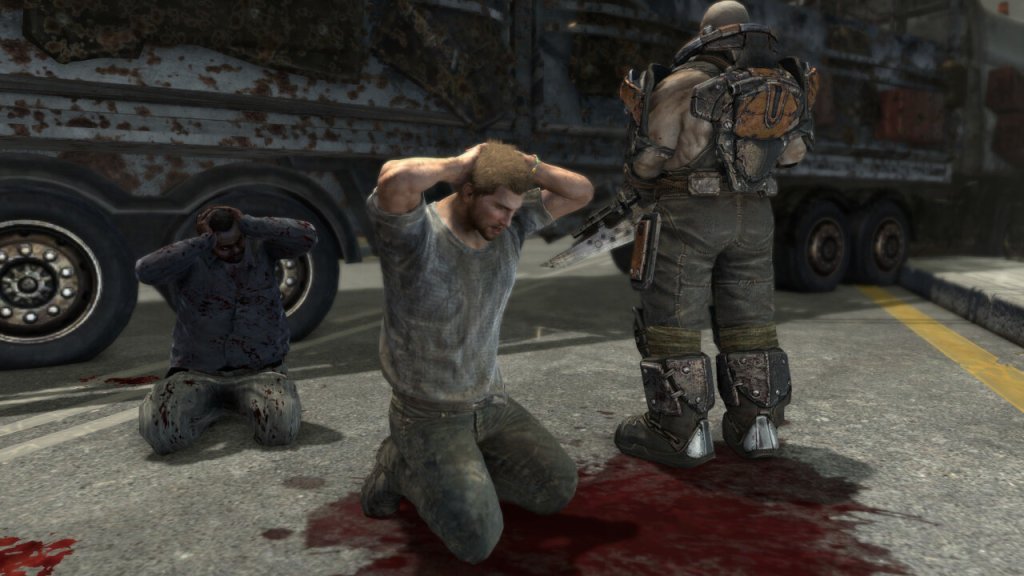
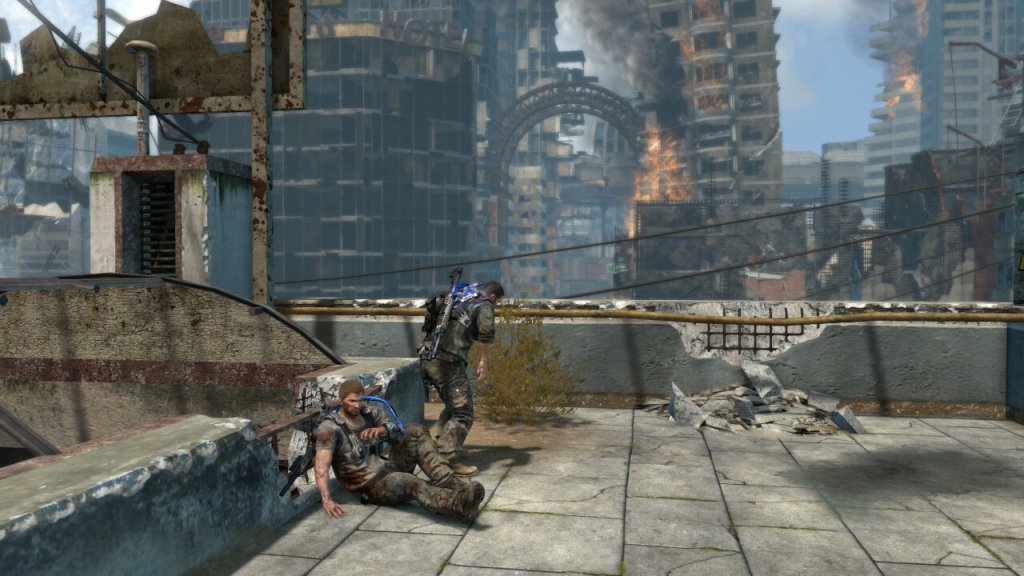
Dead to Rights: Retribution primarily takes place in the fictional and crime-ridden city of Grant City. The game’s environment is characterized by its dark and gritty atmosphere, which reflects the city’s seedy underbelly and ongoing criminal activities. In terms of weather, the game’s setting generally features a consistent and moody aesthetic that contributes to the overall atmosphere.
While the game doesn’t have dynamic weather systems or changes in weather conditions, it typically portrays Grant City as a place shrouded in darkness, with rain-soaked streets, dimly lit alleyways, and a generally overcast and gloomy ambiance. This atmospheric choice aligns with the game’s themes of crime, corruption, and a city in decline. The game’s visual design emphasizes the noir-like qualities of a crime-infested urban environment, and the lack of variation in weather conditions reinforces the consistent tone of the narrative. Players will often find themselves navigating through grim and rain-soaked urban landscapes as they progress through the story and engage in combat encounters with various adversaries.
Jack Slate is the protagonist of the game and a tough-as-nails cop with a no-nonsense attitude and a physique that puts Marcus from Gears Of War to shame. He’s on a mission to uncover a conspiracy involving a powerful criminal organization and bring them to justice. Jack is skilled in both firearms and hand-to-hand combat and is accompanied by his loyal canine companion, Shadow. Most of the game is spent playing as Jack, with a few sections requiring the control of Shadow, either to access hard-to-reach areas, or if Jack is incapacitated as part of the game’s plot.
Shadow is Jack Slate’s faithful canine companion and a key element of the gameplay. Shadow can be commanded to perform various tasks, including attacking enemies, retrieving items, and assisting Jack during missions. Shadow’s presence adds a unique dynamic to the game, as he can help Jack in combat and solve puzzles. Be careful around enemies, Shadow does not have much health and can only attack at close range.
I wonder if this was any inspiration for Riley from Call of Duty Ghosts?
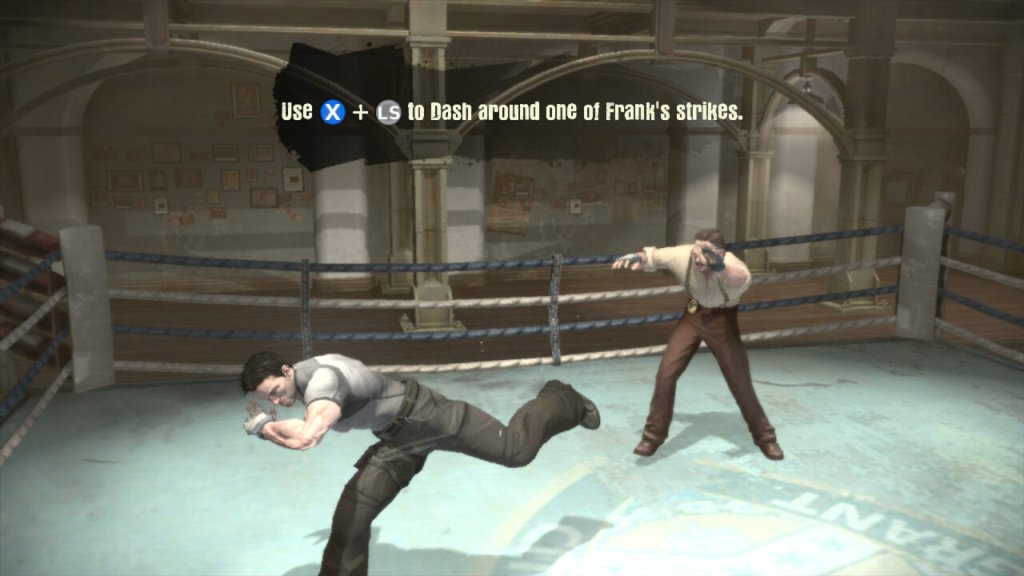
The game’s main focus is hand-to-hand combat, with gunfire taking a side role. Many of the guns you pick up in the game have very little ammo, meaning you have limited use of these weapons and must be used sparingly. You might want to save them for distant enemies instead.
The gameplay tried to mix brawling & melee attacks with shooting, however this gets repetitive fast with very few puzzles to break up the gameplay. There are some sections where you will have to fortify and hold out against a horde of enemies but again there is very little diversity in the gameplay.
Grant City is depicted as a city where corruption runs rampant within its law enforcement agencies and political institutions. Jack Slate’s journey to uncover the truth behind the criminal conspiracy highlights the pervasive corruption that has taken hold, with powerful figures involved in illegal activities.
The game touches on the abuse of power by individuals in positions of authority. The criminal organization known as the Triad wields significant influence and control over the city, and part of Jack’s mission is to expose and challenge this abuse of power.
While not explicitly political, the game’s portrayal of Grant City as a dystopian and crime-infested metropolis can be seen as a commentary on the societal decay that can result from political corruption and a lack of effective governance.
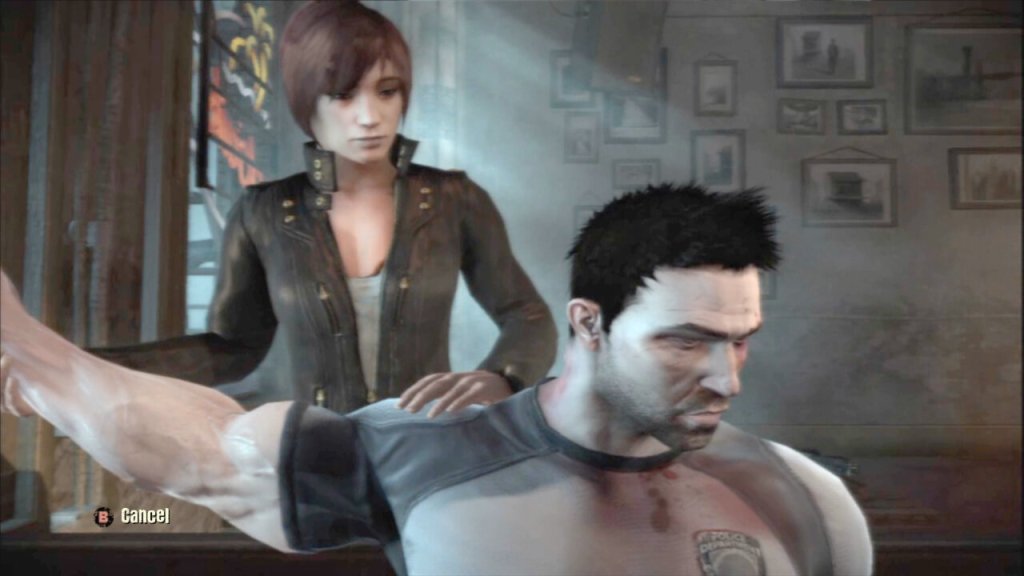
The character of Cassandra Hartz (seen below), a journalist investigating the criminal activities in Grant City, indirectly highlights the role of the media in exposing corruption and holding those in power accountable. Her presence in the game alludes to the importance of investigative journalism in a society plagued by political and criminal misconduct. Most of this is explained through the game cutscenes with her.
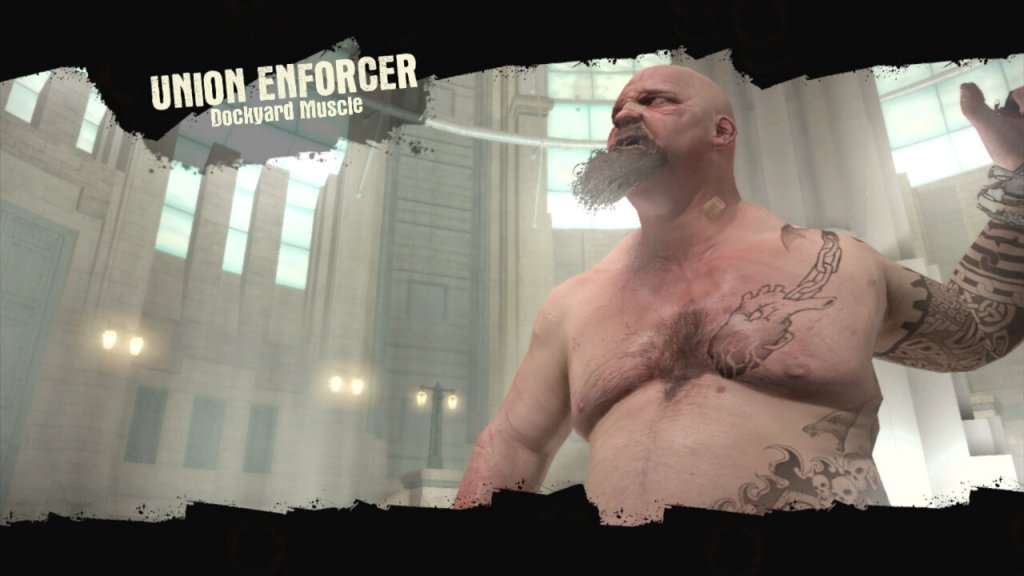
The type of enemies found in the game will change as you progress, initially facing against the Triads, the GAC later become the main focus of the game who are much more difficult to take down. The GAC were the Anti-crime units that became corrupt, whilst the Triads are your average gang where you must take out the boss to defeat them.
The game was only ever released on consoles, with no PC version released. Although It can be played on the PS3 or Xbox 360, Sadly it remains on seventh-generation consoles as we have yet to see it released or made compatible with the Xbox One. It also appears to be the final game in the franchise, as no new games have been released.
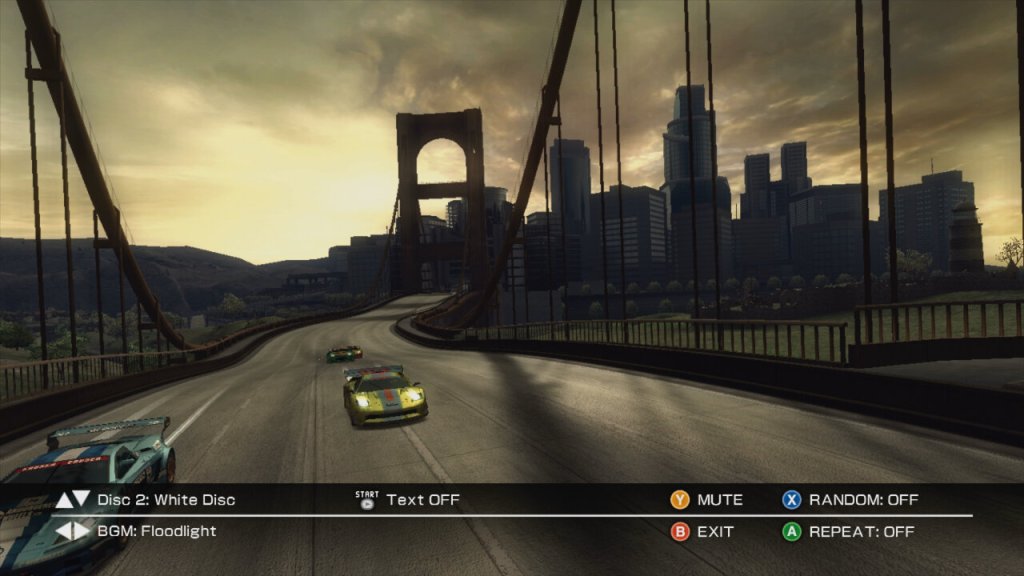
Ridge Racer 6 is a fast-paced and adrenaline-fueled racer that’s easy to pick up and play, but difficult to master. The game features a wide variety of cars and tracks to choose from, each with its own unique handling and feel. The controls are responsive and tight, and the drifting mechanics are especially satisfying. However, some may find the game’s AI to be a bit too aggressive and unfair at times, especially at the last section of the world tour.
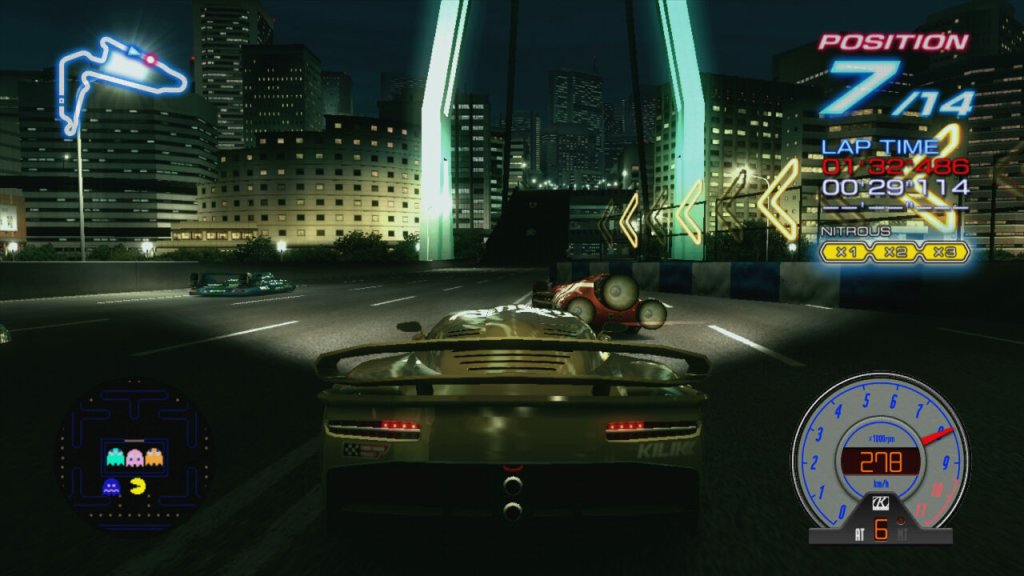
Like other Ridge Racer games, it features a mini arcade game based on a Namco property, in this case it’s the original Pac-Man. The interface is very similar to Ridge Racers on the PSP, with a very similar menu structure and HUD design, this would also carry over to the iOS version.
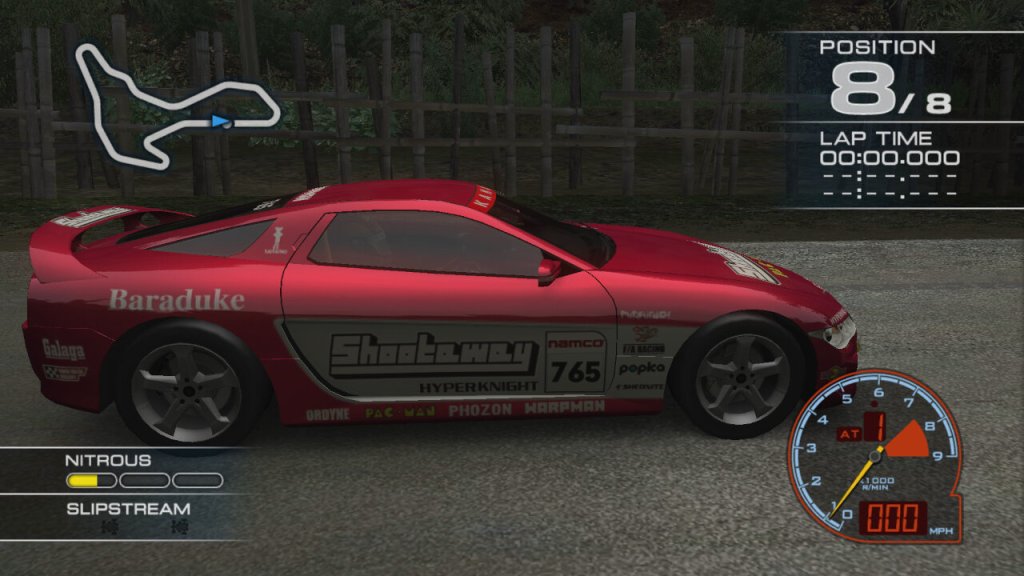
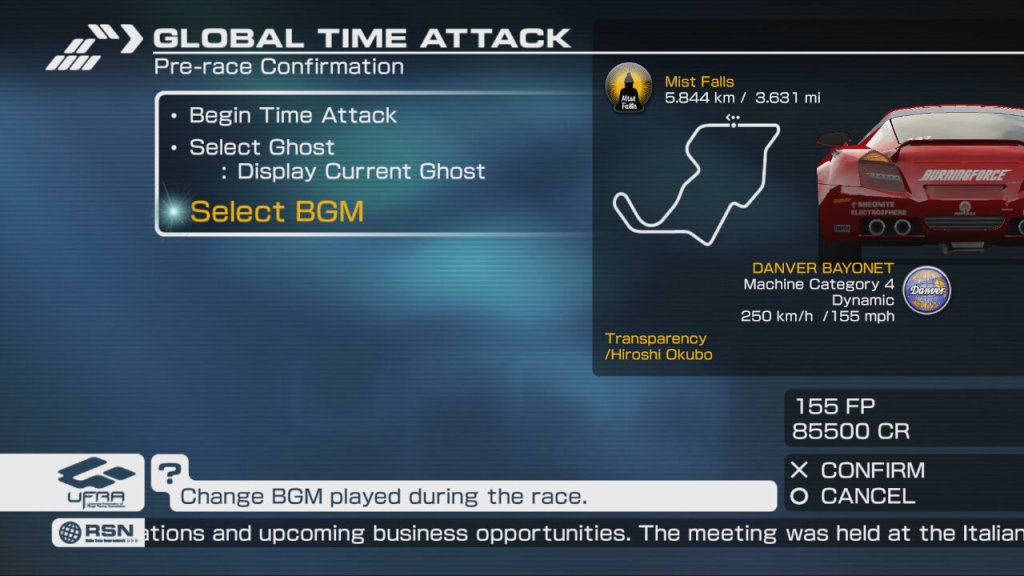
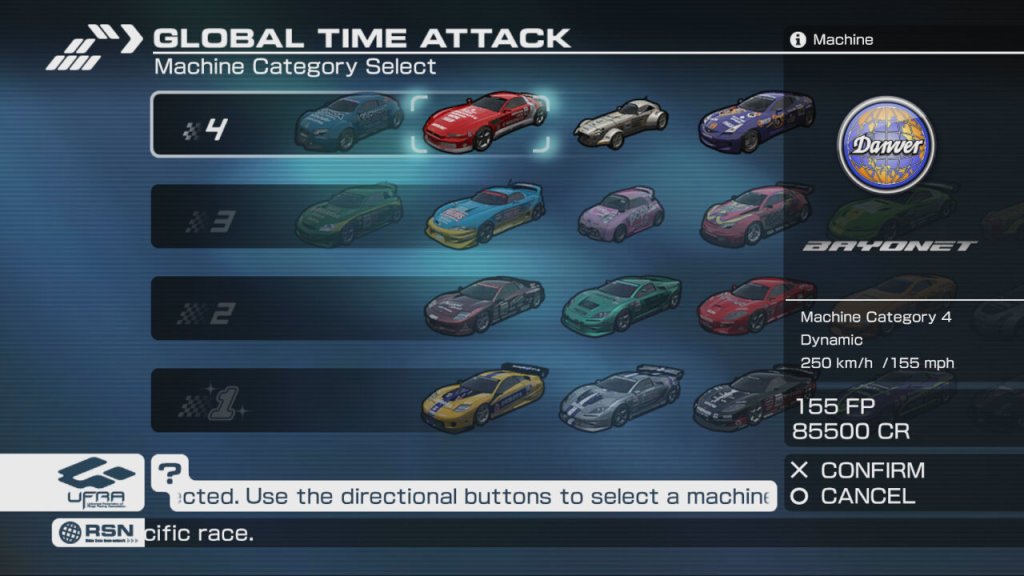
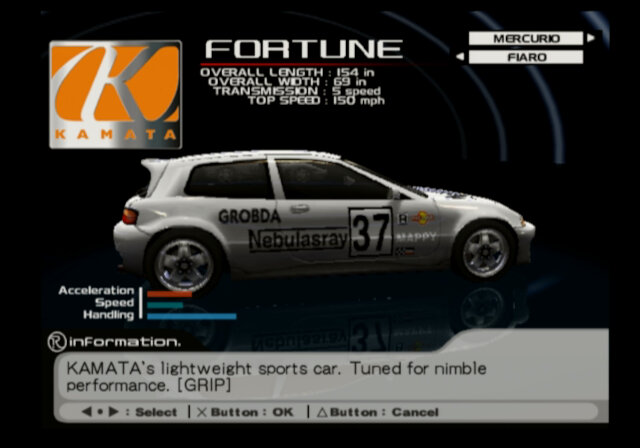
The game makes use of its own brands of cars that feature unique handling and statistics, with some cars performing better at drifts. Some examples of fictional cars that are known to be included in Ridge Racer 6 include the Kamata Fiera, the Danver Bayonet, the Assoluto Bisonte, the Terrazi Wild Gang, and the Himmel 490B. Each of these vehicles has its own unique strengths and weaknesses.
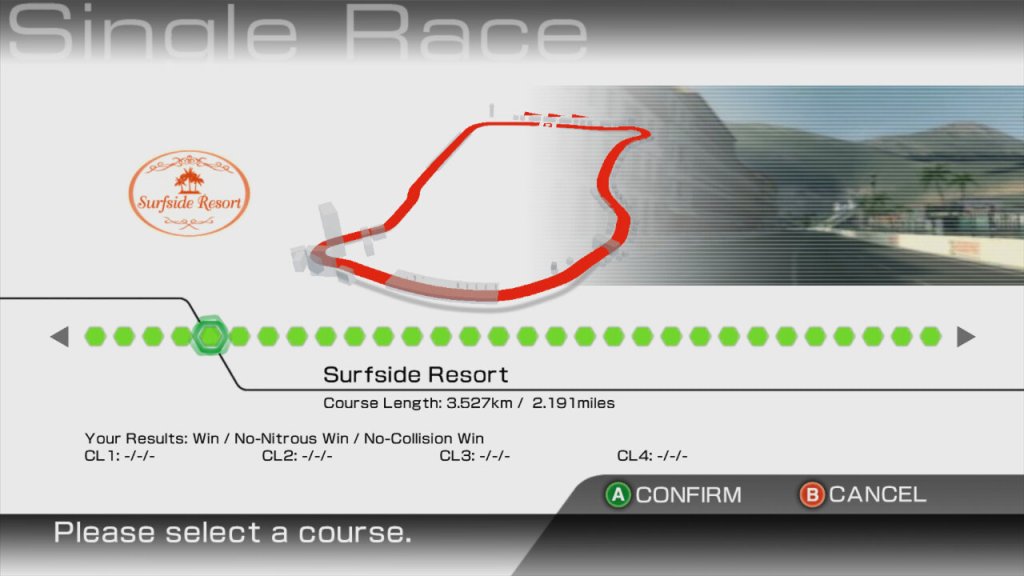
Harborline 765 – a city course that winds through a harbor area.
Southbay Docks – another city course that features tight turns and narrow streets.
Highland Cliffs – a mountain course with plenty of twists and turns.
Sunset Heights – a coastal course with plenty of jumps and high-speed sections.
Midtown Expressway – an urban course with long straights and wide corners.
Seaside Route 765 – a coastal course that takes place along a scenic seaside highway.
Lakeside Parkway – a course that features a long straightaway and tight turns around a lake.
The World Tour mode is a game mode in Ridge Racer 6 that allows players to compete in a series of races across a variety of different locations and tracks. In this mode, players progress through a series of Grand Prix events, with each event consisting of multiple races that take place on different courses. I believe this is also the first Ridge Race title to feature online lay over the internet, using Xbox Live, which remains active to this day.
As players progress through the World Tour mode, they earn points and unlock new cars, upgrades, and tracks. The difficulty of the races increases as players advance through the Grand Prix events, providing a challenging and engaging gameplay experience. In addition to the standard races, World Tour mode also includes a variety of special challenges and events, such as time trials, drift challenges, and lap battles. These challenges offer a unique twist on the standard racing gameplay, and provide an additional layer of depth and variety to the World Tour mode.
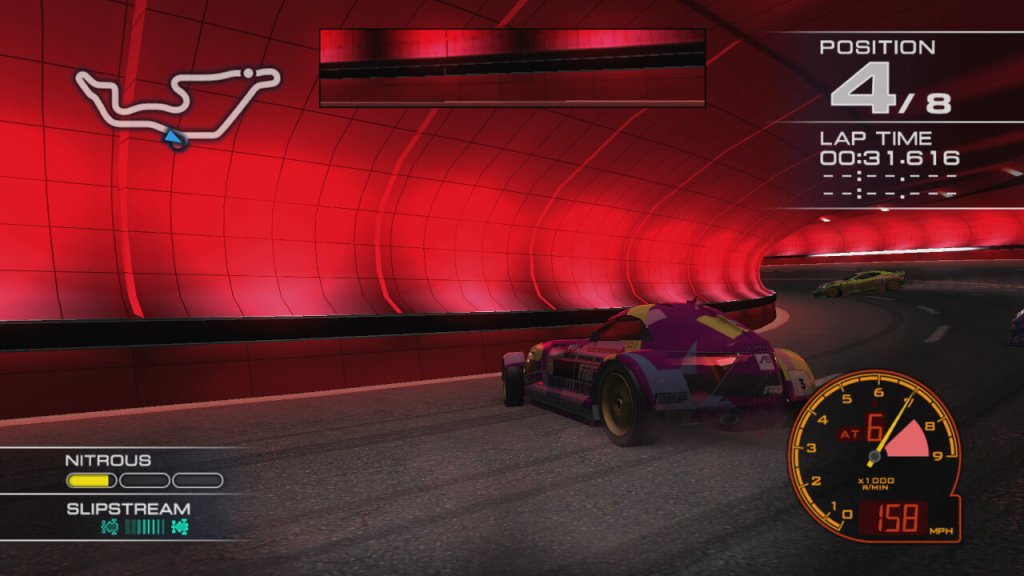
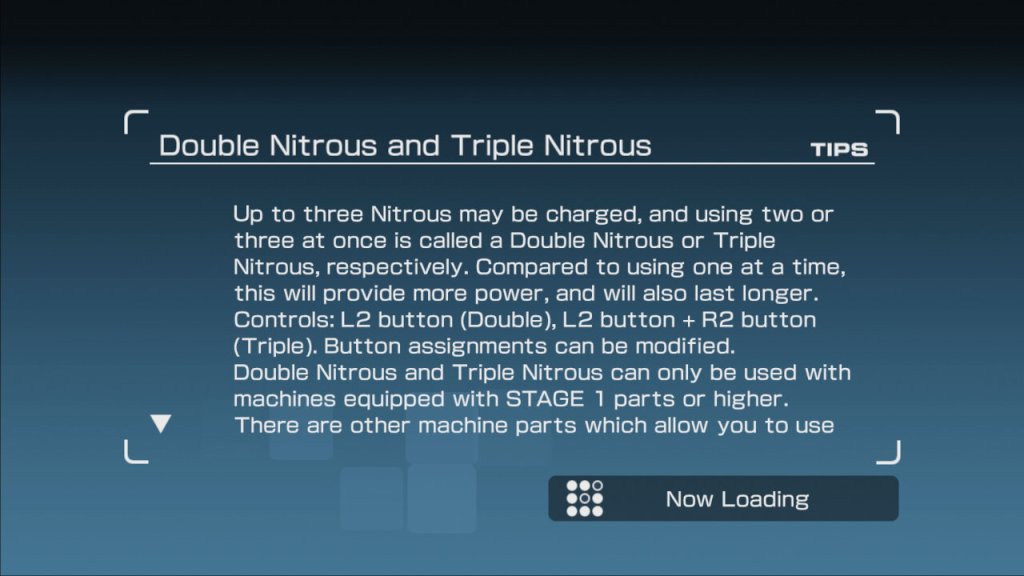
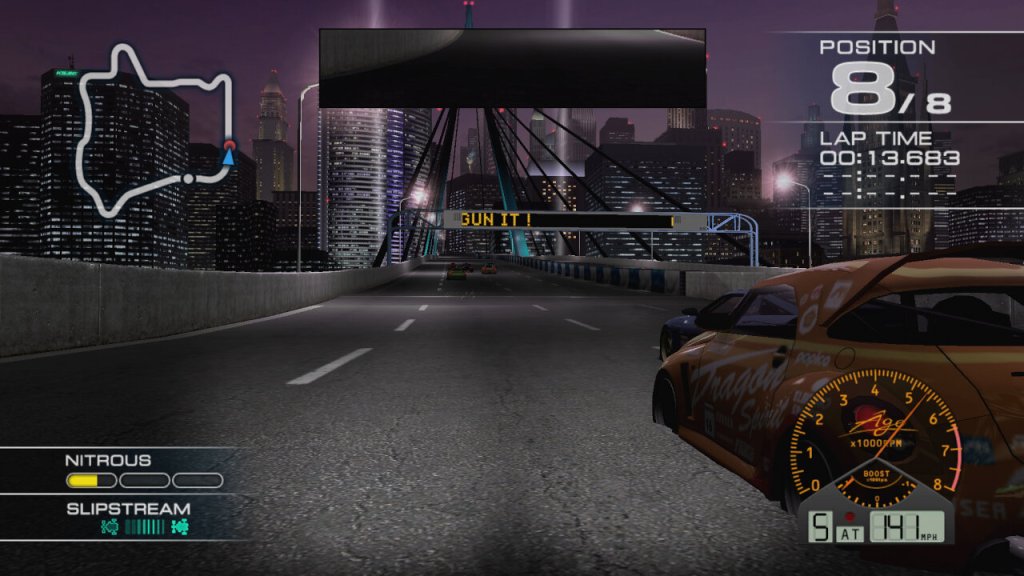
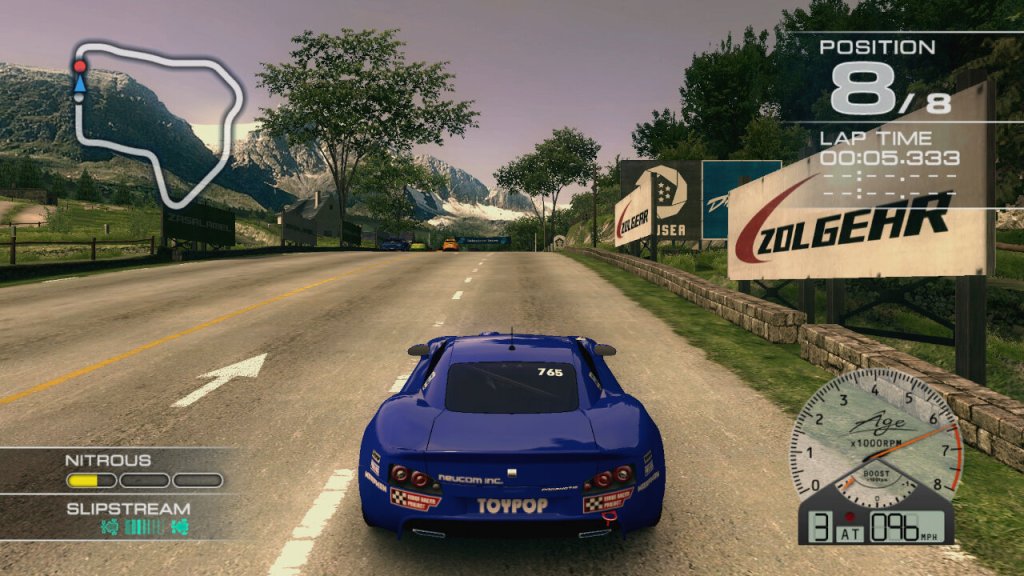
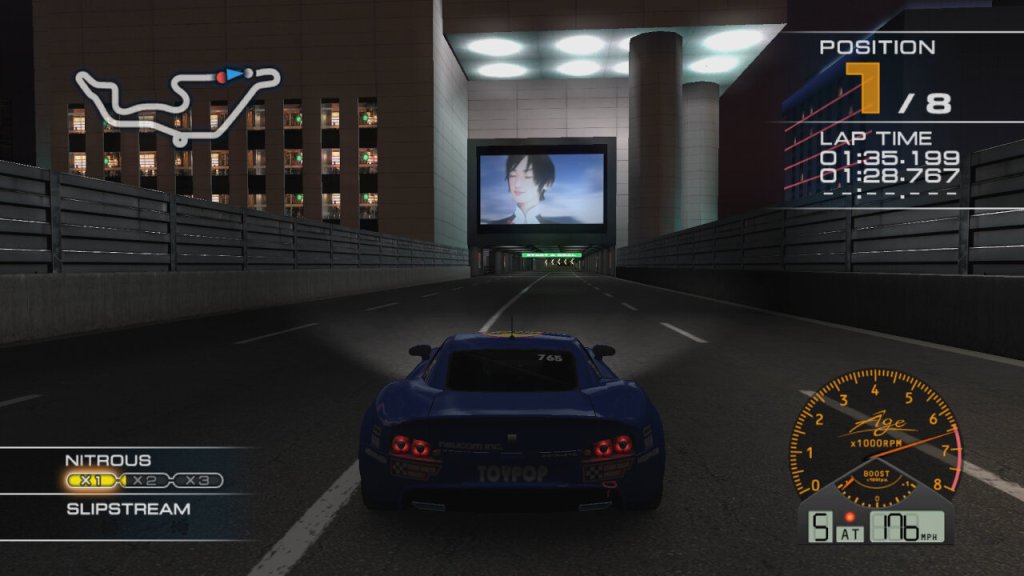
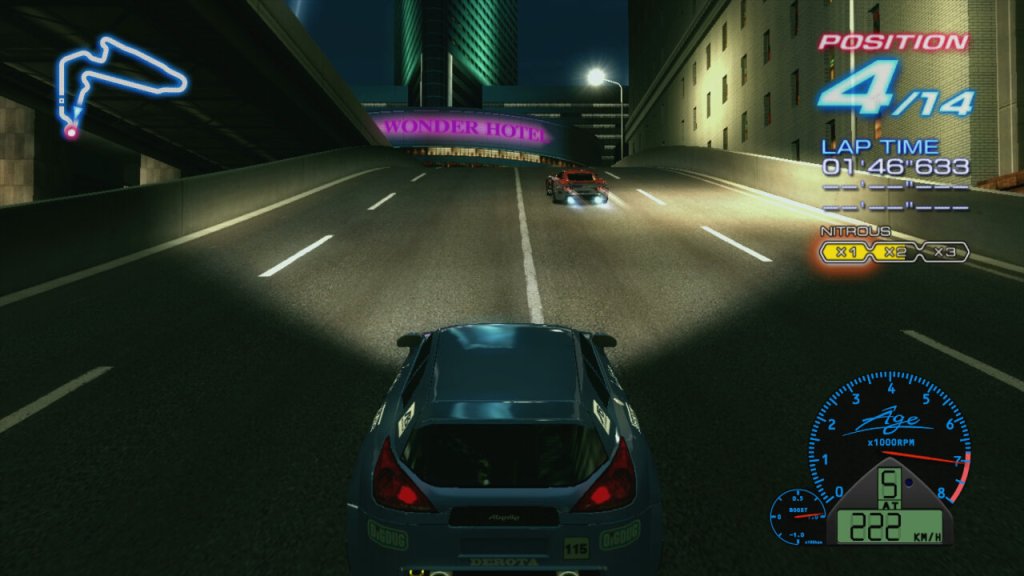
The Nitro game mechanic in Ridge Racer 6 is a system that allows players to temporarily boost their car’s speed and acceleration, giving them a strategic advantage during races. The Nitro system works by filling up a meter that is located on the game’s heads-up display (HUD) when players perform certain actions, such as drifting or drafting behind other cars. Once the Nitro meter is full, players can activate the Nitro boost by pressing a button, which causes their car to accelerate at a significantly faster rate than normal. This can be particularly useful during key moments in a race, such as when players are trying to overtake opponents or catch up to the pack.
In addition to the standard Nitro boost, Ridge Racer 6 also features a “Full Nitro” mechanic that can be activated when players have filled their Nitro meter to its maximum capacity. Full Nitro provides an even greater speed boost than standard Nitro, and can be particularly useful for closing large gaps between players or pulling away from the pack.
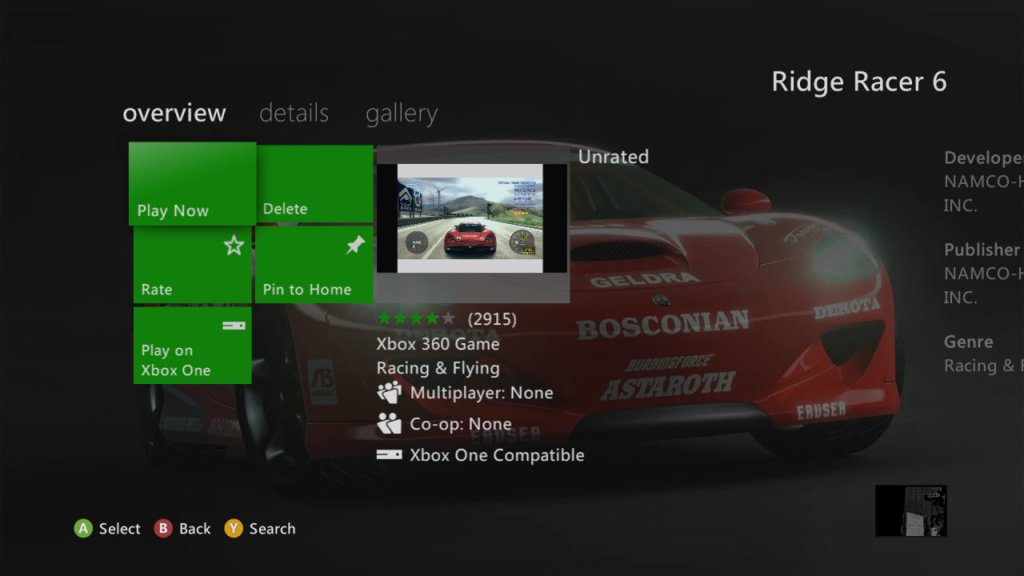
The game was only ever released for the Xbox 360, but was ported to the Xbox One as an Xbox 360 backward-compatible title. This isn’t Xbox One X enhanced which means it does not benefit from the higher resolution the Xbox One X provides.
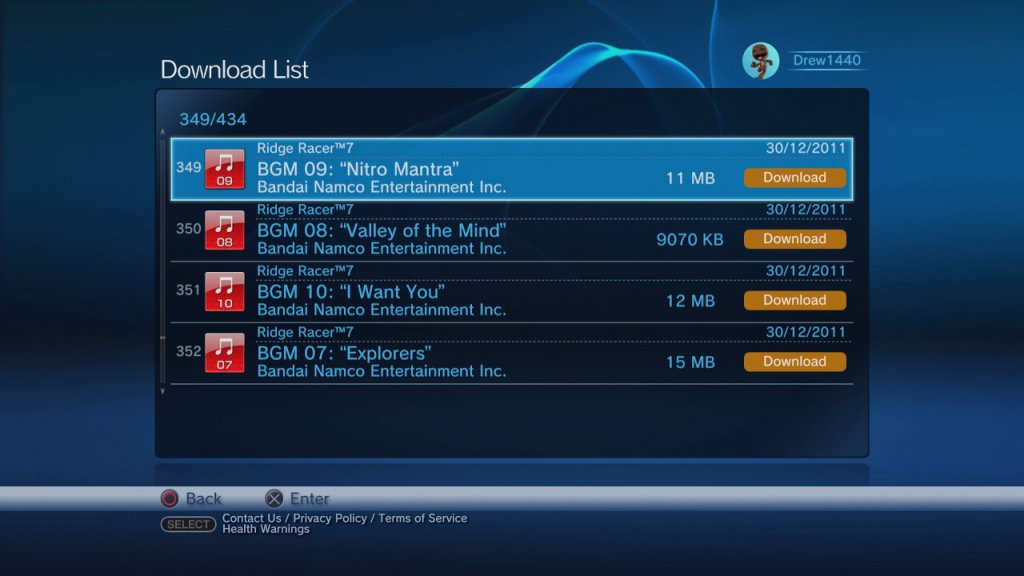
Many of the tracks and cars appear in Ridge Racer 7, a PS3-exclusive game. Some of the music tracks that feature in R6 could also be downloaded for the PS3 as DLC.
Speaking of DLC there are numerous unlock codes to enable machines to be unlocked, and you can also purchase additional songs that were featured on the PSP version of the game.
The song downloads are rather large for their size, which makes me think these are using a lossless format, or they feature additional files. I always assumed Xbox 360 games used the WMA format for audio, or at least the Xbox version of it which should result in a smaller file size. It could also be for surround sound or additional channels, as the songs have additional effects when you fire off Nitorus.
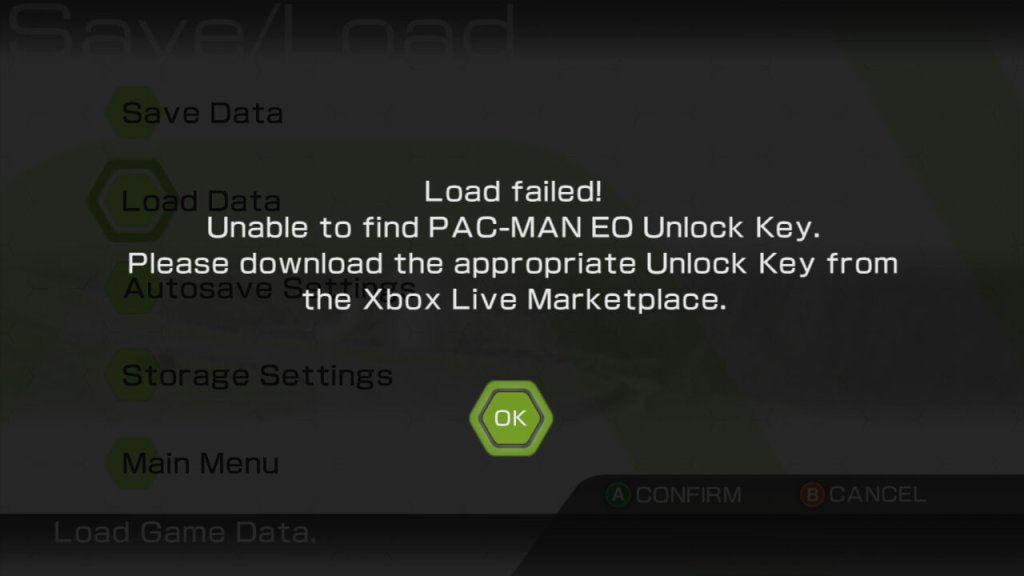
A quick warning, the DLC become attached to your save file and you cannot load your save without them, this becomes more problematic as the Xbox 360 store becomes more ‘broken’. In order to redownload the DLC I had to navigate through the download list in the Settings/Account section of the Xbox dashboard. They no longer appear in the game information tile of the dashboard.
A better way is to purchase them from the Xbox One store (console or Web) which will then push them to the top of the download list on the Xbox 360, which makes it easier to download. Remember to save the files to the same storage location as your gamesave, the hard drive or memory unit is best.
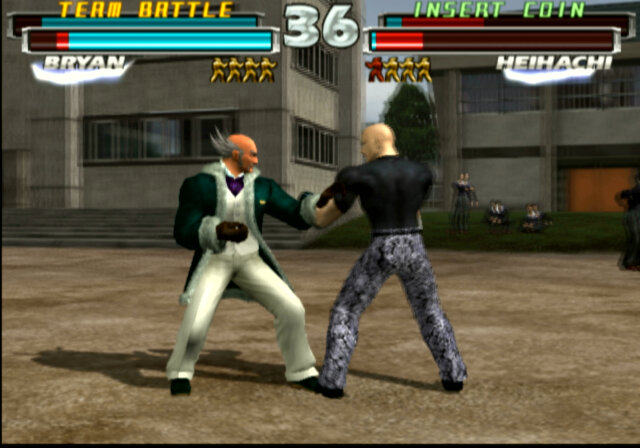
Also a nice touch, you can change the race announcer from the standard voice to the robotic system voice, or Heiachi from the Tekken series. And there’s an option to lay the Mac-Man game from earlier.
Overall, Ridge Racer 6 is a fantastic racing game that’s sure to please fans of the genre. The game’s stunning visuals, tight controls, and satisfying drifting mechanics make for a truly exhilarating experience. While some may find the game’s AI to be a bit too aggressive, it’s a small price to pay for an otherwise fantastic racing experience. As it stands, it was a great launch for the Xbox 360, and a taste of what HD gaming would bring for racing games.
Inversion, released in 2012 for multiple platforms, aimed to offer a unique twist on the shooter genre with its gravity-manipulating mechanics and a focus on destructible environments. Developed by Saber Interactive and published by Namco Bandai Games, it generated some initial buzz due to its innovative concept.
It’s best thought about as a Gear of War clone with gravity gameplay mechanics.
The story of Inversion centers around the protagonist, Davis Russel, and his quest to rescue his missing daughter in a world invaded by an alien force known as the Lutadores. Set in the fictional city of Vanguard, the game explores the aftermath of a catastrophic event called the Inversion, where gravity has been altered, leading to widespread destruction and chaos. Davis Russel, a police officer, and his partner Leo Delgado find themselves separated from their families when the Inversion occurs. As Davis navigates through the decimated city, he discovers that the Lutadores are using their advanced technology to control gravity and oppress humanity. Davis encounters an underground resistance group called the Resistance 33, led by a man named Dr. Raymond Gonzales, who holds knowledge about the Lutadores and their motives.
Throughout the game, Davis embarks on a journey to find his daughter and unravel the mystery behind the Inversion. Along the way, he confronts various Lutadores forces, including powerful bosses and their minions. Davis gains access to a gravity-manipulating weapon known as the Gravlink, which allows him to manipulate gravity, alter the environment, and combat enemies. As the story progresses, Davis discovers the Lutadores’ true intentions and their connection to his missing daughter. The narrative explores themes of family, sacrifice, and the fight against oppression. Davis must overcome personal challenges and make difficult choices to save his daughter and liberate humanity from the grip of the Lutadores.
Inversion’s core gameplay mechanic revolves around manipulating gravity to alter the environment and combat situations. While the concept was intriguing, the execution left much to be desired. The gravity manipulation abilities lacked fluidity and precision, making it challenging to execute actions with the desired accuracy. The controls felt clunky and imprecise, hindering the overall enjoyment and responsiveness of the gameplay.
Inversion features numerous combat encounters throughout the game. However, the combat lacked depth and strategy, resulting in repetitive and monotonous gameplay. The enemy AI is often predictable, and the lack of varied enemy types and tactics diminished the challenge. Additionally, the AI of allied characters proved to be lackluster, failing to provide meaningful assistance or engage players in cooperative gameplay elements.
One of the touted features of Inversion was its destructible environments. Players could use gravity manipulation to collapse structures and create cover. While this added a layer of dynamism to the gameplay, the destructibility felt scripted and limited, lacking the freedom and interactivity seen in other games with similar mechanics. The impact of environmental destruction on gameplay and strategy was not fully explored, resulting in missed opportunities to enhance the overall experience. In most cases, you will use the gravity mechanics to clear debris so you can progress to the next area and that’s about it.
They really could of added secret areas to the levels that could have been uncovered using gravity that would reward you with additional ammo or collectibles that could flash out the backstory. Again very similar to Gears Of War but it adds a lot more depth to the game itself.
Versions
Like most seventh-generation games, it was released on the HD twins (Xbox 360 and PS3) and on the PC (Windows). Nowadays it’s difficult to obtain this game digitally, meaning physical copies are the only feasible way.
Windows
This version was available on Steam, but has since been delisted for users outside North America. I had issues running the game on Windows 10 & 11, with the game refusing to launch. Only way to play the game was to use an older Windows 8 machine. There are supposedly fixes available online but unfortunately I was unable to get them to work.
Also announcing is the lack of Stream achievements despite this game being released in 2012, many Steam games were supporting achievements by then.
Xbox 360
The preferred console platform, but sadly this is not compatible with the Xbox One.
PlayStation 3
Pretty much the same as the 360 version but suffers from a lower frame rate.
Tekken 3 but with a new tag mechanic and a huge roster.
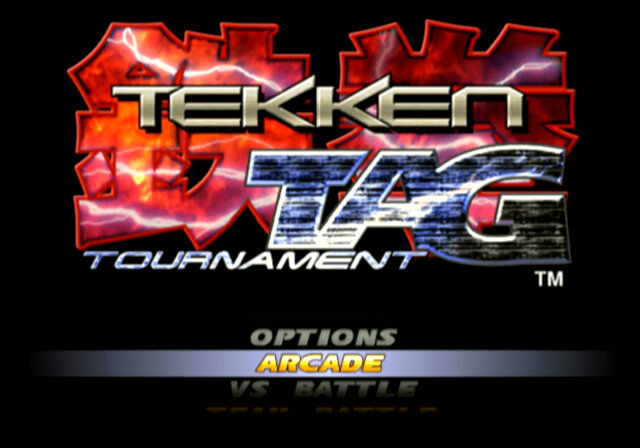
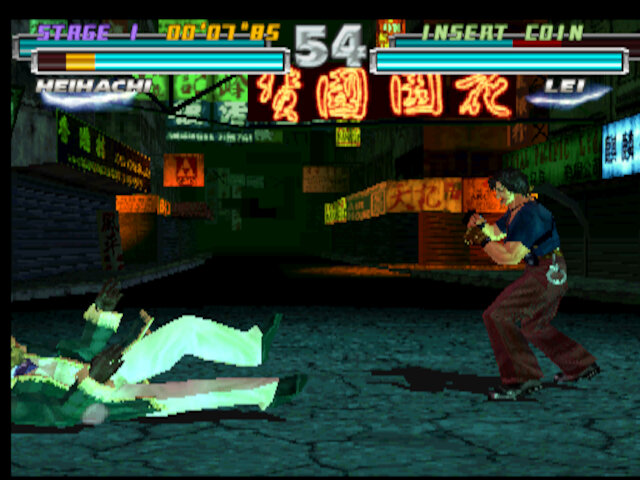
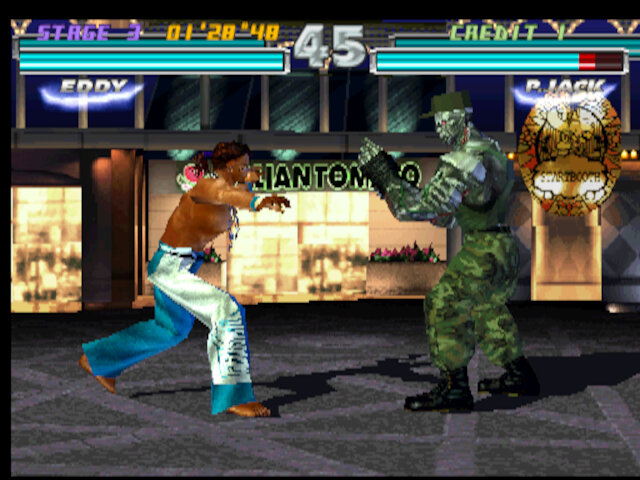
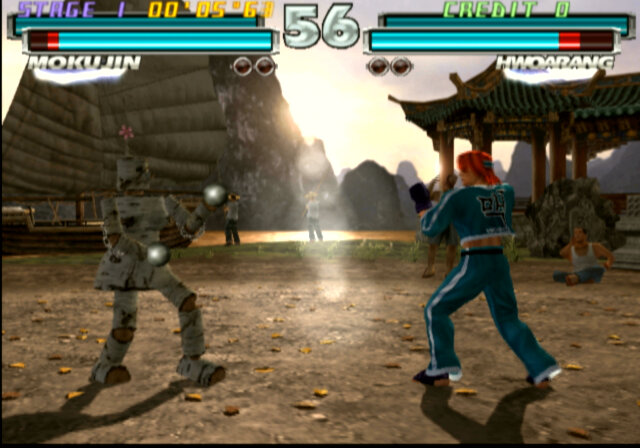
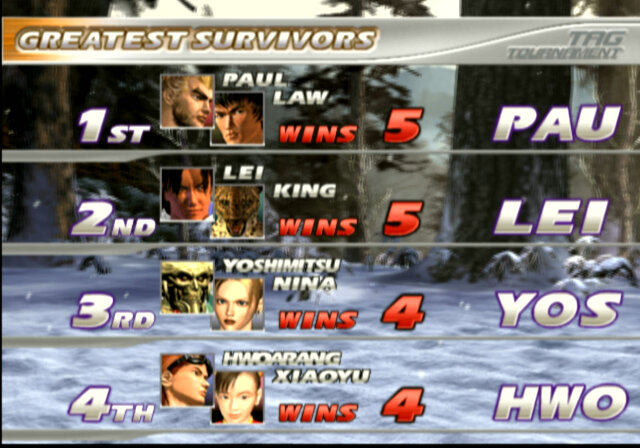
Tag Tournament takes the existing Tekken formula and adds a new tag team mechanic, allowing up to four characters to fight against each other. Its also one of the few games to be released for three generations of PlayStation hardware (sort of, The System 12 arcade board is an overclocked PS1 board.)
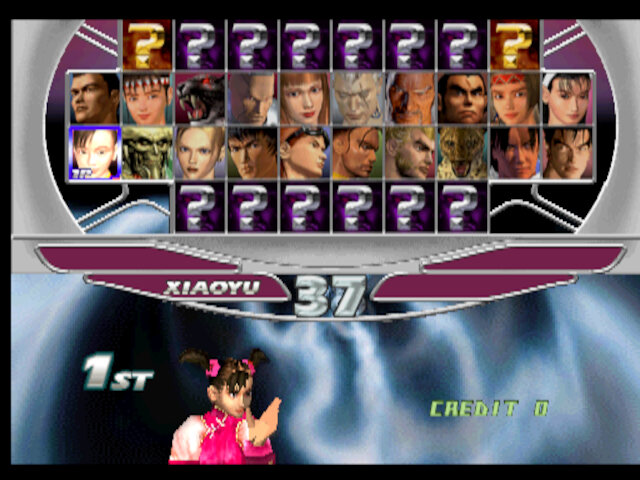
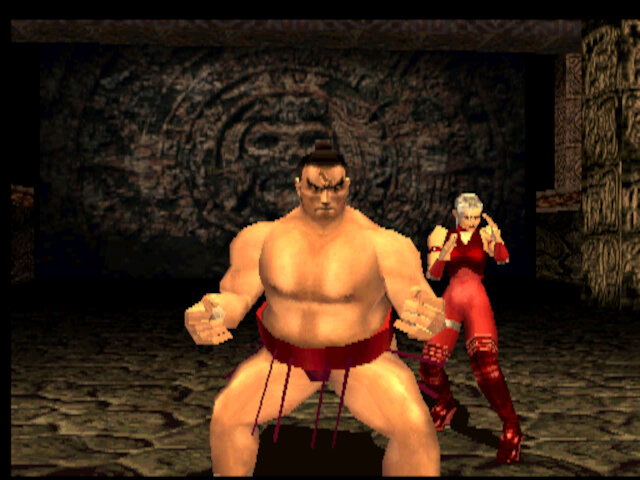
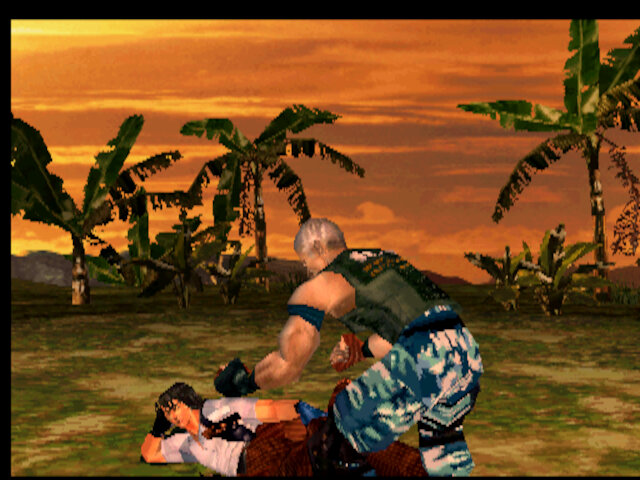
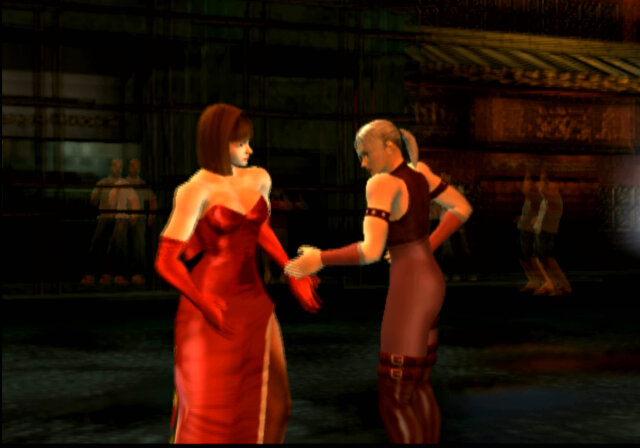
The fighter roster is stacked with an insane lineup of characters, many of which all featured in the first three installments of the Tekken franchise. You’ve got your classics like Kazuya, Jin, and Heihachi, all ready to unleash their devastating combos. Its like a Tekken greatest hits reunion featuring everyone’s favourite characters from previous games, but there are a few omissions like the original Jack, King and Armour King. Still Namco have also implemented Easter eggs for when you choose a certain par of characters, that affect the characters animations before and after the fight. Pairs like Nina & Anna, Kazaya & Heihachi and Michelle & Ganryu are a few examples to name that do this this, and it gives a nod to the Tekken backstory that fans of the franchise will be invested in.
Some pairs will also have unique moves that can be used to attack and switch out at the same time. These require a button combination along with the tag out button to trigger.
Versions
Arcade
The original release of the game was in the arcade, like other early Tekken games. The game ran on the Namco System 12 board which was an upgraded PlayStation with additional memory and a faster clocked processor. This allows for multiple fighters to be featured onscreen, required for some of the character move sets. This version of the game also features its own soundtrack which is played on Namco’s own C352 sound processor that was also used in their System 23 arcade boards.
Many characters are locked in this version and are on a time based unlock, where characters gradually come available as the arcade machine is powered on. There is a MAME cheat to unlock all the characters upon clearing the EEPROM that can be used instead.
PlayStation 2
Tag Tournament was one of the launch titles for the PS2, and remained exclusive to the console for the home release until the HD PS3 version. This version features completely upgraded graphics that take advantage of the PS2’s Graphics Synthesizer
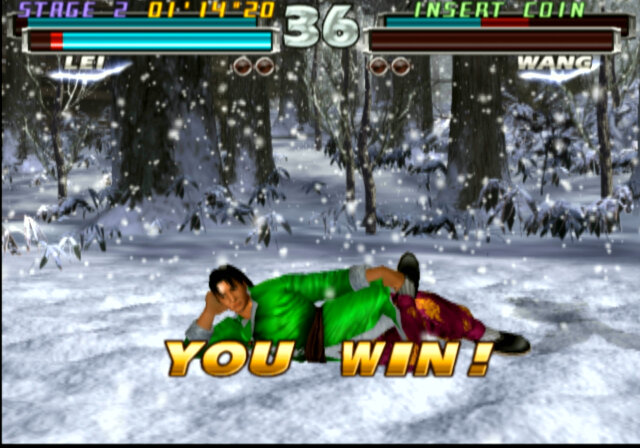
Unknown is a fully playable character in this version and has a unique feature where she can emulate another fighters moves.
This version also features a few unlock-able features and game modes.
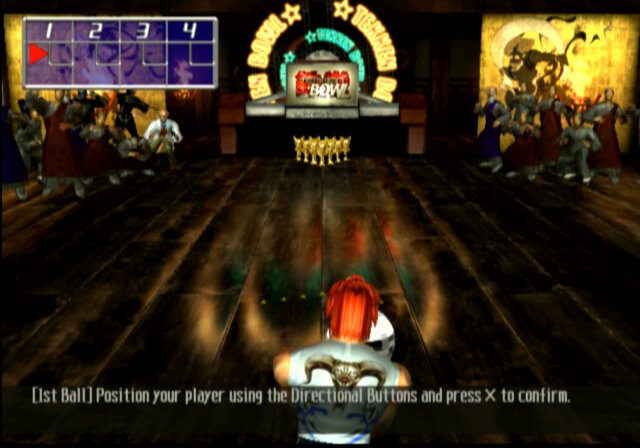
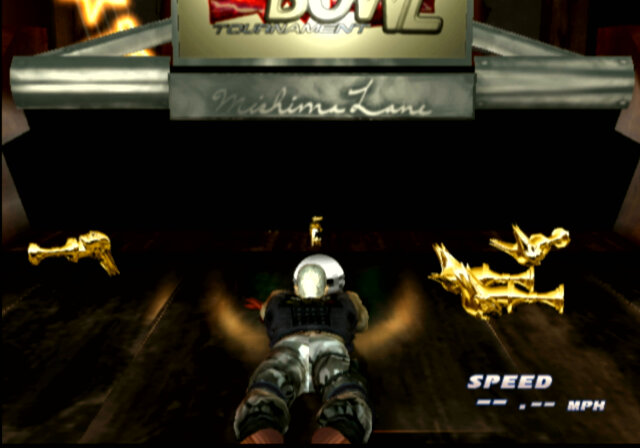
Tekken Bowl: In Tekken Bowling, players would select a character from the roster and take them to the bowling alley. The character would replace the traditional bowling ball, and players would control their chosen character’s movement and angle as they approached the lane. The objective was to knock down as many pins as possible in each frame.
The mini-game incorporated the unique abilities and characteristics of each character into the bowling mechanics. Characters would have their own distinct bowling animations and techniques, adding a touch of personality to the gameplay. Some characters might have special abilities or moves that affected the trajectory or speed of the “ball” they threw.
Namco would later create a Tekken bowling spin-off for smartphones.
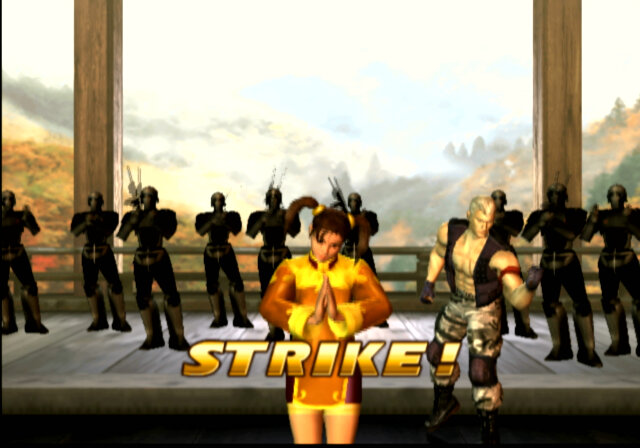
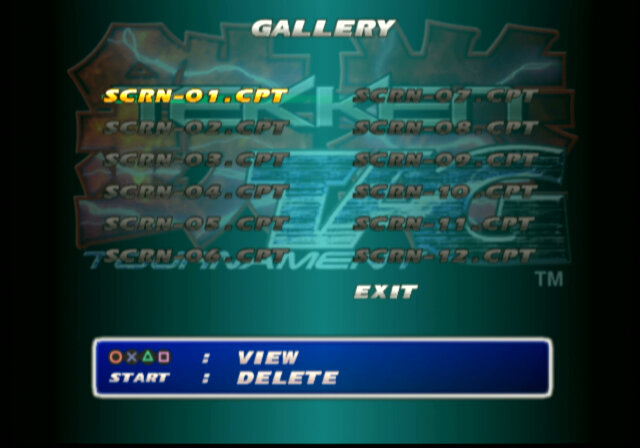
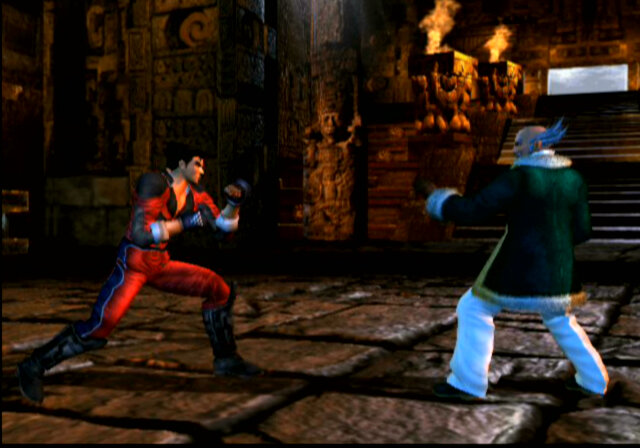
Screenshots: A screenshot can be captured and saved to the memory card, useful when you want to capture for character whilst they’re in the middle of a combo. A screenshot can be taken by pressing the pause button and selecting screenshot.
Pair Play mode: Another feature is the pair play mode, which allows two players to fight with their own controller against the CPU. Four plays can also play in a VS match if the PS2 multi-tap controller is used.
Lastly each character has a unique ending sequence which is rendered within the game engine, except for unknown which is a pre-rendered MPEG2 FMV.
PlayStation 3
Namco ported the game to the PS3 in 2012, and was released as part of Tekken blood Vengeance. Inserting the Blu-ray disc would prompt you to install the game as a bonus feature of the disc.
This version featured upscaled graphics running in HD resolution, trophy support, and is a port of the PS2 version. The soundtrack mostly remains the same, though there are some differences in composition. Sadly there is no online play over the PlayStation network, which would have made a nice addition though it would have suffered a limited population, as this game was not released standalone. Rather it was treated as a bonus.
Conclusion
Tekken Tag Tournament is an absolute knockout of a game. It’s a high-energy, pulse-pounding experience that’ll have you hooked from the moment you pick up the controller. Whether you’re a casual fighting game fan or a seasoned pro, this game delivers the goods. The Tag Tournament formula would be repeated in 2011 with the release of Tag Tournament 2 for the PS3, Wii U and Xbox 360.
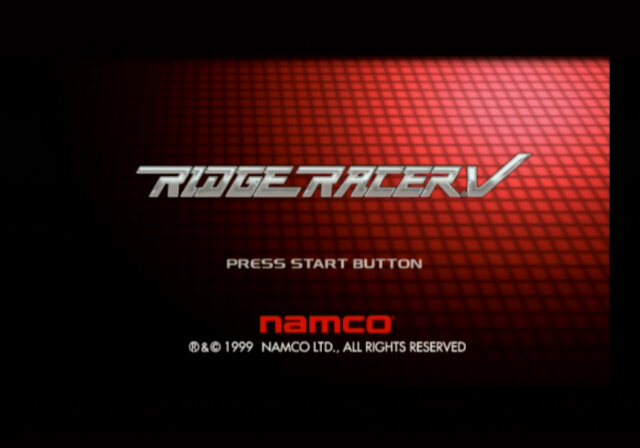
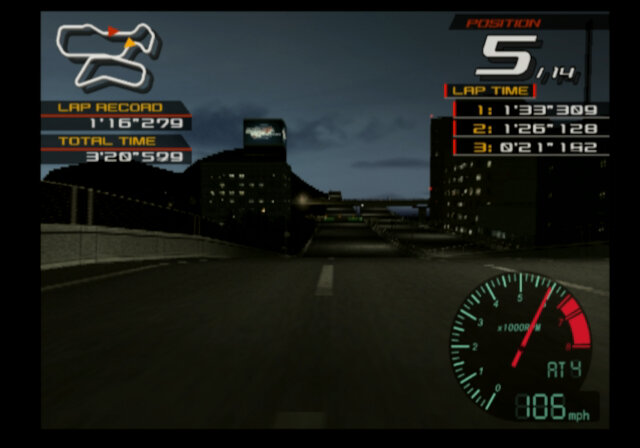
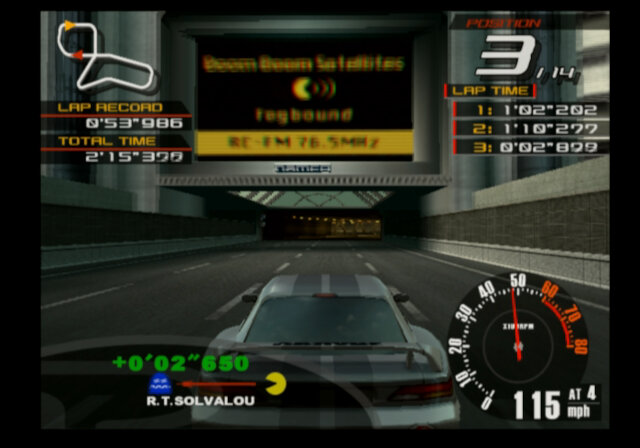
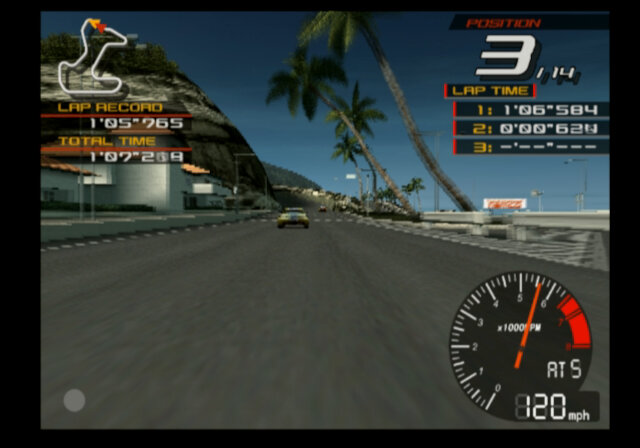
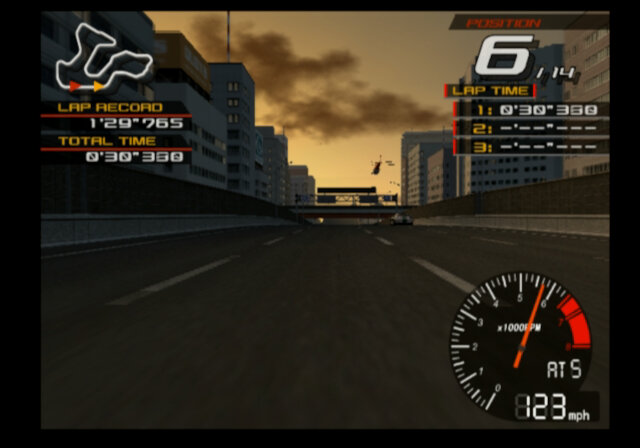
One of the launch titles for the PlayStation 2, Sony’s follow-up to the popular PlayStation. Like the first Ridge Racer, this was one of the first games developed and released for the PlayStation 2 and was built from the ground up for that console. Ridge Racer V brought us 60fps which was a staple of the arcade versions but was something that the home console versions had always lacked. Although Namco did treat us to a 60fps build of the original Ridge Racer that was bundled as a bound for Ridge Racer Type 4, a lot of sacrifices had to be made in order to reach that frame rate. RRV gives us an insight as to what the PS2 is capable of, and what to expect from a new generation of racing games.
Although it seems Namco has forgotten to count, with Ridge Racer V being the fifth console installment, it’s not counting the three arcade titles, plus you have Ridge Racer 6 which was released in the same year. The numbering scheme is about as inconsistent s as Microsoft’s
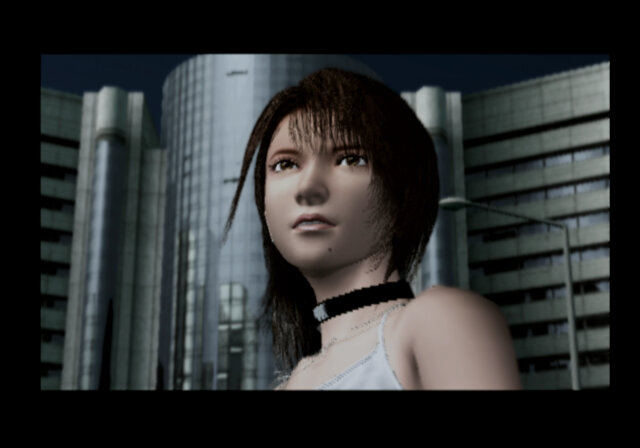
Ouch, you could cut yourself on those jaggies (look at the neck)
Oh and no Reiko, instead she was replaced by Ai Fukami (Fuck-a-me) who appears in the intro. Unlike the R4 intro, the cars don’t stop for Ai as they did for Reiko. https://www.youtube.com/watch?v=VhQhZyNKqhM
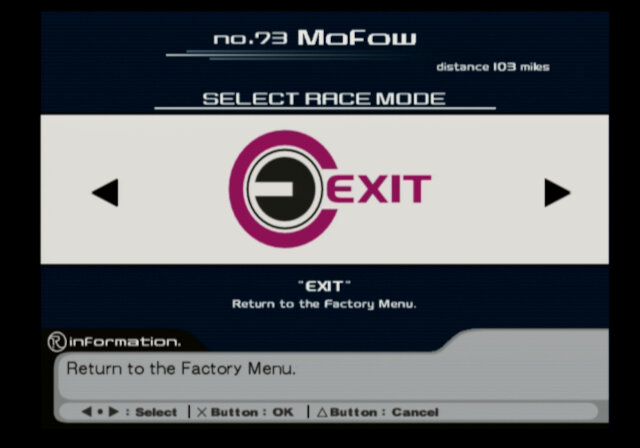
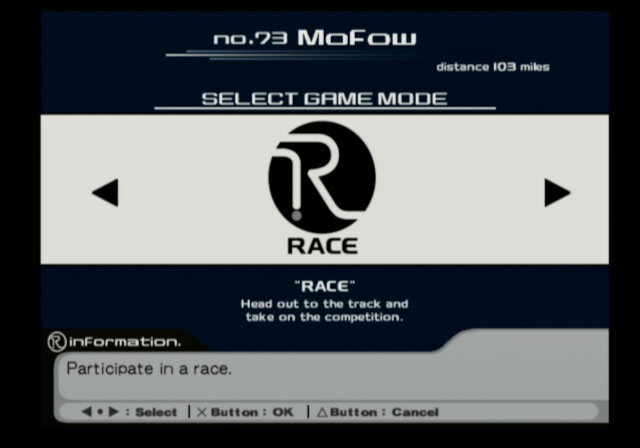
Straight away you will notice how sleek the menu and navigation system are compared to previous titles, borrowing design concepts from Tokyo Racer Drift which was released on the Dreamcast. Each menu selection plays its own quick animation which gives a nice touch to the game, and reminds me of the menu icons from the original WipEout that was created by the Designers Republic.
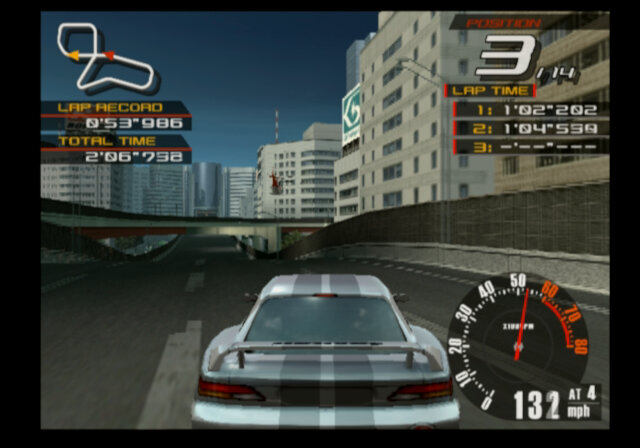
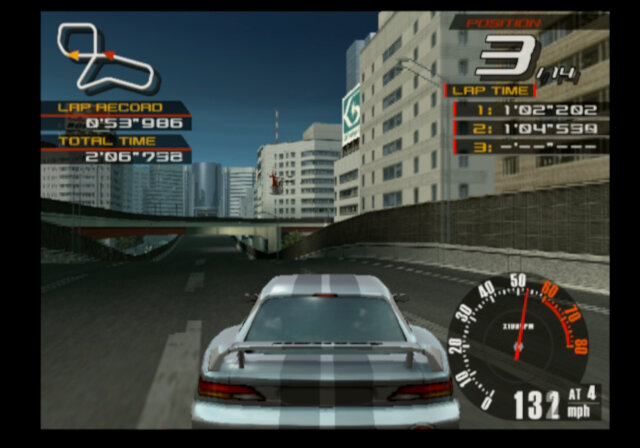
Whilst the game gives the appearance of reflections, they are not real-time but the game casts generic reflections of trees onto the car to simulate it. This is affected by your car’s position on the track, steer to the left and on the edge of the track and you can see the reflection of trees on your car, even if that part of the track has no trees at all. I guess real-time reflections were beyond the scope of the PS2 at the time of release, or Namco didn’t have enough time to implement this. Speaking of graphics, you will know how aliased the cars are in addition to the track objects. The PS2 had an unconventional form of AA which took developers some time to get used to and as a result, some games have bad aliasing due to how their field scanning is implemented, as the games run exclusively in interlaced mode. I’m not sure if later releases (Greatest Hits, Platinum in Europe) fix this, or if it’s fixed in the Arcade Battle version.
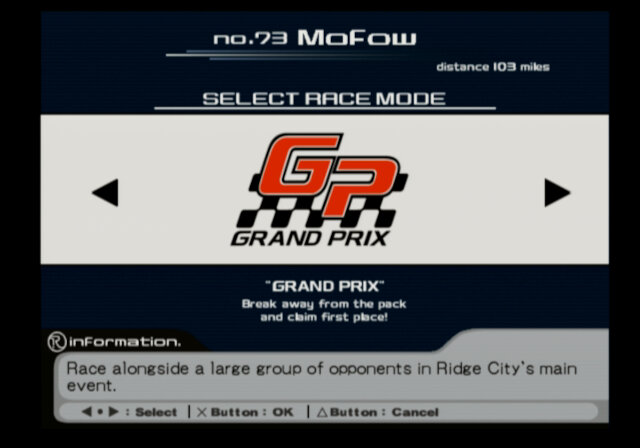
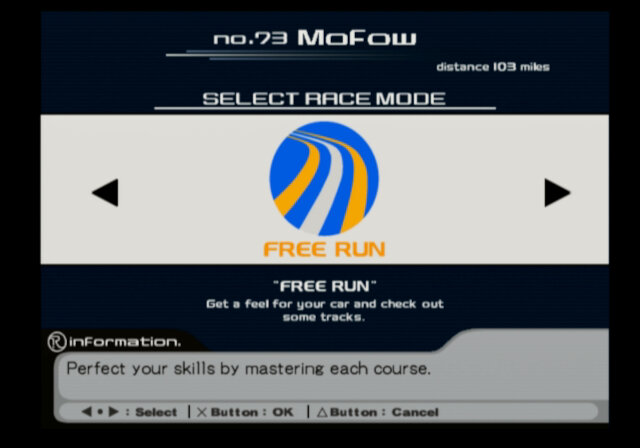
Race Modes
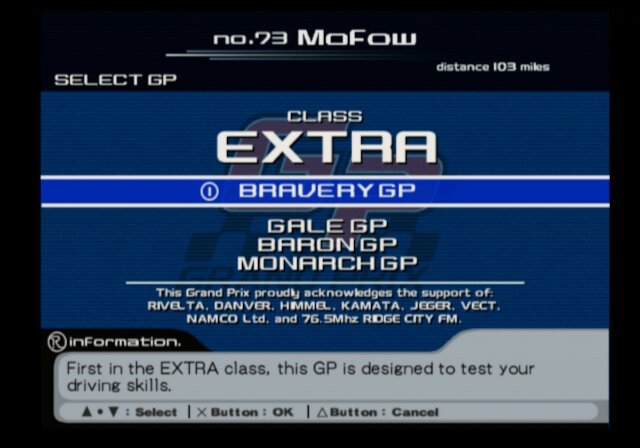
GP Selection Screen
Grand Prix
Like in R4, RRV features its own unique Grand Prix. This is a departure from one we saw in R4 with the four teams being missing along with their managers can choose your own team name and colour but that’s it. As for the cars, we have a choice of different car manufacturers and models, including Danver & Himmel. These are fictional brands that are used throughout the Ridge Racer, and possibly in Namco’s other games. Each car has its own unique stats, including top speed, acceleration, handling and control style (Grip or Drift).
Standard Basis GP: Consists of four rounds of different courses, at first you must place 4th or higher to progress to the next found, then 3rd, then 2nd and then 1st for the last race. Winning this GP will unlock a new car based on the machine you have chosen to race with which can then be used in the Extra GP’s. You will also win a trophy, which can be viewed later in the game. Alternatively known as Frontal GP in Normal difficulty and Fountain GP in Hard mode.
Extra Heroic GP: Tracks have been shuffled around, finish standings are the same as the basis GP, only you now race on the extra car you unlocked. Known as Bravely GP in normal, and Spartan GP on hard difficulty.
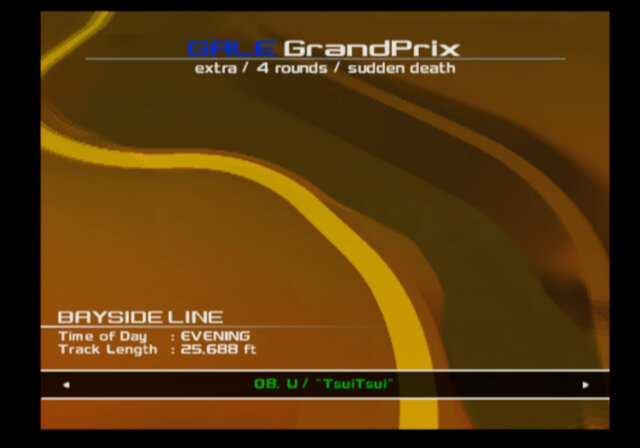
Extra Blast GP: This series uses a sudden death type of gameplay, where if the clock timer runs out, then you are ejected from the race. As you race you will pass through checkpoints which extend the time. If you are familiar with the arcade versions of Ridge racer this will seem familiar to you. For these races, you will still need to satisfy the qualifying rank to progress. Known as Gale Gp in normal, and Tornado GP on hard.
Extra Knight GP: These tracks are now completed in reverse mode. Also known as Balon GP on normal, and Duke GP on hard.
Extra Throne GP: You race on the airport oval track, with your car being equipped with an oval engine. This is a single long near-circle-shaped track similar to the Rage Racer tracks. Top speed is the priority here. Known as Monarch GP on normal and Tyrant GP on hard difficulty.
Maxim class: This is unlocked by beating the Tyrant GP on hard difficulty, which opens up the Ultimate GP.
Music track selection screen
Duel
Unlocked later in the game, it’s a 1 vs 1 mode against another opponent. When you beat them, you unlock their car which can then be used in the extra GP.
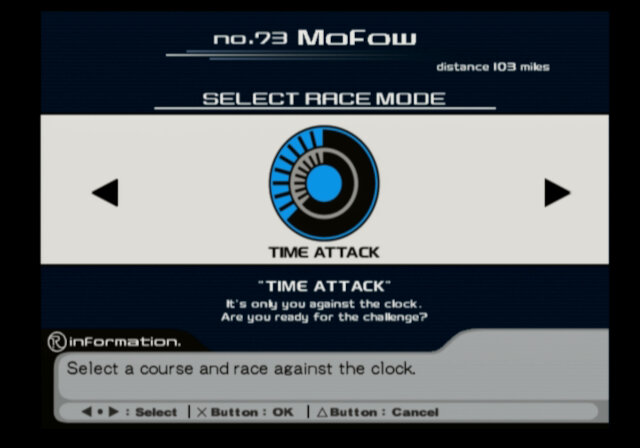
Time Attack
The goal here is to beat the rival times and come in first, which will unlock that rival for challenge dal. This will also increase your car standing number.
Car selection screen
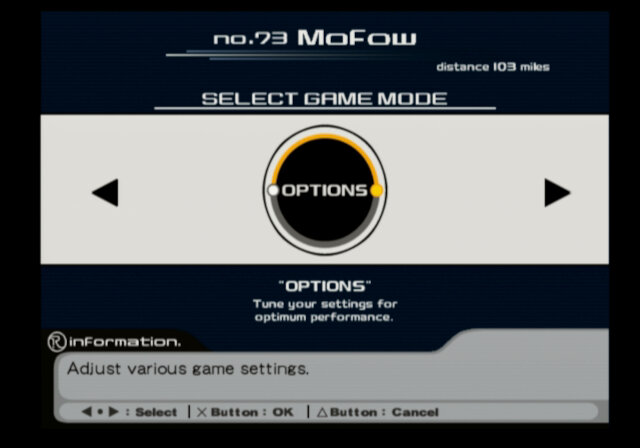
Other Modes
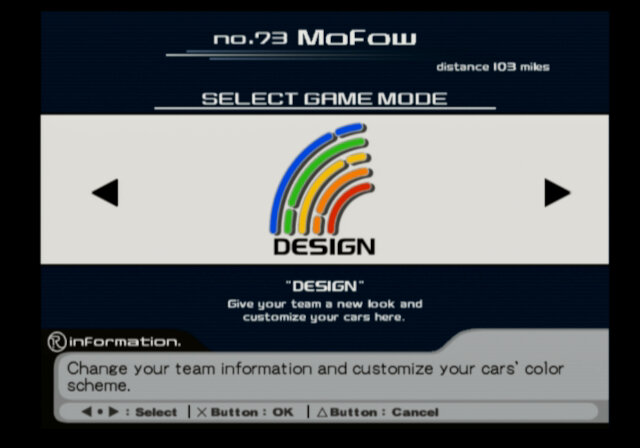
Design: Similar in concept to the decal feature in R4, you can customize the colour and patterns on your team’s car. Here you can only change the colour combinations.
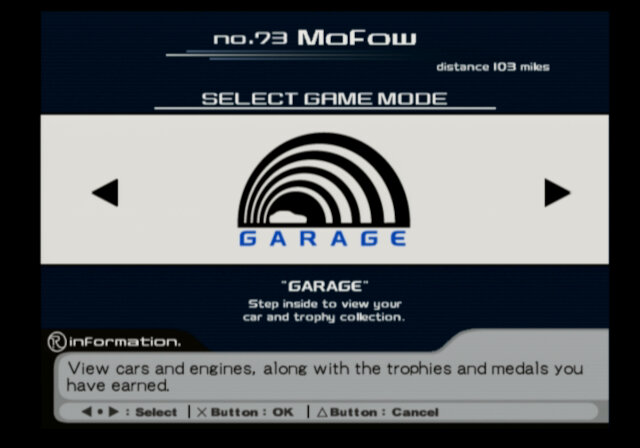
Garage: View cars that you have unlocked by winning the GP races with that car, along with any unlocked engines.
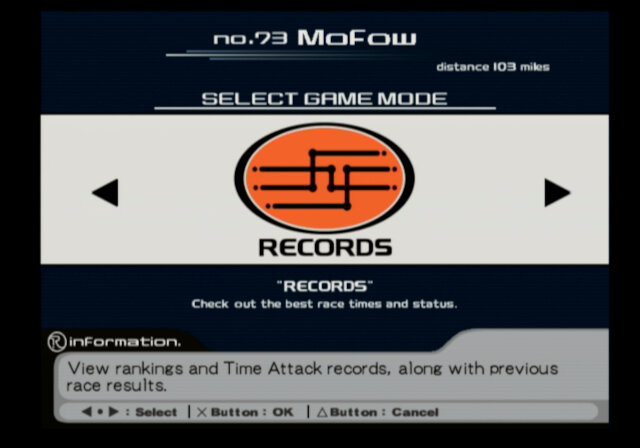
Records: Best lap times and the player names for time attack mode
Courses
In GP Mode, a quick tour of the race track is played
RRV included a brand new set of courses, most of which are based on the original course from the original Ridge Racer game, But these new courses are interlinked somewhat, with many taking place within Ridge City but branching out into different paths that take you into a different direction, with some leading you into the main downtown whilst others take you onto the highway. The tracks are fixed, it’s not an open world like Burnout paradise, instead different paths are blocked off depending on which track you select, very similar to how it functioned in Rage Racer and Ridge Racer Type 4. Speaking of which, none of the tracks featured in those games appear in Ridge Racer V, only the track from the first arcade game, or which many of the RRV tracks are based around.
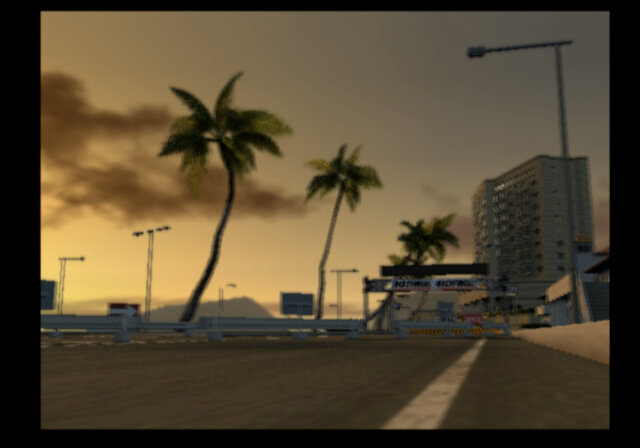
Despite this, you get a good feel of the Ridge Racer city, Some tracks can be raced at different times of day, such as Day, evening & night. Unlike the first Ridge racer game where the sun will set or rise during the race which results in a day/night cycle, The sky will remain constant through the race, giving the game a realistic passage of time. This is the case even with the 99 trial.
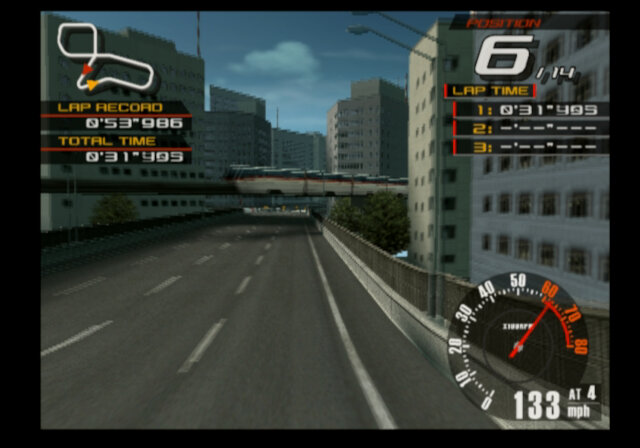
Park Town: Probably the first track in RRV you will race if you follow the Grand Prix, this starts off the same as Above The City but then branches out to a different track which gives an alternative view of Ridge City, of which the scenery consists of high-rise building. A tram/monorail system can be seen in some parts of the track.
Outer Pass: This track looks a lot like the original track from Ridge Racer judging from the course map, but it’s set using the background roads that we can finally race in. It starts off on the bottom road where you can see the onpass ramp for Park Town and Sunny Beech before it leads to its own side of the tunnel. Towards the end it branches back to the original track before diverting back to its own path. A few sharp turns make this track more challenging and there’s an extra turn where the seaside part is.
Above the City: Starts off the same as park town but branches to its own path, again filled with buildings and highways, although there are a few parts of open grass and trees, it’s clear there’s less scenery diversity than in R4.
Bayside Line: One of the longest tracks in the game, complete with sharp turns. This one takes you out near the highway and then branches back to the start of Outer Pass.
Greenfield: The advanced track from the original Ridge Racer, now updated with modern visuals.
Sunny Beach: It’s the original track that we all know and love, only now its been modernized 7 years later, and has been remastered of sorts. Compared to the original there’s been a few changes with different skyscrapers and building placement, and minor changes to the shops opposite the beach area where the first checkpoint resides. Sadly the Pac-Man easter egg no longer appears in the building at night.
Airport Oval: Unlike other tracks, this one takes place independent of the other tracks, it’s a large oval-shaped track designed for top speeds, although there is a sharp turn that will require a drift, depending on your car. Since the other tracks feature low-flying airplanes, it can be assumed this is the Ridge City airport.
Additional Notes
This is one of the games that insist on funning in 480i mode (or 440i mode, PS2 games use this weird resolution) and trying to force it to 480p using GSMode results in only half the screen being rendered, as such there is no official way to run this game in progressive mode. It’s a shame because this game has some bad aliasing, and could benefit better from progressive scan. Even the lap timer suffers from noticeable interlacing effects.
The game does not fare better with emulation either, with various texture and shading issues in PCSX2, and even had issues running in Sony’s official PS2 emulators on the PS3 and PS4. Supposedly this is due to how Namco implemented the texturing and shading for these games: https://github.com/PCSX2/pcsx2/issues/2427#issuecomment-590020696 https://github.com/PCSX2/pcsx2/issues/3278 The intro sequence is also messed up and requires switching between hardware and software rendering modes in order to display.
Saving to a memory card larger than 8MB may take a while to read and write. With a 128Mb card it took a minute to save the game. I’m not sure if replacing the MCM IOP driver could help with this, or just break/corrupt the file entirely.
Conclusion
Whilst in some regard it’s a step back from Ridge Race Type 4 with the reduction of cars, tracks and the story mode, you have to take in mind the game was possibly developed in a short timeframe that R4 had, and Namco’s desire to have is a launch title for the PS2, the 1999 copyright date is very telling of this and one of the few games on the PS2 to have this copyright date. As a launch title it makes a huge splash with its high resolution, 60fps gameplay, and the intro sequence with Ai, possibly the highest poly model on the PS2. But this would be the only installment of Ridge Racer for the PlayStation 2 whilst the original PlayStation enjoy four mainline Ridge Racer titles, the PS2 would only have RRV and R: Racing Evolution which is more of a spinoff rather than a follow-up game. It wouldn’t be until 2004 that a proper followup to Ridge Racer would be released for the PlayStation Portable. And even then, it’s considered a compilation game rather than a true sequel. Ridge Racer 6 for the Xbox 360 would be the proper sequel with unique tracks. As for why only one title? Possibly due to higher budgets required for PS2 development and the popularity of sim racing games like Gran Turismo. Hopefully we get another proper Ridge Racer titles from Namco at some point in the future.




























 Drew1440: Blog