Tag Archives: Namco System 11

Tekken 2

The sequel to the first Tekken game, released for arcades and was ported to the Sony PlayStation and eventually the Zeebo console

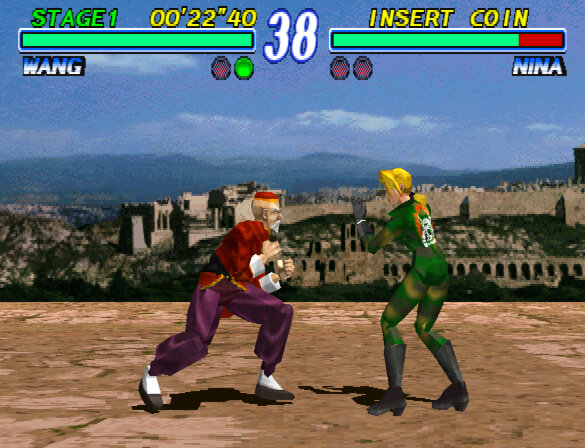
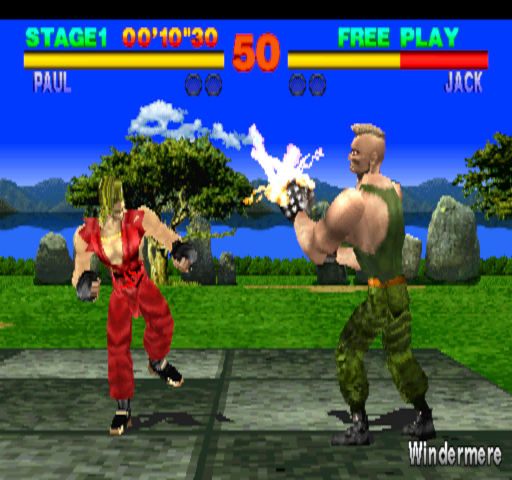
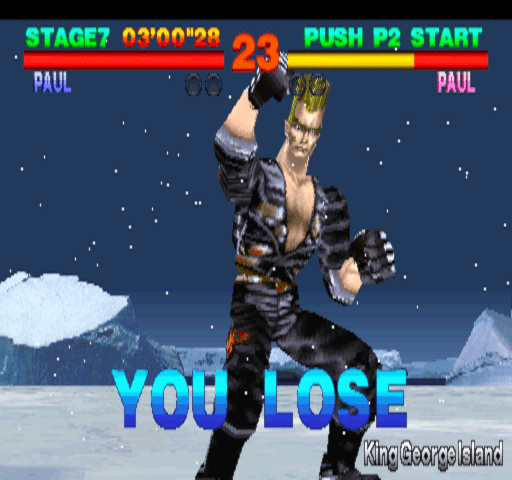
A lot of improvements have been made, with the graphics for the character models being improved and refinements to the character move-sets. The stage background have also been redesigned, featuring more detailed backdrops. Unlike the first Tekken, the stages don’t seem to be based off a specific location and the stage name no longer appears in the bottom right corner, rather they are inspired by a series of locations, e.g Jun’s stage is inspired by a European countryside, Lei is based off being at the top of a city skyscraper (Similar to Joe’s stage in Last Bronx) and King’s stage being set in a Church.

A removed feature is the view change option, In the first Tekken game you could change the viewing angle in the first 10 seconds of the match, now only one view is available in Tekken 2.

Characters

  • Lei: Jackie-Chan inspired cop, Namco forgot to give him a Time Crisis game
  • Jun: Greenpeace activist, and the only mainstream game she appears in (Also appears in the Tag Tournament spin offs)
  • Jack-2: Jack with with a upgraded processor
  • Baek: Tae Kwon Do fighter, similar to Hworang
  • Bruce: Muay Thai kickboxer
  • Roger: / Alex: Genetically altered animals who are capable of fighting
  • Angel: A literal Angel sent to save Kazuya’s soul

Most of the previous characters return from the previous game, except for the mysterious WildCard

Heiachi finding out he’s no longer the final boss

Arcade Version

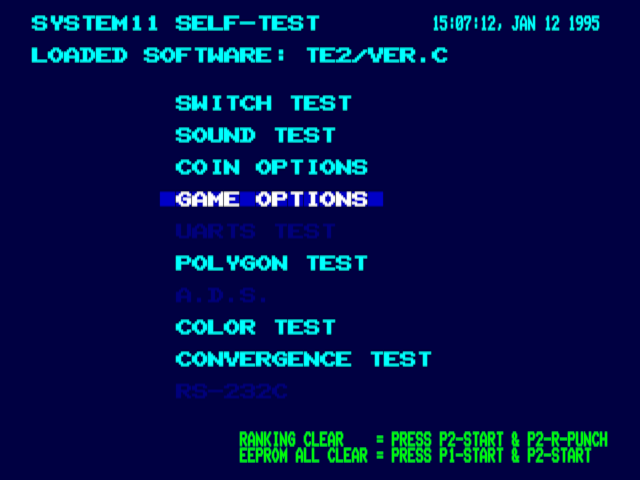
Released in 1995 for the arcade and running on the same System 11 arcade platform as the previous game which allowed for operators to upgrade their machines by swapping out the ROM board.

There are a few versions of the arcade version, the original released and a Ver.B update that has a few game-play changes in regards to the AI behaviour. The title screen has also been amended indicating the new release.

MAME is able to run both versions of the game without any issues, although it has the imperfect graphics flag set. Zinc, a high level System 11 emulator is also capable of emulating Tekken 2, but was last updated in 2005 and its plugins are very outdated but they do enable bilinear filtering and upscaling.

Namco would later port this version to the PS2 with the release of Tekken 5, along with Tekken 1 & 3. This is not a direct port as some changes have been made. The audio from the PSone versions have been used since Namco System 11 uses its own custom sound hardware that the PS2 does not emulate. I’m also not sure if these games run on the PS2 I/O CPU, tapping into its native backwards compatibility or if Namco ported these games onto the PS2 Emotion Engine.

Zinc emulator

The Zinc emulator can be configured to apply texture filtering to reduce the blocky artifacts and enhance the overall image quality, resolution can also be increased too.

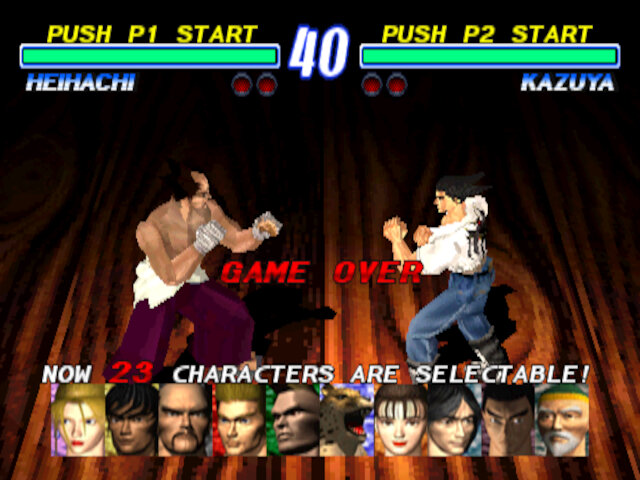
Unfortunatly where the Zinc emulator falls short is the emulation itself, suffering from various sound issues due to lack of mature Namco sound emulation. As such the music sounds out of tune and many sound elements are missing.

PlayStation

The game was ported to the PlayStation with some additional features added. The soundtrack was also revised with an arranged remix making used of the PlayStations CD audio, the arcade original music also exists and can be selected by the user.

Like the first Tekken home port, FMV endings have been added for each characters that details their backstory. Namco expanded these to have their own soundtrack, compared tot he first game where every characters would have the same music playing over the FMV.

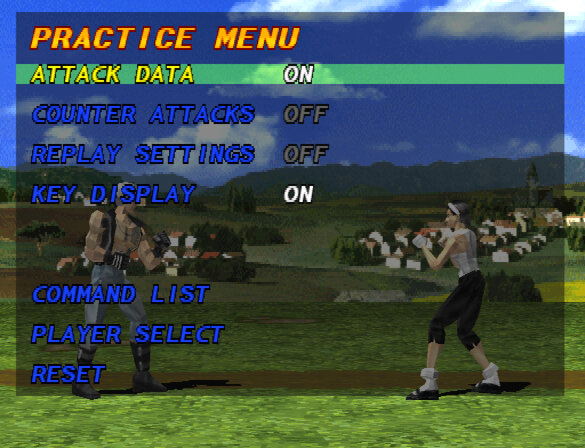
Additional game modes have been added such as survival, training and team battle mode. Also, when pausing the game you can view the character move and command sets. These would also be carried over to future home releases of Tekken games.

Most emulators wont encounter any issues playing Tekken 2, but there are a few issues with PXGP being added. Polygons have a tendency to warp with this enabled, and the character portraits can go off model.

Zeebo

The game was ported to the Zeebo console in 2008 and was similar to the PlayStation version but with slightly improved graphics. The textures appear to be cleaned up from the PlayStation version with some filtering enabled. The music however was butchered beyond repair due to the limited ROM sizes of the game. Zeebo games were distributed over the mobile network using UMTS, which meant games had to be of a certain size in order for them to be downloaded quickly which limited the music of these game to polyphonic like sounds.

I’m also not aware of any emulators or known dumps of this version, so the only footage exists that was uploaded on Youtube.

.

Tekken

The game that put the PlayStation on the map for fighting games.

Select Screen, with the mysterious Wild Card fighter

Plot

So the backstory is, Heihachi Michima throws his kid (Kazuya) off a volcano as a test to see his sons strength as a test to see if he is a worthy successor for the Mishima Ziabatsu corporation. Kazaya (who is 5 years old at the time) nearly dies but makes a deal with the devil. He swears revenge on Hitachi for throwing him off the volcano and enters the iron fist tournament. Clearly this family feud was beyond Jerry Springer…
There also a bunch of other fighters who enter the tournament for money or to prove themselves, including a robot and a bear.

Gameplay

Each character corresponds to the face buttons on the PlayStation controller, with two buttons being assigned to the left/right hands of the playable character, with the X and O buttons for the left/right which can be used to issue kicks to the opponent. Guarding is done by holding the left, or right depending on where your character is facing the opponent. Some moves cannot be guarded against.

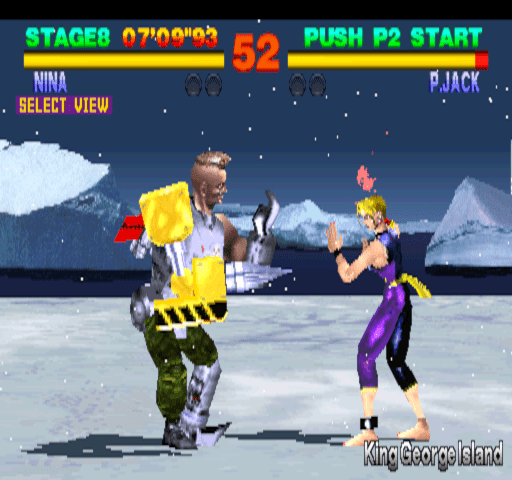
During the first 9 seconds of the fight, you can press the select button to switch between different views (1P Start on the Arcade version)

Arcade mode consists of nine stages, for the first seven stages these are opponents picked at random, on the eighth round you will fight against a rival, depending on the character chosen. The 9th round puts you against Heihachi, and after winning the match the end credits will play. The arcade version runs through a montage of KO replays for each round, whereas the home version will show the characters ending FMV.


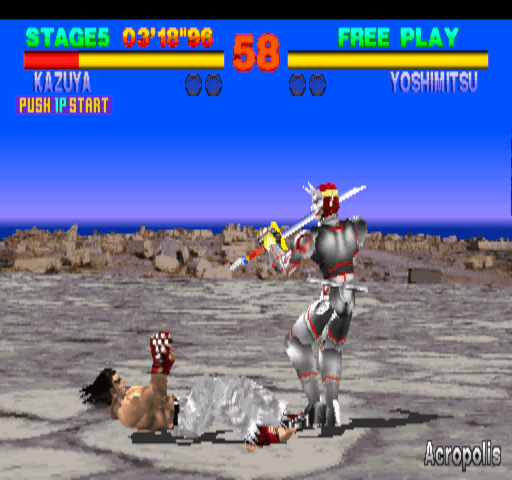
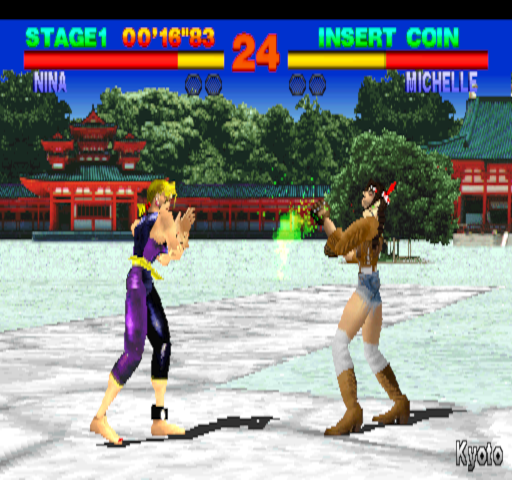
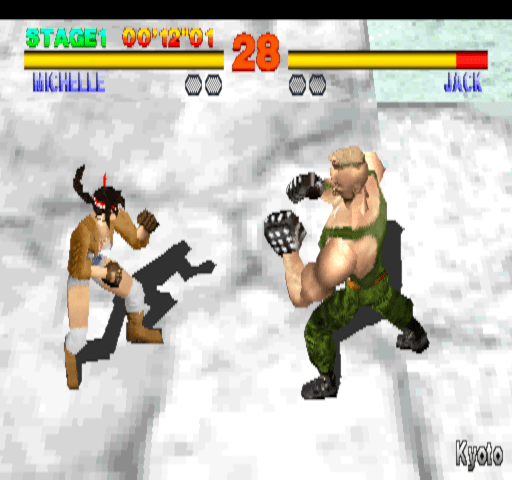
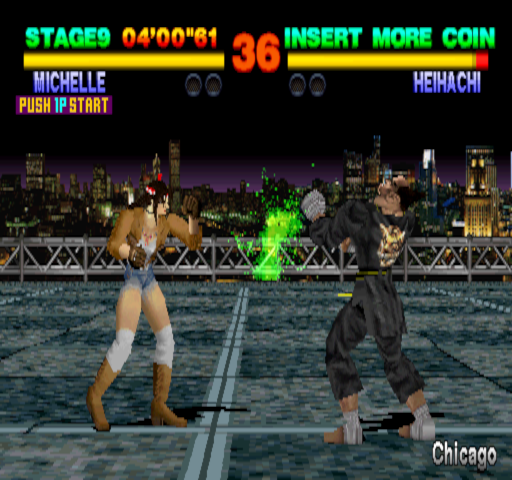
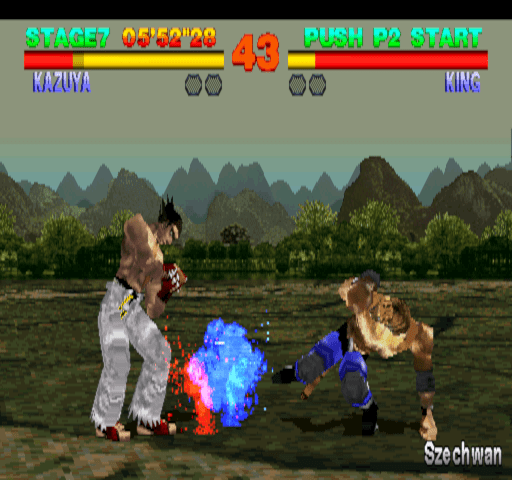
Tekken featured different fighting game stages that are based on different real world locations, and each location has their own background theme.

Characters

Nina Williams: An assassin. Rival is sister Anna Williams
• Michelle Chang
Paul Phoenix: A biker who has a killer fist, also a judo expert
Wang Jinrei: Standard old guy who is an expert in Marshall arts
Yoshimitsu: The Ninja
Prototype Jack: A robot who is slightly altered from the regular Jack
Marshall Law: Bruce Lee who can’t keep his mouth closed
Lee Chaolan: Step-brother to Kazuya
Kunimitsu: A kleptomaniac Ninja, rival to Michelle who she stole a pendant from
Kuma: A bear
King: Mexican Catholic wrestler who has a head of a Lion/Tiger for a mask
Kazuya Mishima: Seeks revenge against his dad for throwing him off a volcano,
Jack: A robot cyborg
Anna Williams: Sister to Nina Williams
Armour King: Rival of King
Ganryu: Plus sized Sumo wrestler
Heihachi Mishima: The final boss of the game

All characters have an alternative costume that can be selected by pressing Triangle/Square, instead of X or O. There is also Devil, who is Kazuya but serves as the final boss of the game. He can be unlocked and become playable character by completing the Galaga mini-game at the start with a perfect score.

There is also an unused charicter that exists, known as Wildcard. Believed to be Kazuya’s long lost twin, he grew up and was raised by Yoshimitsu who adopted him into the Manji clan where he learnt how to fight. He entered the iron fist tournament to reunite with his family, but after learning of the devil gene and Kazuya’s heart of darkness, Wildcard left and was never to be seen again.

Versions

Arcade: The arcade version runs on the PlayStation based Namco System 11 board, which is very similar but with a different sound processor, the Namco C76 and C352 which was also used on their System 22 arcade board. This version only allows a limited amount of characters to be selected and playable compared to the home PlayStation release.

PlayStation: Released 1 year after the launch of the PlayStation, this version included FMV based endings for each of the character which explains the back story. Like other Tekken games, the home version has a revised soundtrack, but has the option for the arcade original soundtrack also.
The home release of Tekken 5 features an arcade version of the first Tekken game, which looks and play exactly like the actual arcade release, no improved textures or effects. I’m not sure if these are ports for the PS2 hardware or if they’re tapping into the PS2 PlayStation backwards compatibility.

Other Differences

The only other noticeable difference is the question mark animation spins on the arcades character select screen, whilst it is static on the home release. An animation also plays when a character is selected on the arcade, but does not display on the PlayStation.
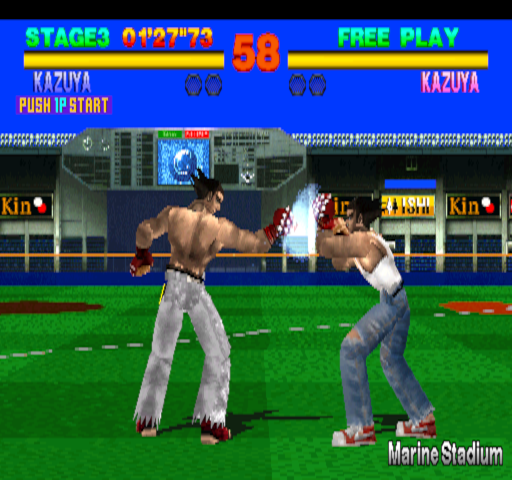
On the stadium stage, a screen can be seen in the background that shows a copy of both characters fighting, the arcade has a static texture in place of this. The stage name is also different, referred to as Marine Stadium in the arcade, and Stadium in the console version.


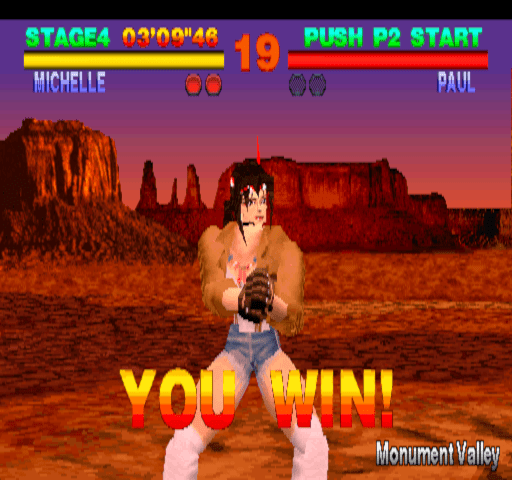
In Monument Valley, the sun sets in very round for the arcade version, but in the console version the sun sets only one, and stays down for each round

These differences may be due to the arcade version having a larger amount of VRAAM compared to the PlayStation version, 2MB vs 1MB. However the main system RAM remains the same (2MB), along with the main CPU and the GTE (33.8Mhz, although MAME shows this to run at 67Mhz since the PSX CPU divide the incoming clock signal by half, so its still running at 33.8)

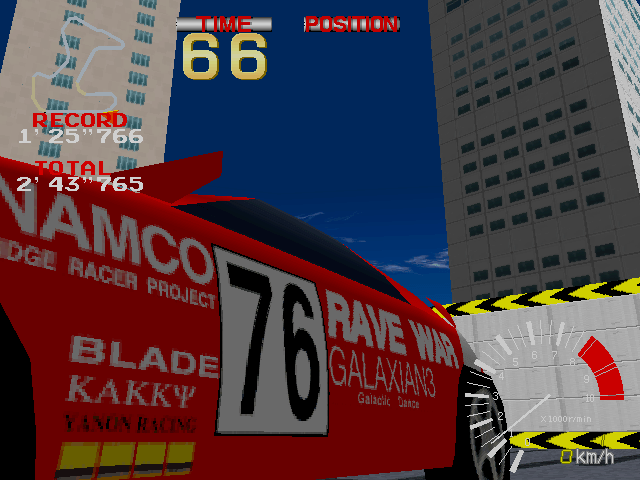
Originally Tekken was known as RAVE WAR which appears on a couple of Ridge Racer cars on both the arcade and PlayStation. Also to note the game was originally in development for Namco System 22, which Ridge Racer and Time Crisis had run on.

Rave War – Unseen64