Released for both Mac and PC in 1997, Virtual Springfield puts you directly into Springfield where you can freely explore the Simpsons town, Springfield. Whilst promoted as being a 3D game, it’s actually 2D with a 3D-based perspective, using an engine built by Vortex Media Arts. This isn’t the first Simpsons game released, with previous titles being released on the NES and the Sega MegaDrive, and it wouldn’t be the last either.
Launcher where you can start the game
This game was an interesting look at Springfield since in the show, whilst there was never any continuity of the town itself, buildings would come and go and the layout of the town never remained consistent, not helping was the change of animation studio from the first few seasons. Still, a lot of references to the early seasons of the show are present.
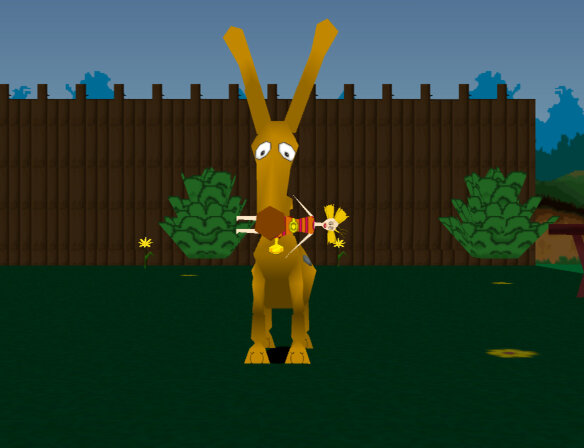
Marge cooking the cat
The main object of the game is to collect all 74 of collector cards, which are hidden across 17 different locations. Some locations are locked and can be unlocked by collecting specific items. The game’s HUD is designed around the player wearing a VR headset and using it to navigate Springfield.
The game runs slowly on PCem when running it directly from the CD-ROM (being played from an external Blu-ray drive) so it’s usually based to create an iso image of the game, then mounting it into PCem. (Update: It seems that I had set the CD-ROM speed in PCem to 4x, which wasn’t fast enough for the game, since increasing it to 16x the stuttering issues have reduced, but you still get the odd delay, defiantly dump to BIN/CUE when running in PCem)
The game is navigated using a point-and-click approach, moving your mouse cursor to a specific area lets you either select or interact with an object or if it turns to an arrow, lets you move in that direction. If the game is left idle, random animations are played out.
Milhouse had a growth spurt
Some buildings (Like the Simpsons house) can be entered some have multiple rooms that can be navigated through. Some rooms/buildings are blocked and require an item to be in the inventory before it can be accessed, these can be obtained by picking up the item by clicking on it.
Who shot Mr. Burns – Part 3Aye CarambaRIP Krusty
It’s not really a game in the traditional sense, there’s no fail state or any challenge, except for collecting cards. It’s more of an application like the previous Simpsons Cartoon Studio. Nowadays you could probably build the same game within a modern browser, like Bing maps but for the Simpsons universe, and maybe leverage a VR headset for full immersion.
Sappy and Pelma
Being a long-time fan of the show (For seasons 1-9) and an obvious target for this product, my only gripe is that there weren’t more things to interact with per location. Sure the game will have a limited scope, imposed by the technology of the time.
There are the occasional mini-games featured in the Noiseland Arcade, but certainly more activities like this could have been sprinkled into the game.
Thought this was a banjo at first
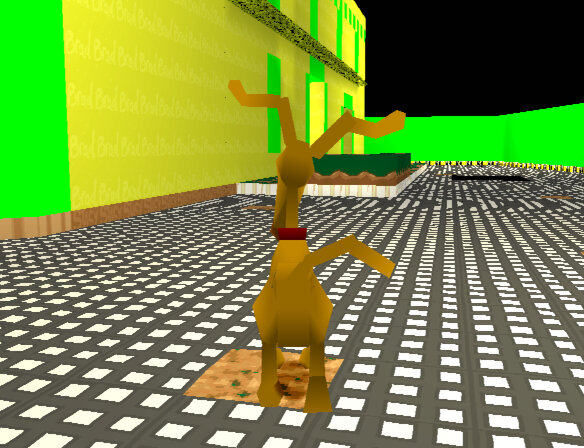
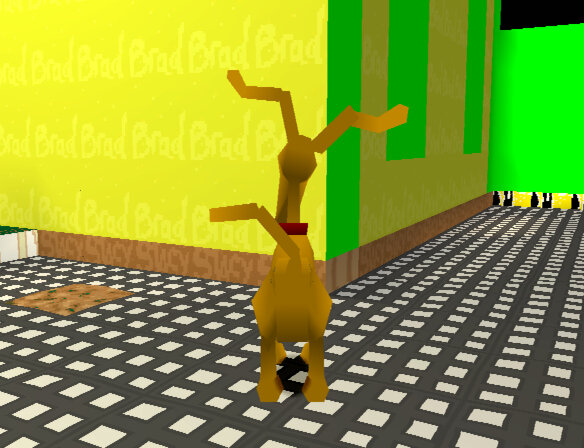
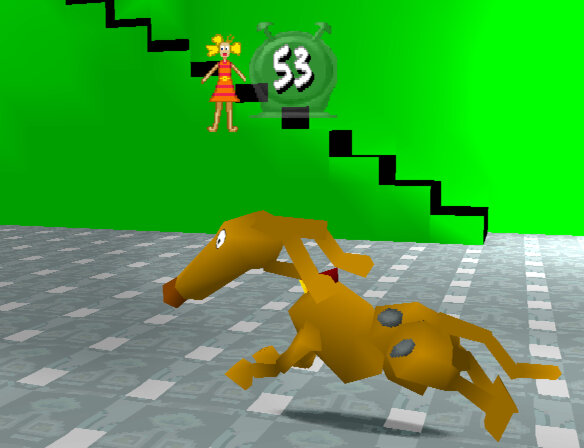
Quite a few locations are missing like the Springfield dog track where they adopted Santa’s little helper, Krusty Burger (appears in-game but cannot be entered), Department of Motor Vehicles, Police Station (again cannot be entered)
Macintosh
Virtual Springfield uses a hybrid disc that allows the PC copy of the game to run on a Macintosh system. To get the game up and running, you simply insert the CD into the Mac and click on the Virtual Springfield icon on the desktop, the game will launch, providing you set the colour depth to 256 colours. No installation is required.
The game will run on a G4 PowerPC-based Mac, running on OS 9.2.2, but you must change the display colour depth to 256 colours, otherwise, the game will crash the system upon startup. Virtual Springfield will not change the display automatically. It also works by changing the resolution to 640×480 since the game will not scale for a higher resolution, resulting in the game being displayed in the center of the screen with black borders around, if run at a higher resolution. What annoys me is the game does not give an error message informing you of this, just crashes the Mac instead.
The classic environment on Mac OS X does not seem capable of playing the game, this was tested on both OS X Jaguar and Panther classic modes.
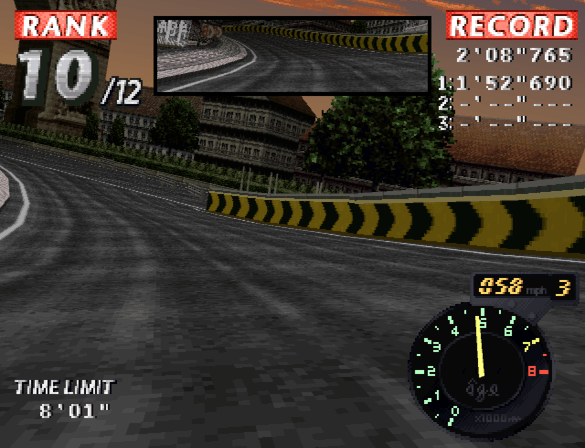
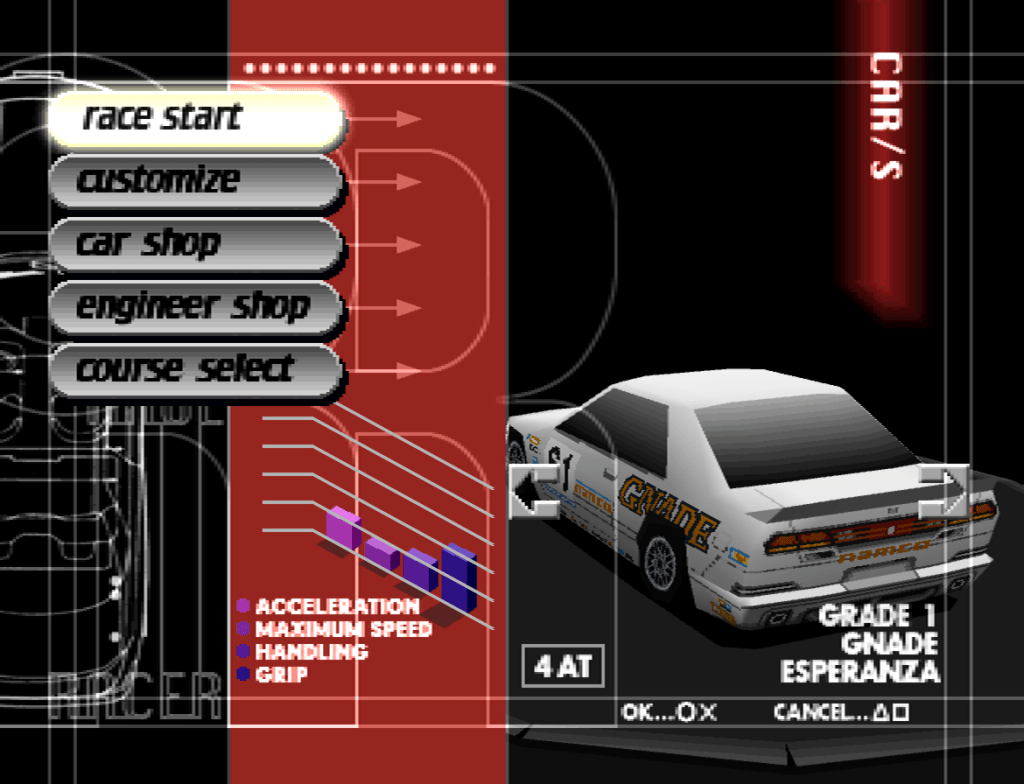
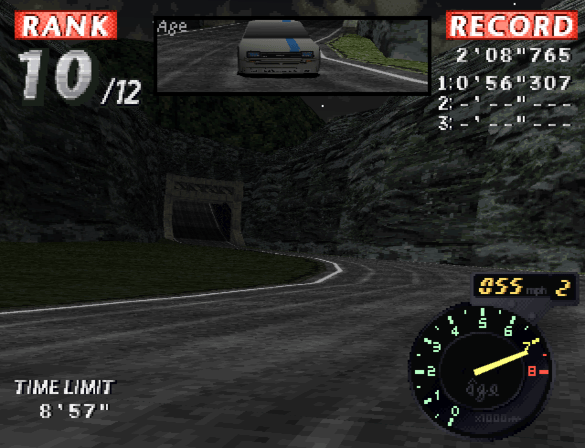
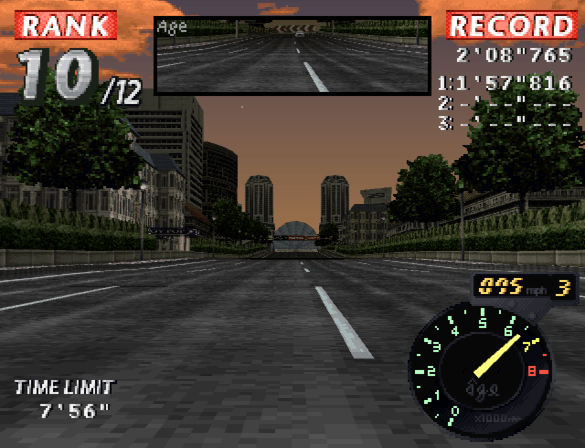
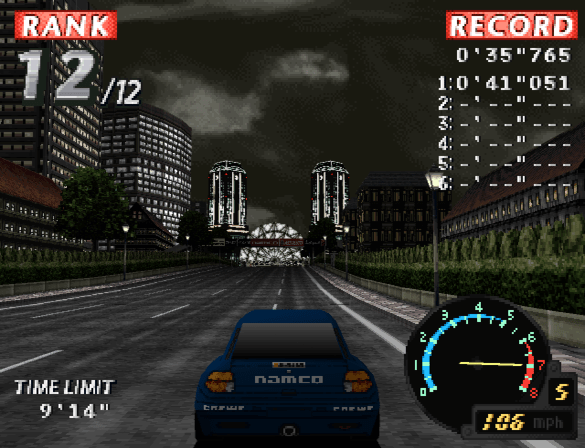
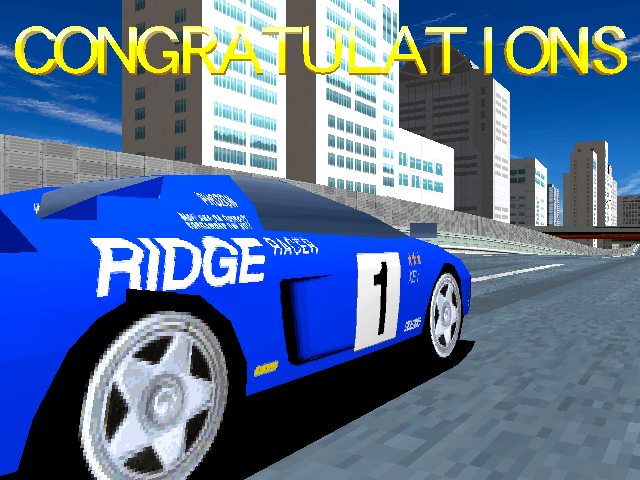
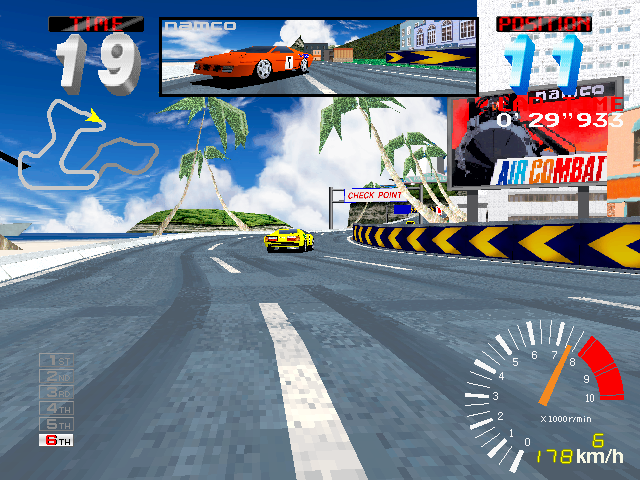
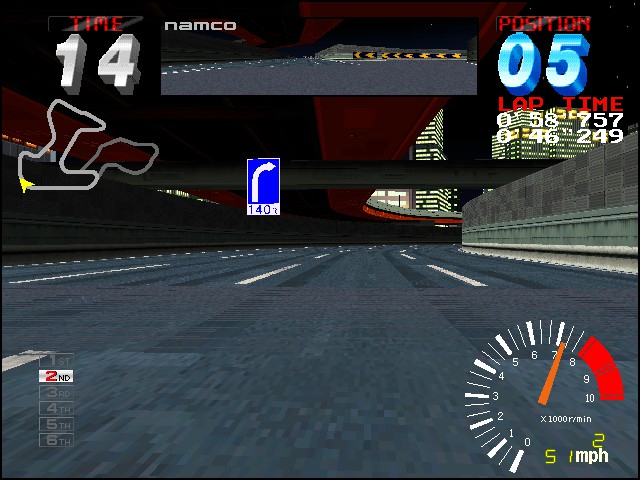
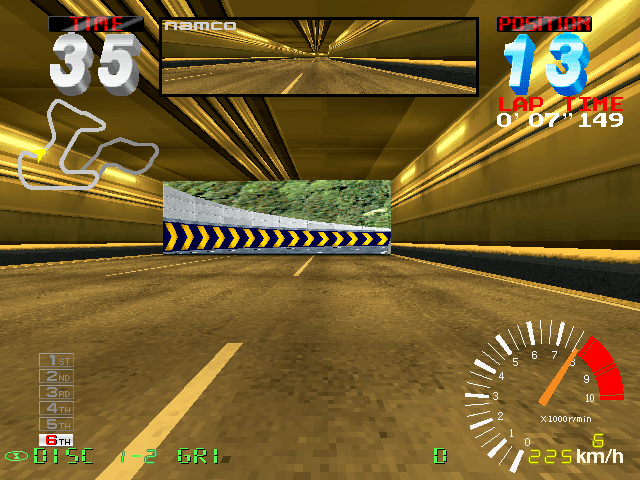
The third console instalment of the Ridge Racer series. This sets on a more darker tone, with more realistic looking graphics and a completely revised soundtrack inspired by industrial drum and bass.
Grand Prix
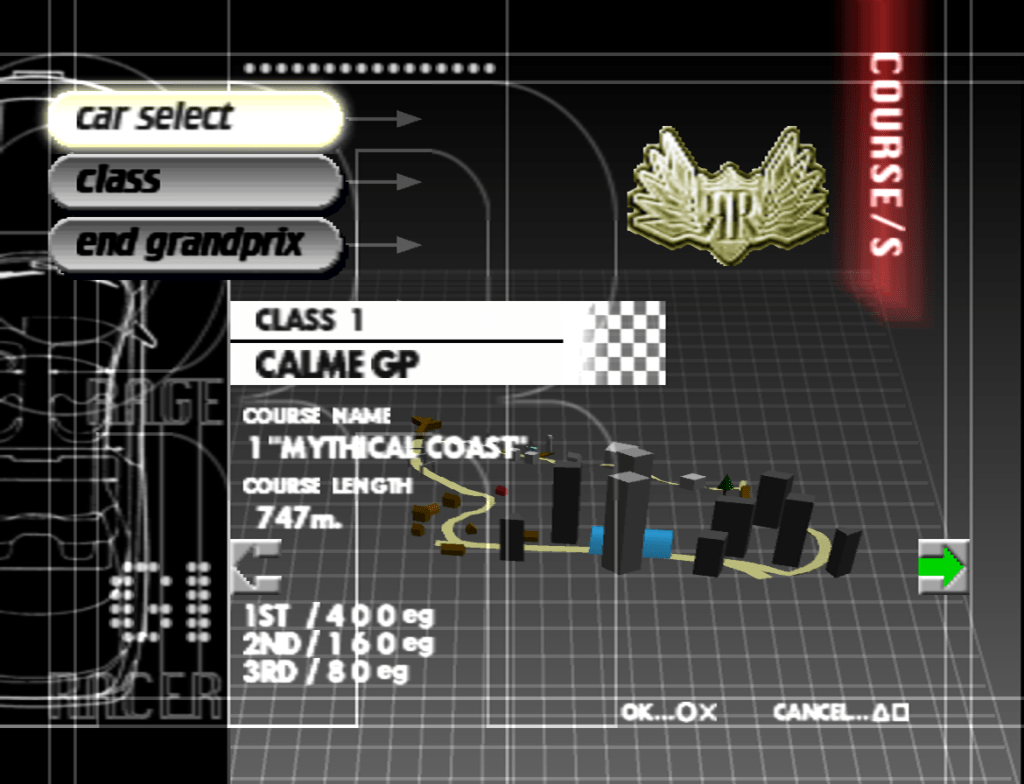
The main game mode where you complete a series of races. Like the previous game you start in bottom place and have to finish in third place or higher against the computer controlled cars. There are five classes in total with a bonus sixth class and an extra GP, which is unlocked by completing the main GP mode.
Medals are awarded depending on what place you finish in. As you play the game you will need to replay a few of the races to build up your credit in order to purchase new vehicles, as you move up the GP class the competitors cars also get faster
Unlike the previous games in the Ridge Racer series, cars are handled differently with you only starting from one car, instead of four being available. When more races are completed, credit are awarded which allow you to spend them on buying new cars or upgrading your existing car, which will be required in order for you to progress though the next class of GP. Different cars have different specifications, with some having better handling, acceleration or top speed. Some of the later cars are in manual transmission only which requires you to manually change and shift gears.
The Grand Prix mechanic would be expanded heavily in it’s successor – Ridge Racer Type 4.
Time Attack
The mode that no one ever uses, here you get access to the fastest models of the cards with the goal of having the fastest time.
Tracks
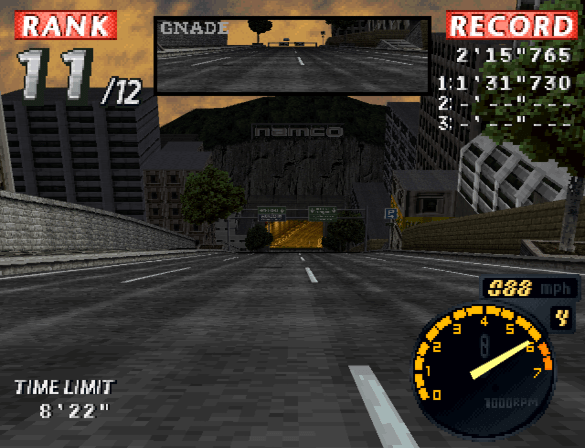
Like the previous Ridge Racer PlayStation games, they all use the same track with some variations in them, Rage Racer is no exception as all tracks have the same starting area but then branch off into different sections and bends, which then combine back together at the end of the lap. This gives the premise of the tracks being set in the same urban city or a town.
The tracks follow a specific design and were designed around the PlayStation’s limitations, as most tracks feature bends that obscure the environmental view as to prevent pop in and to keep the game running at 30fps. Slope and hills are also used to this effect and are incorporated as a game mechanic as for manual transmission vehicles you have to drop down a gear in order to maintain your speed. All of this was used in the next Ridge Racer Game (Type 4) to greater effect and shows how Namco was able to make the most out of the PlayStation hardware which was becoming mainstream at this point.
The environments themselves feature a European look judging from the building design, and some Greek style columns can be seen with the first track, which contrasts from the Japanese look of the city in the first game.
However the quantity of the tracks is part of the games downfall, with it recycling the same tracks as reversed and mirrored. It would have been nice to race on the original tracks from Ridge Racer and Revolution, or include the Rave Racer tracks which was already released to the arcades by the time Rave Racer came out. The fact that most tracks are reused limits the variety and questions the value of the game, eventually you are going to get bored of these tracks. It’s even worse when you compare it to the Rush and Crusin series of game which feature way more tracks that are independent from each other.
Mystical Coast: The started course for the game, driving past the waterfall into the tunnel, then pass down onto the coast area with Spanish/meddidertain style housing and then into some ruins until you reach a tunnel that takes you back to the starting line
Over Pass City: starts the name as Mystical Coast where you pass the waterfall but the tunnel takes a different direction into the main city, here there are very steep hills past the tram and steep curves as you return to the starting line. This is the longest course in the game.
Lakeside Gate: Tricky since there are a lot of sharp turns where you need to drift sharply. Reaching top speed isn’t much of an issue here but having a car that you can control well is necessary. There’s a lot of tunnels and cave/hill like scenery when then proceeds into a rural area with some open scenery.
The Extreme Oval: A simple track designed for cars to reach their top speeds, but has one sharp turn within a tunnel.
Music
As someone who regularly listens to drum and bass, the music in Rage Racer was a pleasure to listen to with many songs taking inspiration from the industrial rock and break beat samples of the era. With many tracks being inspired by popular tracks of the era. They are also similar to music that was used in Namco’s other games, like in Tekken.
Conclusion
As a Ridge Racer game it takes the series into a more serious setting with its GP/credit based mechanic and its realistic art style but as a racing game it falls short due to lack of content, especially with the amount of tracks.
The game as not been released on any digital platforms, which is odd since this is an entirely Namco game that does not feature any licensed cards or music.
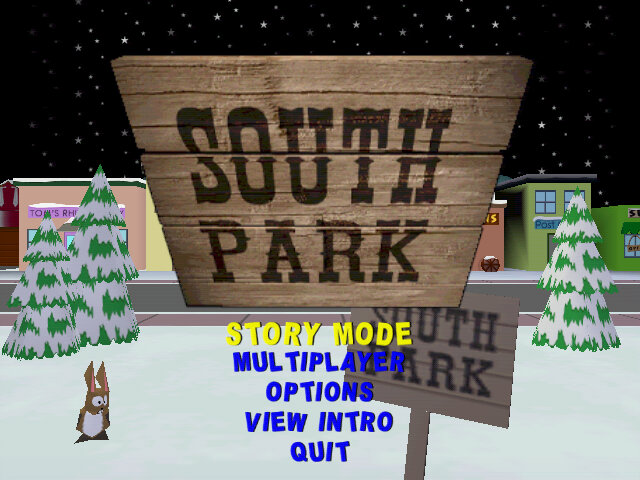
The game based on the popular TV show, came out very early in the shows life, along with a hit number 1 single
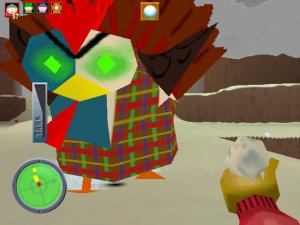
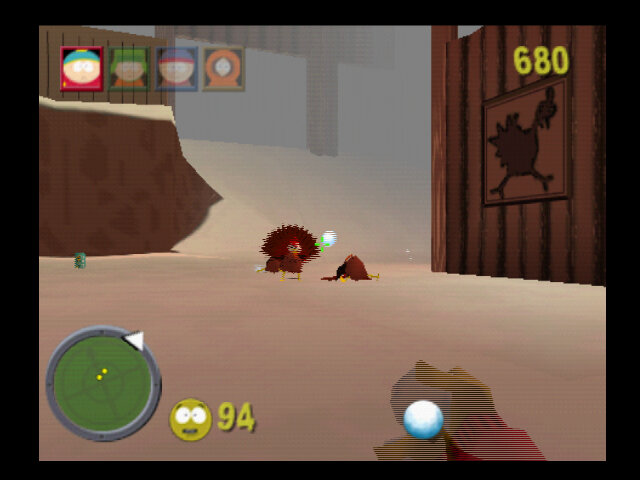
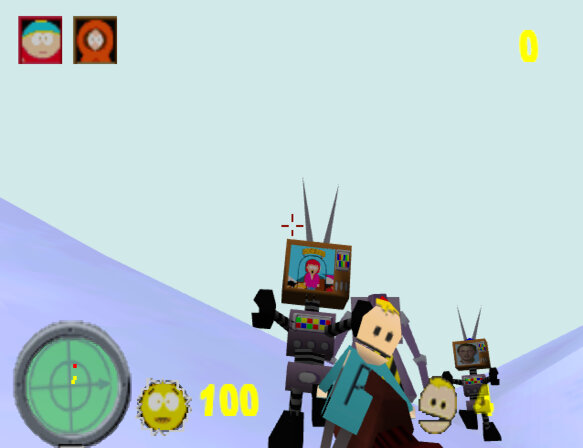
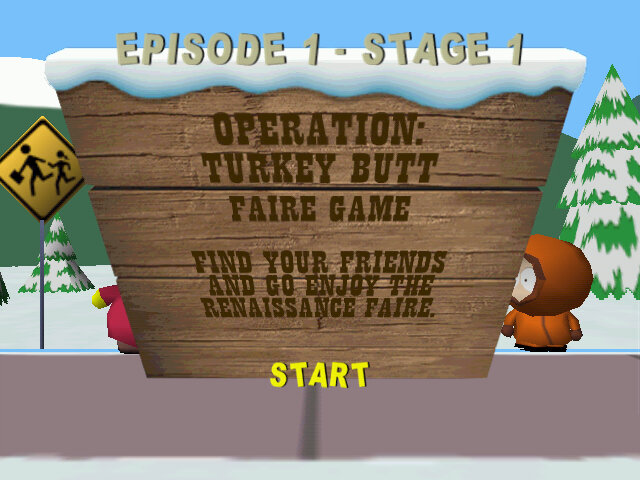
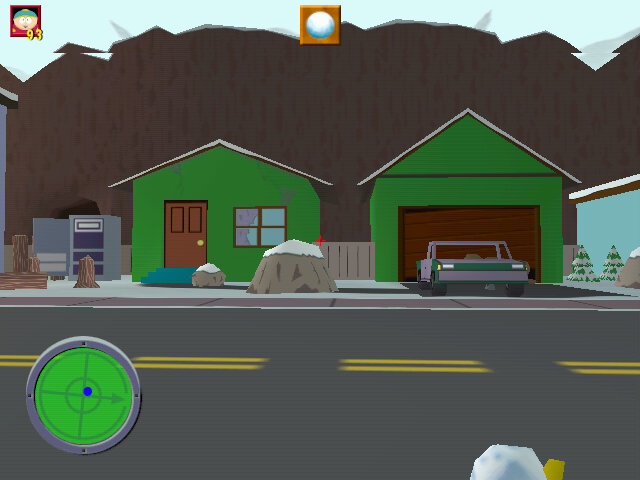
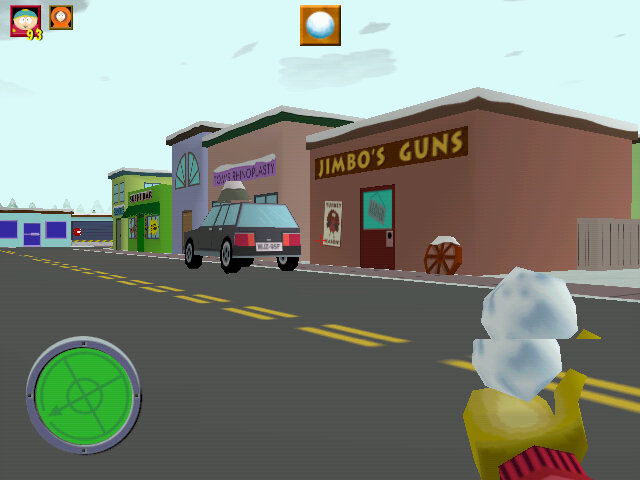
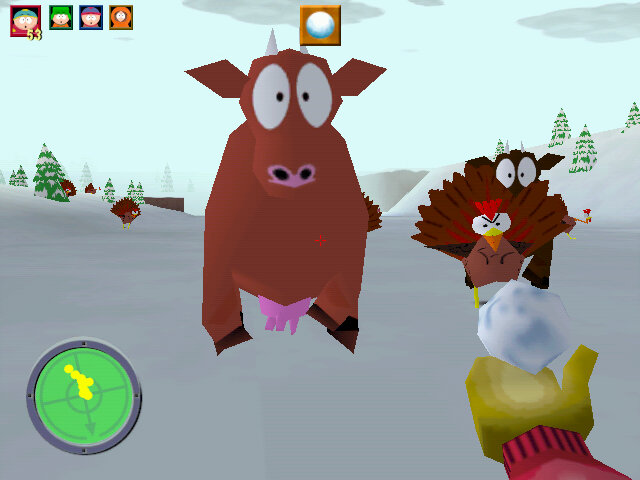
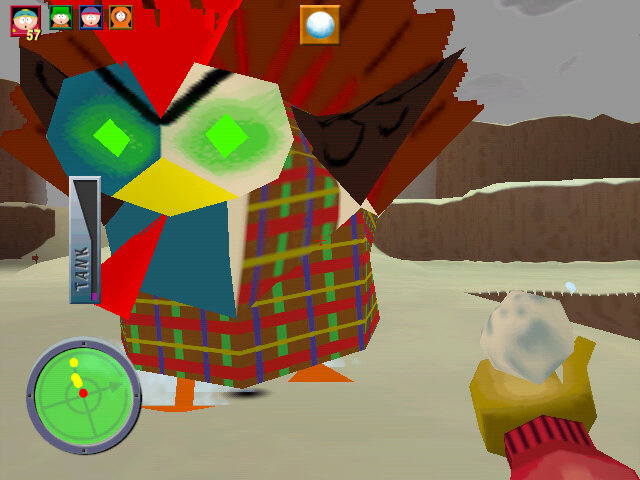
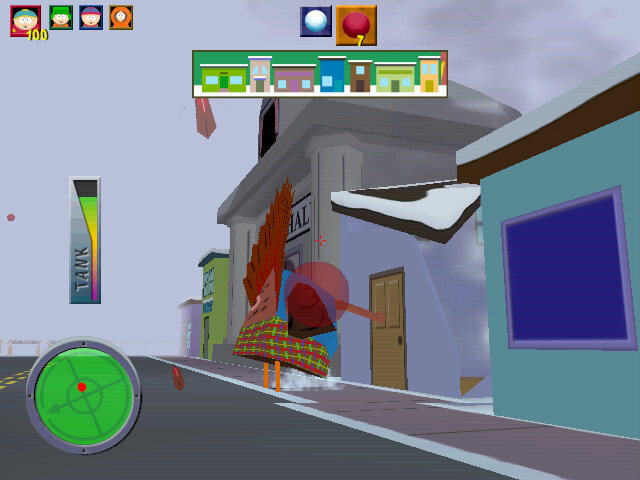
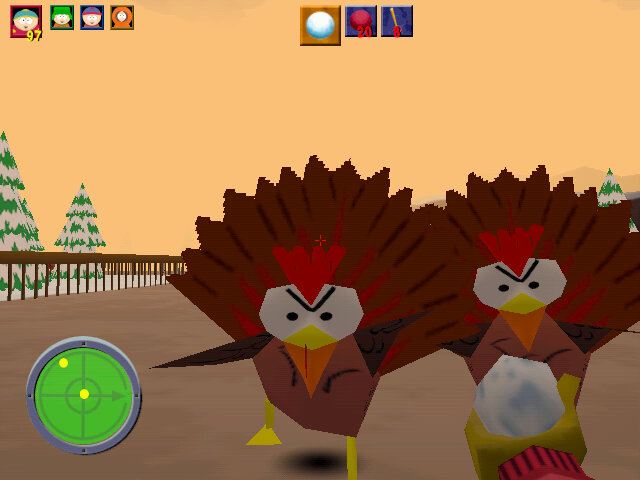
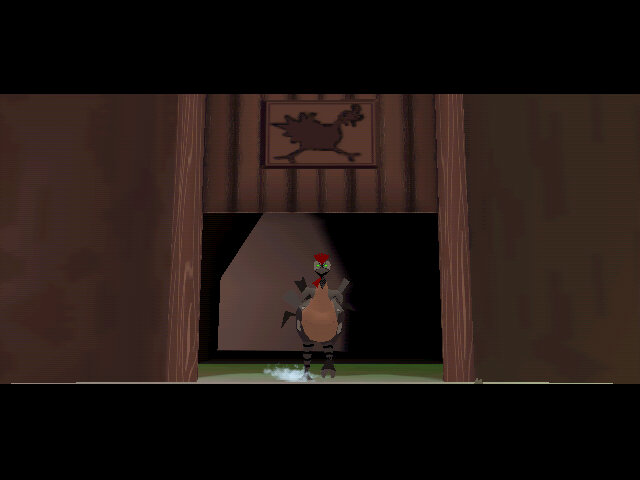
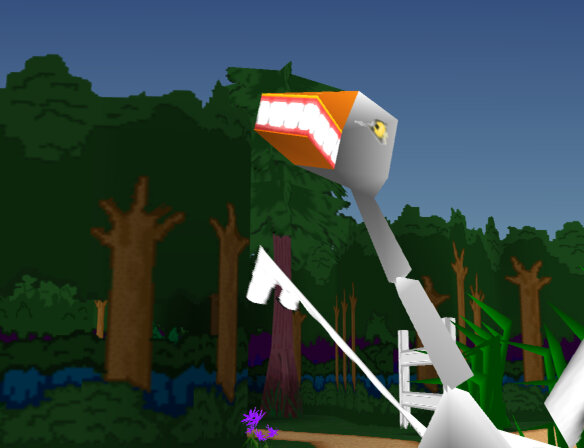
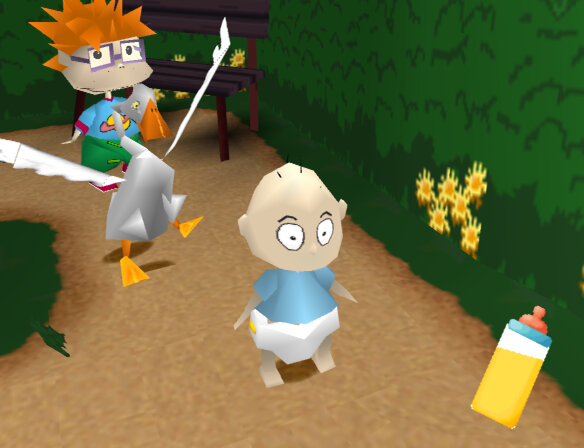
Story mode does not make for a good game, with the enemies being repetitive to the point of tediousness. The first level starts you off in your home town where you are attacked by deranged Turkey’s (who have the most horrible sound effect, and it’s horrendous if there’s 3 or more enemies present) and throughout the first three levels its just ongoing Turkey’s, with the occasional cow thrown in (only on the PC version, I’ve not seen the cow in the console versions on this level).
A Tank version of the turkey.
On the next stage you encounter Tank enemies which are larger Turkey’s that have the ability to spawn more turkeys that will attack. The tank’s have much more health than regular turkeys and will start to run into the beginning of the level when their health goes below 30%. If a tank manages to make it to the start point of a level, than another stage will need to be completed after you complete the level, where you have to kill the tank enemies that escaped, with a replenished health bar. You will need to do this before they destroy the town, of which depends on how many tanks had escaped. For this reason its a good idea to kill the tanks in the main game, since you are going to have to beat them regardless. What’s frustrating to me is they speed run back to the start of the level, meaning you have to chase them whilst firing, and causing you to backtrack. This makes the level much more tedious since you hare going through areas you have already passed.
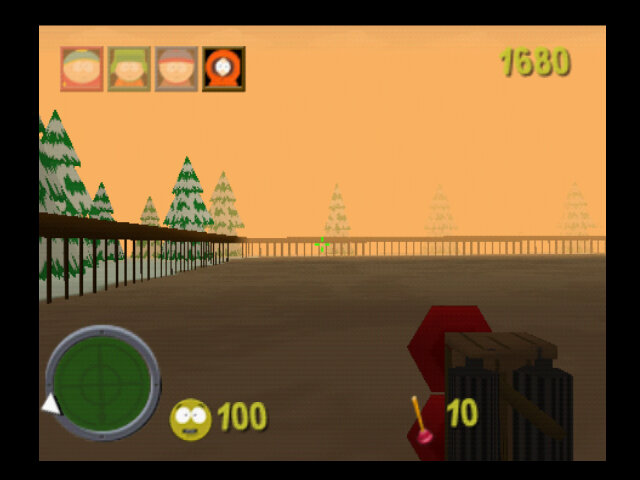
The next levels don’t change much, replacing the turkeys with clones, robots, aliens and moving toys, however its mostly the same type of enemy throughout the level which become boring fast. Some of the later enemies becoming literal bullet sponges, taking 20-30 hits before they go down.
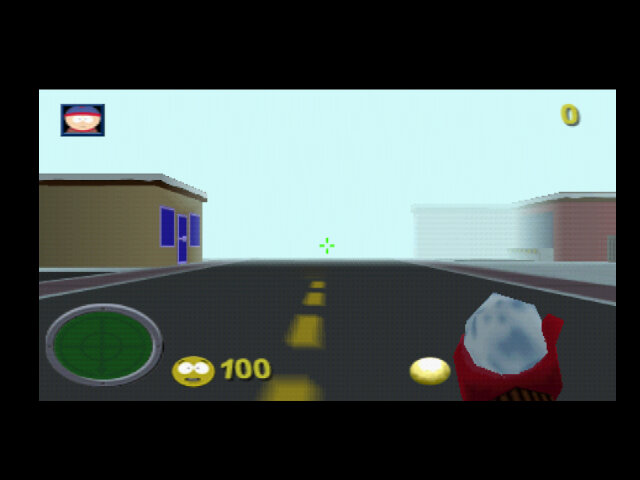
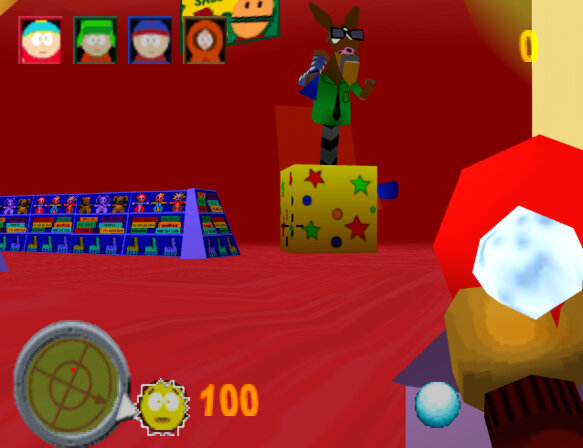
The multiplayer on the other hand is rather fun, playing as a regular FPS with a interesting selection of guns. The console versions let you play with two players, whilst the PC version supports LAN netplay. If there is one reason to play this game, its for the multiplayer mode.
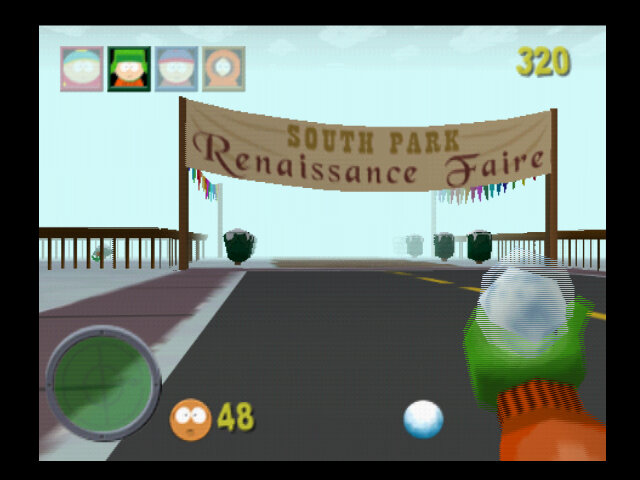
The Nintendo 64 version has 17 different maps to choose from, all with a variety of weapons. The PC version has the most maps, with 26 in total This includes all the N64 maps, plus some PC exclusive maps. PlayStation has an alerted version of the multiplayer mode, discussed in its section.
Nintendo 64
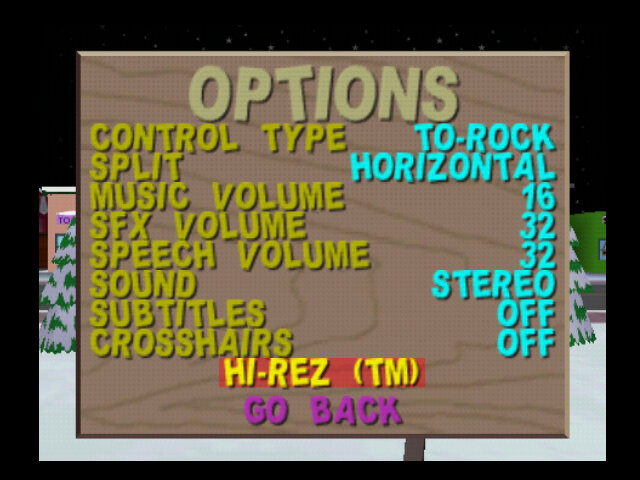
The first release of the game, and was the best version of the game until the PC version, however it remains the most accessible. Multiplayer supports up to four players on one console with a range of multiplayer options, including deathmatch. This version also features a high score table and supports 16:9 aspect ratio and a ‘High-Res’ mode with the use of the expansion pack.
Downside to this version is the significant frame drops when there’s a lot of action on the screen, and the short draw distance being disguised as fog.
Below is running on Retroarch Mupen64plus with Angrylion RSP plugin, I do own a copy of the PAL version of the game, but my N64 is one of those models that only supports composite out (No RGB or even S-Video, way to go Nintendo)
PlayStation
Released a year later (1999) and used a revised soundtrack compared to the MIDI N64 version, the cutscenes are captured from the N64 version instead of being pre-rendered on a workstation like many other games of the era. Graphically its a downgrade compared to the N64 version, and the multiplayer only supports two players, known as head to head in this version.
The PlayStation version comes with a head to head mode that has 6 maps, some of which are modified from the Nintendo 64 version. DM1 is based off the Ravine level from the N64, but with some alterations like the removal of water. DM4 is based of the badlands level, DM5 off badlands 2 and DM6 is based off the Gym Class map. DM2 and DM3 look to be unique maps for the PlayStation version.
Captured on Duckstation emulator with bi-linear filtering and rendered at twice the original resolution, with GTE accuracy enabled
Windows
The definitive port of the game, with better graphics and CD audio. Also comes with a proper multiplayer mode that use the Gamespy client (now defunct) to organize games. However there are issues running this game on modern systems, as the game only seems to work on Windows 98/Me systems (95 untested but assumed to work) this could be down to DirectX/Glide support on modern systems.
Below is running on the PCem v17 emulator running Windows 98, emulating a Pentium Overdrive MMX 200Mhz, 3DFX Voodoo graphics, with a Aztech sound galaxy soundcard.
There is also a software rendering mode that renders the games graphics in just the CPU, ideal if you do not have a dedicated 3D accelerator or one that is unsupported. Unfortunately it gives PlayStation level graphics at a weird screen aspect ratio.
Cheats PC
These were hard to find, so I thought i’d put them here
Press the Esc button, select Options and move the mouse cursor to the lower left of the screen and then click, you can then enter the below cheats. Sometimes you may have to move the cursor so it goes off the screen before you can enter a cheat.
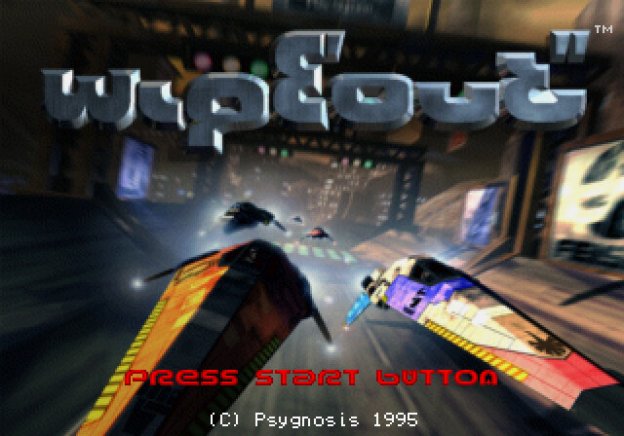
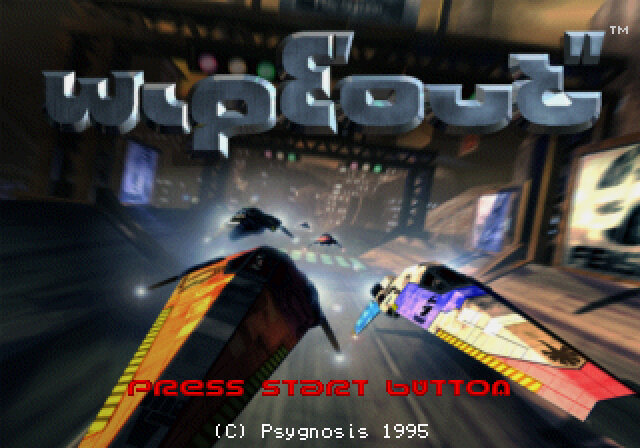
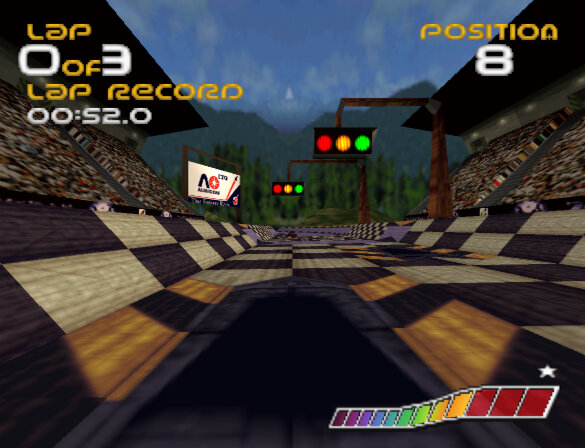
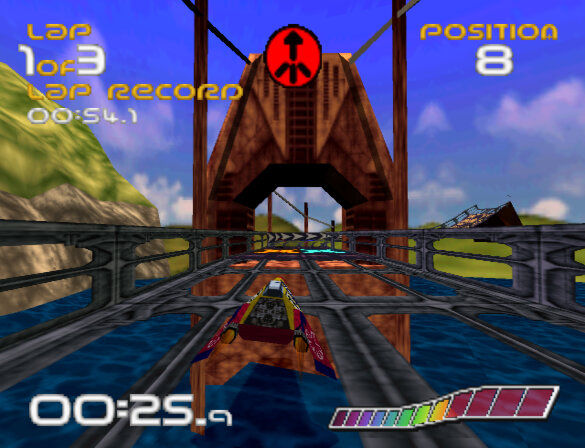
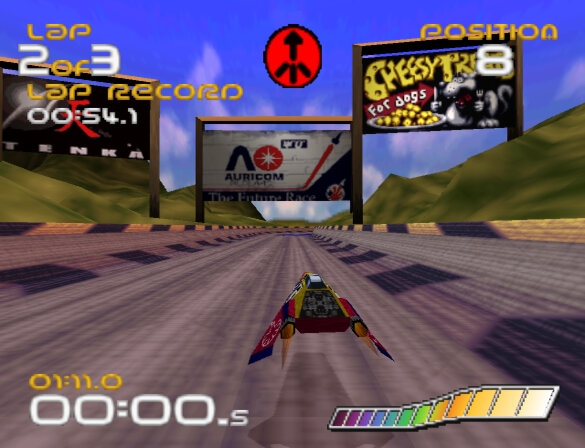
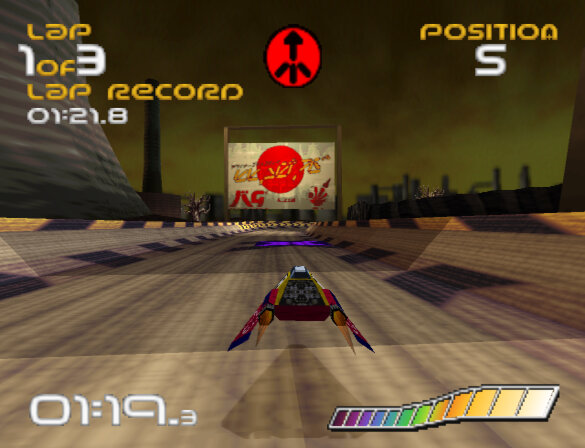
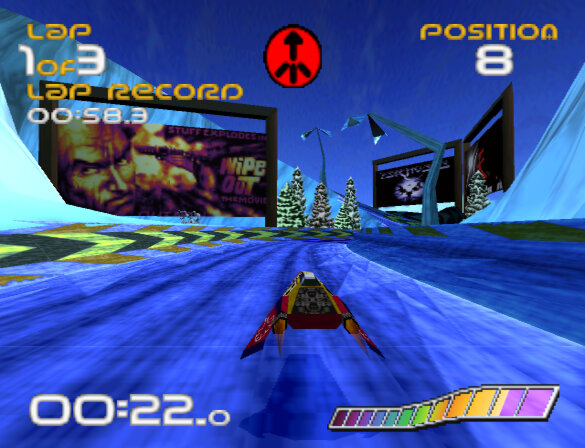
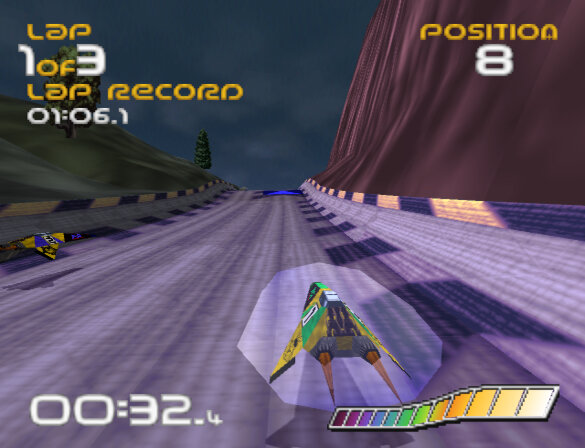
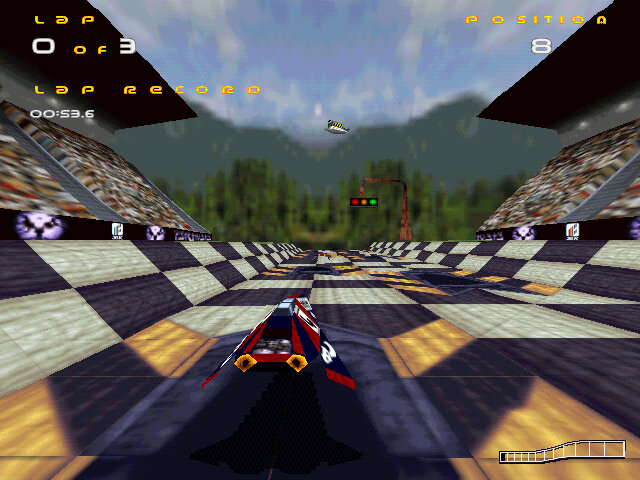
A futuristic racing game released in 1995 for various platforms.
In Wipeout your mostly battling against the track itself, rather than the rival ships, and at fast speeds the game can become a challenge, requiring quick reflexes. Thankfully it comes with a banging soundtrack, something which is a staple of the Wipeout series of games.
2 Player mode exists for the console versions, but its one of those games that needs a serial cable, two PlayStation or two Saturn’s, TV’s and copies of each game.
PlayStation
Probably the best version, since it has all the graphical effects, and the sound effects when you enter a tunnel. Can also be played on the PlayStation 3 and PSP as part of the PS Classics. Only issue with this port is the low resolution and the pop-in textures on the track, poor draw distance. As a bonus the game supports the use of a NeGcon controller, allowing for an analogue control, useful for turning and for the airbreaks.
On modern emulators you can sort of re-create the PC effects such as higher resolution and texture filtering, but you are still stuck at 30fps. Overclocking the CPU results in the game running too fast.
Duckstation: Enhanced
The game clears up rather well compared to how it originally looked
Sega Saturn
Wipeout was released for the promising Sega Saturn, and serves as an example of the PSY-Q dev kit for the Saturn, which Psygnosis were trying to promote at the time as an alternative to Sega’s devkit (a version of PSY-Q was released for the PlayStation). The soundtrack has been altered with some songs being removed
Screenshots: SSF emulator
Windows
WipEout was ported to the PC a year later than the PlayStation release, and was designed exclusively for ATI video cards and was typically bundled with Windows PC that had those cards. It’s one of the games that supports ATI’s CIF API rather than Direct3D. This limits it to ATI Rage series 3D chipsets, the one in my Dell OptiPlex being one of them, but in order to play CIF games you need to use an older 1999 driver from ATI (The Windows 98 bundled driver has no CIF support), also CIF is only supported under Windows 98, there is no support for Windows NT 4.0. ATI later removed CIF support from its drivers from late 1999 onwards, so you may have to downgrade the driver order to play. A CIF wrapper exists for Windows 7 onwards, although I’ve not tested it.
Screenshots below are captured from a Dell OptiPlex GX1 with an Intel Pentium 2 350mhz and an ATI RAGE 2 with 4Mb of VRAM
The main difference is the ability to play the game in a higher resolution and with the ability to play at a higher framerate, it’s not exactly 60fps on a Rage2 but its a lot more smoother than the PlayStation version. However the sound is not has good as the console versions, with the PC missing the echo sound effects that play when you enter a tunnel. It’s also one of those games that’s stores the music as Redbook CD audio, and the game plays the audio back like a regular CD player would. This gives the option to change the CD (as the game runs from the hard disk) to play your own music.
MS-DOS
Very similar to the accelerated Windows version, but has a lot of enhancements removed, there’s no texture filtering, the framerate is lower and the resolution is reduced, likely because everything is being done on the CPU. You are limited to a low 320 resolution, 16 bit colour.
Personally I would stick with the PlayStation version, or the Saturn if you prefer more detailed textures. The PC versions sacrifice too much for what benefit they give, although you get the opportunity to run in a higher resolution, the missing sound effects are a huge setback and ruin the immersion of the game. besides with modern emulators you can run the game with additional filtering and upscaling, the FPS is still stuck at 30fps.
Hackers
A concept imaging of Wipeout appeared in the movie Hackers, which features slightly different gameplay with obstacles on the track, a crew that speaks to you instead of techno music playing. It was believed to be rendered on a SGI workstation and features perspective correct texture mapping
Undercover – The main story mode of the game, you complete a set of missions which can range from driving from point A to B within a set amount of time, to escaping or pursuing another car
Take a Ride – Sandbox mode, only two cities are available with the other two being unlocked as you progress through the story.
Driving Games – A set of activities to choose from, Pursuit, Getaway, Cross Town Checkpoint, Trail Blazer, Survival and Dirt Track. Carnage is a mode exclusive to the PC version.
Training – Introduction to the came and the various mechanics and techniques to mastering Driver
There are no two player or multiplayer modes, Driver is a single player game.
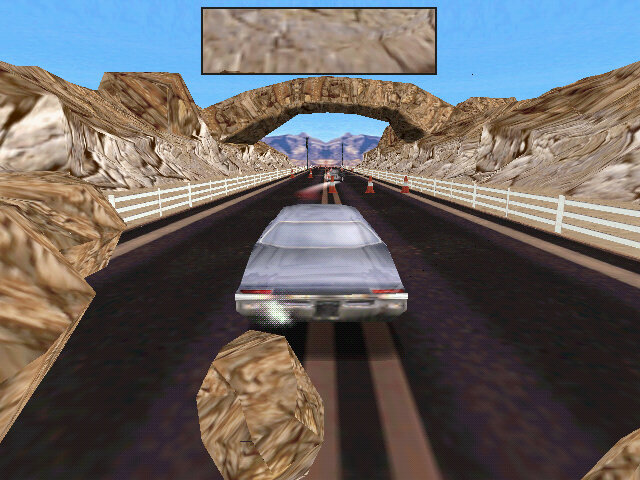
Desert training level
PlayStation
The version that most people have played and are familiar with. This was the first version of the game to be released. Main attraction was the sandbox Take a Ride mode where you could drive freely until you caught the attention of the police, who would then proceed to ram you to death.
Cop car went vertical, a common occurrence
The game occupies on memory card block per story save, and two blocks for replay data, you can easily fill a memory card with this data, thankfully the game
PAL-land version
Thankfully this game runs in full PAL resolution, no top/bottom bars, likely since the studio that developed the game was based in Europe. There is a difference in the logos, with the NTSC version having a altered blue version of the logo with the works ‘You are the wheelman’ which is also present in the games title. The PC version adapts this for both Europe and US markets (Makes sense since the PC isn’t regionalized compared to the PlayStation releases, PAL/NTSC does not exist on PC)
Windows
Despite this version running in a higher resolution and a capability of having a higher framerate there are a few drawbacks compared to the PlayStation version. there was also a Mac version, although I believe its very similar to the PC version.
Screenshots here are running on an emulated PC (PCem v17), running an Intel Advanced/ZP with a Overdrive MMX processor with a 3DFX Voodoo Graphics card. The operating system is Windows Me. The graphics here will depend on the 3D video card an API, as 3DFX cards used Glide, the Direct3D version may look different.
Differences between the two
One of the main differences is the background music which was changed in the PC version. Also unlike the PlayStation version, there are no separate themes for when you gain felony, in the PlayStation version the music would change when you attracted the attention of the cops, but the PC version remains the same throughout. As someone who grew up on the PS1 version, it was kind of jarring to play Miami without the familiar theme, and for the game to not change when catching the cops attention.
Comparison screenshots below, the PSX version is running in Duckstation at twice the native resolution (640×480) with bilinear filtering and 2x anti-aliasing enabled. With these enhancements we can try to bring the PSX version up to the PC version, which is running at 640X480 resolution with ultra graphics present.
PSXPC
One thing to mention with the PC version, as with all PC games of the era the game is reliant on using Redbook CD audio for the background music, where the games streams the music from the disc itself, like an audio CD. For this to work you had to have an audio cable connected from the CD drive to the motherboard or soundcard, in addition to the IDE cable. On modern systems (with SATA drive onwards) this is no longer supported, and modern Windows versions / soundcards its no longer possible to stream analogue audio from the CD drive, instead being delivered through the IDE or SATA interface, which this game won’t support. The game itself will still run and you can still hear sound effect like the car engine, but you wont hear any music.
PSXPCPSXPC
The spawn points are also different for each of the maps/level, again not sure why these were changed
The map layouts were also changed, with some areas being remodelled completely, Dodge Island had a massive change, possibly since it was designed around the PlayStations limitations initially.
The cop radio voices were also changed, with some lines being completely different
A speedometer is present which gives the speed of the players car in miles per hour
The car models themselves had change and I cant say I prefer the PC version of the cards, which are lacking certain details from their textures, the back of the cards look like a blur compared to the PlayStation version.
Upgrading the PlayStation version
Modern emulators are capable of running the game in a higher resolution with additional smoothing effects. Unfortunately there is little we can do for the framerate, that’s stuck at 30fps, or 25 for Pal-land copies. Still at least there’s no boarder, and you can overclock the PlayStation CPU on some of these emulators, which helps with the slowdown when there’s a lot of cars and particle effects on screen.
The game can be upscaled to 640×480 or 800×600, which the PC version also natively supports. Depending on the emulator, higher resolutions can be used but I don’t recommend it unless the emulator supports perspective correction, otherwise those polygons will be jittering aggressively. This video will help explain further on why this occurred on PlayStation games.
Texture filtering can be hit or miss, whilst it helps smooth out the textures, due to the way the PlayStation handled 2D, it can affect the HUD display too, causing excessive blurring on the HUD, making it look like an N64 game.
Exploring the disc
In the NFMV folder there is a exe file called NFMV.EXE however this does not open even in older versions of Windows
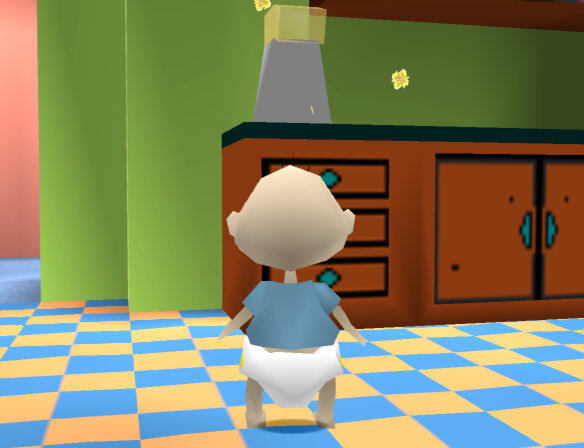
One of my favourite childhood games from the PlayStation, objective of the game is to find Tommy’s Reptar pieces that are scattered all around the house by completing various mini games. Rugrats Search for Reptar was only released for the Sony PlayStation
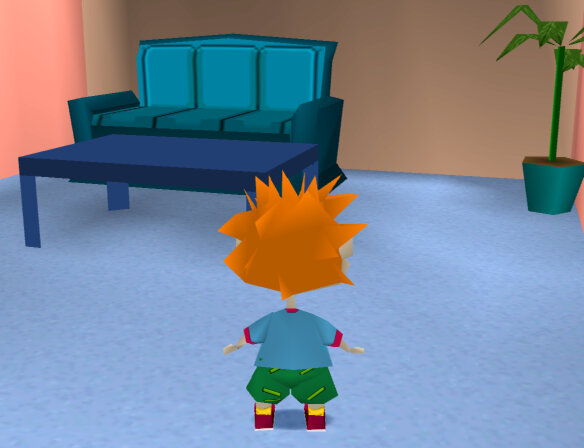
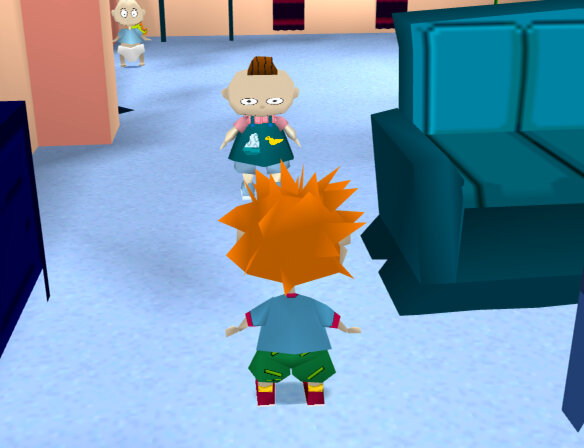
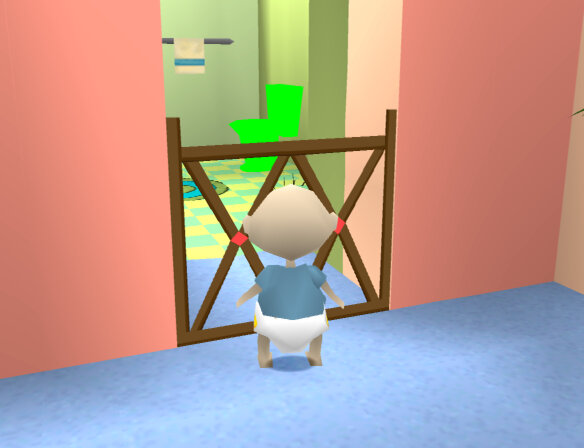
First we need to talk about the Pickles Home, what has been rendered entirely within the games engine, and servers as a gateway to the mini games that need to be completed. It’s a pretty nice house consisting of 5 bedrooms, 2 bathrooms, a living area, kitchen and a study room, along with a garage. Its very faithful to the TV show, at least from the episodes I’ve seen, a lot of cartoon shows tent to remodel the house to suit the plot. It’s probably one of my favourite cartoon house alongside the Simpsons house which I got to explore in Virtual Springfield. Whilst rendered in a 3D environment, the art style tries to be faithful to the shows animation.
Some areas of the house are locked out initially, but when you enter a specific level they are available like the garage, I put this down to memory limitations of the PSX because some rooms that were previously explorable are disabled in some levels. An example of this was the Chuckie’s glasses level which opens the garage area, but removes the basement and garden area for that level. Some objects of the house can be interacted with, mainly Tommy’s toys which can be thrown or picked up.
Activities
Easy
Chuckie’s Glasses
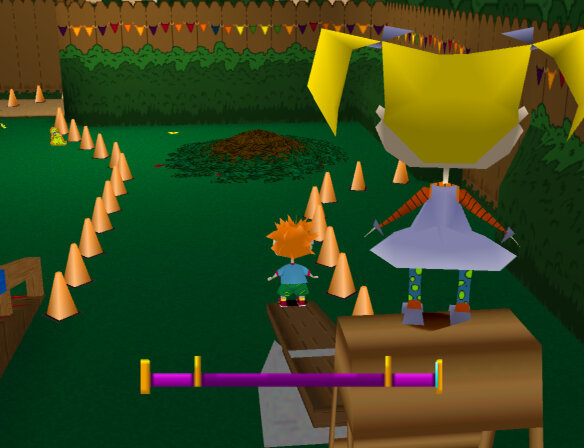
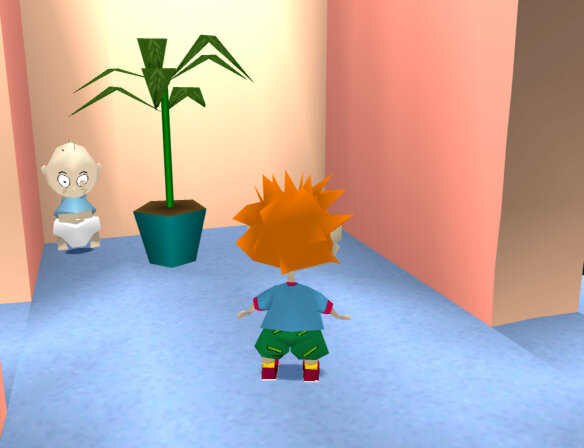
Its raining outside and Angelica decided to play Hide & Seek with the babies, volunteering Chuckie’s to find them. However to make it fair, she takes his glasses, using Chuckie, you have to find and tag the babies (Phil, Lil, Tommy) and race them back to the play pen. It’s fairly easy and you get to explore the Rugrats house as you play, there’s no time limit and if one of the babies win you simply have to find that Rugrat again, although its gave over if they beat you three times.
Ice Cream Mountain
Stu wants to go golfing, he take the kids and promises a huge ice cream mountain, based on an episode in the show. There are 10 levels and to play, you walk to the ball, press the triangle button to start the power meter and press triangle again to hit the ball when the meter is in the right spot. Some require a power shot, others only require a small amount.
Grandpa’s teeth
The level starts off in a playground where you and Chuckie can play on one of the slides/rides. When your done, you can progress through the level into some sort of maze where the goose is hiding with grandpas teeth. Once you navigate the maze, a second segment starts where you have to chase the goose that has Chuckie, using Spike to catch up to it. The third stage concluded with you throwing hockey pucks at the goose (Hopefully PETA didn’t play this game), whilst trying to avoid Chuckie.
Cookie Race
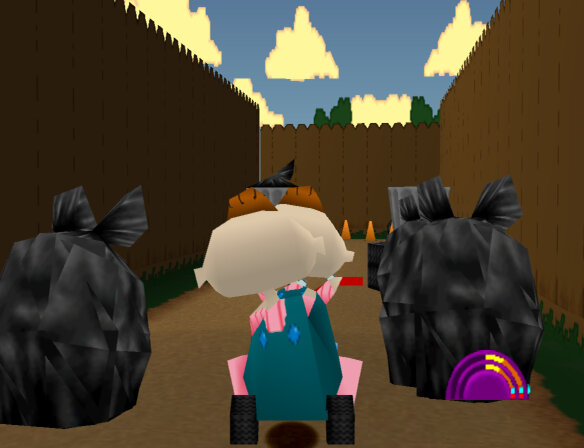
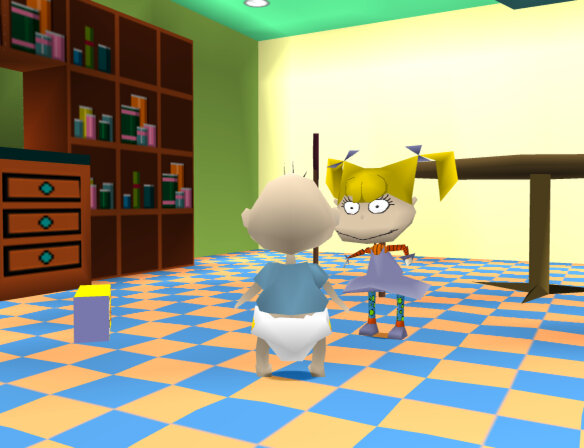
You just have to race and beat Angelica to the kitchen. The house has been slightly altered and some areas have been blocked off, meaning you have to go the long way round. This is fairly easy since Angelica is quite slow but the controls can be a hindrance since its easy to run into an object.
Medium
Visitors From Outer Space
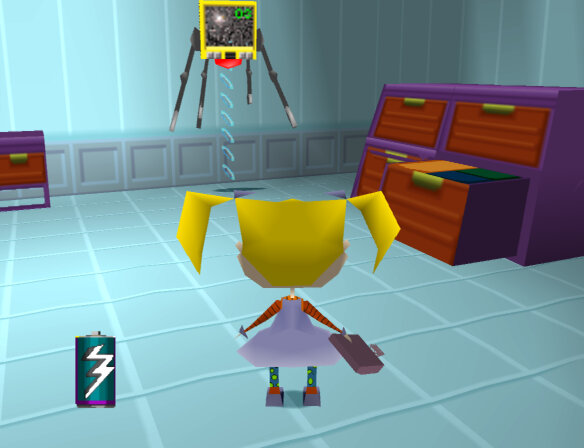
You control Angelica in a spaceship where the babies have been abducted. Avoid the TV robots/aliens and navigate to the lower levels (you can still explore the ship) where you will meet an alien fish thing, who will disable the gravity. Angelica can then float through the air vent and navigate to one of the pod escape ships where she meets the babies, somehow? Based on a real Rugrats episode.
Mr Friend
This one sucked, basically you have to throw objects at Mr Friend and destroy it. First you have to deal with one, then three will spawn. Its challenging since the hit detection is very inconsistent and the controls are digital which makes it hard for Tommy to aim, also some of the throwable objects will just clip through Mr Friend.
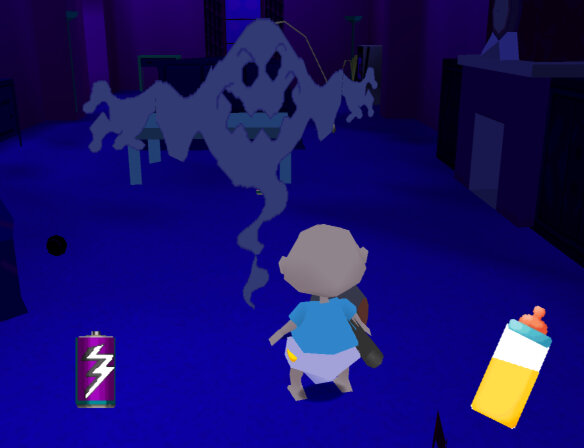
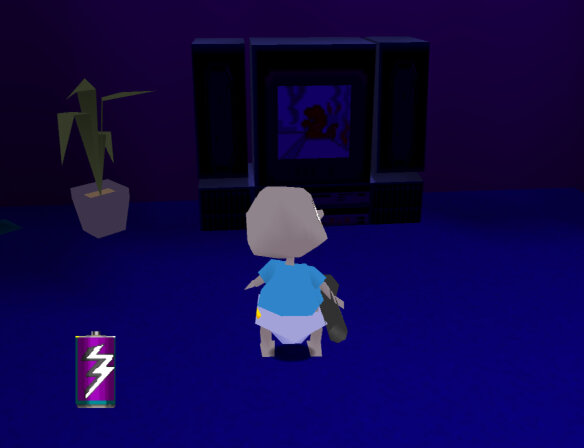
Let There be Light
Stu overclocks his Amiga and causes a power cut, so its up to Tommy to restore the power. This level has the pickles house in darkness, with the textures being darkened for effect. There are ghost’s that roam around the house that can drain Tommy’s health, use the flash light to zap them away. First part see you navigating the house in near darkness to the kitchen where you find the Pickles fridge, but Tommy is unable to open it by himself so he needs the help of Spike to open it for him, which starts the next segment when you have to find Spike.
Circus Angelica
The Rugrats are tasked with performing with Angelia’s Circus, and have to perform a variety of tricks. This isn’t really difficult but the controls can be a major problem since you have to be accurate when it comes to Chuckie’s part, and if you fail twice the game is over.
Hard
Hard basically means long, as there are multiple objectives that have to be completed for the activity.
Incident on Isle 7
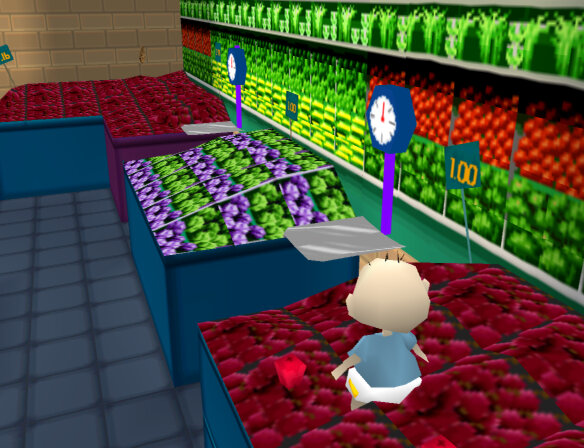
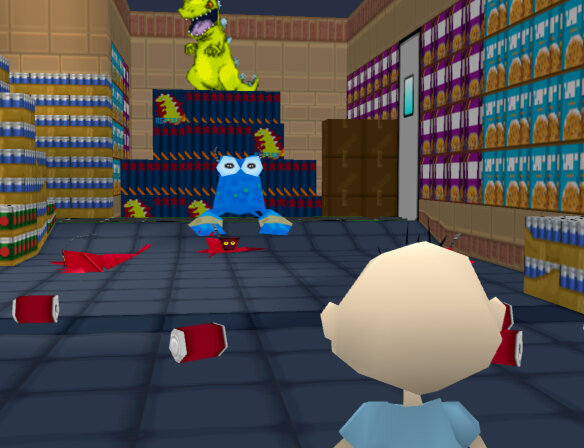
Set in a supermarket, Grandpa takes Tommy shopping for some Reptar cereal, Tommy breaks free and is left to explore the store. First section sees you exploring the different sections of the shop, until to reach the seafood section where a bunch of lobsters get loose. You then have to avoid or kill the lobsters and navigate through the various areas that have spillages that can cause Tommy to fall. Lastly you will reach the boss section where you have to stun the main Lobster in order to hit a switch.
Toy Palace
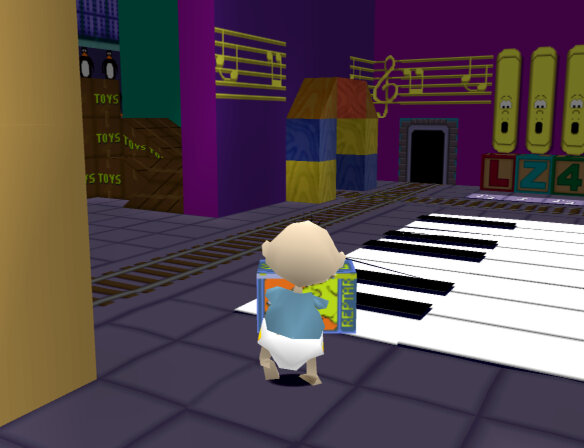
Set in a toy store, Stu loses Tommy and Chuckie after they decide to go solo. They explore the toy store zone in the hope of finding Reptar. Everything seems to cause damage in the first part, and the last part can be frustrating since you have to collect the blocks in order to reach the switch, some of which are located on shelves. The jumping is inconsistent as there is a delay before Tommy jumps, resulting in him falling a few times. Tommy and Chuckie also have a habit of repeating their dialog endlessly.
7 Voyages of Cynthia
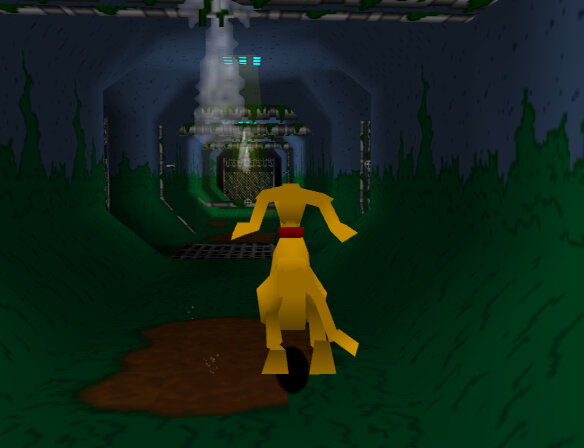
You control Spike (Poorly) in this level as you navigate the sewer, Spike is very vulnerable to damage and will take a hit over every minor collision. The second stage isn’t any better since you have to avoid the mud which will reduce his health. The final stage is easy as you just need to find Cynthia before the time runs out, except she spawns in a random place.
Activities
Cookie Race – Same as the main version
Egg Hunt – Also in the main game, Angelia wants to hog all the easter eggs, so its up to Tommy to find them all before the time runs out, I guess the cookies weren’t enough for Angelica?
Gold Rush – Also available as a bonus game, Phil and Lil need to collect all the coins before time runs out, Same as egg hunt really
Mini golf – Can be played with multiple players, but instead of split screen, its more of a pass the controller for each turn kind of affair. There are 10 courses to play through.
Emulation
Recommended emulator: BeetlePSX or Mednafen, Duckstation works just as well.
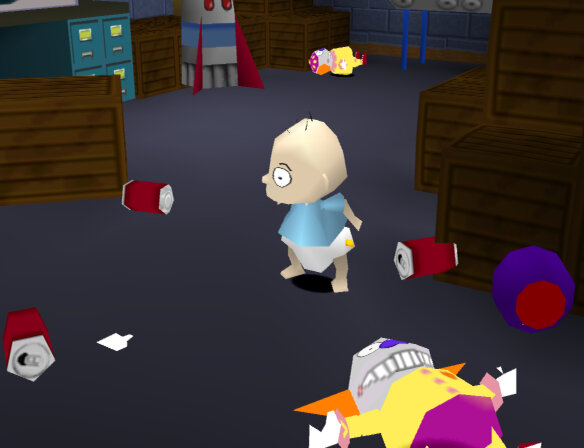
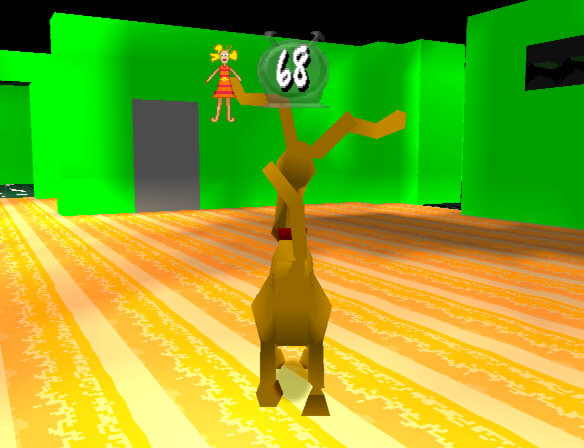
One of the issues that occurred when playing this game in Duckstation was some cutscenes not playing, or the ones that did play would end early, and some of the Rugrats would be played randomly around the house, like in the screenshot below where Angelica is present in the kitchen, and cannot be interacted. This would often happen if you start the game in training mode first, then exit via the door which starts the main game. Angelica’s model is in the training map so maybe the game forgot to remove her from the world?
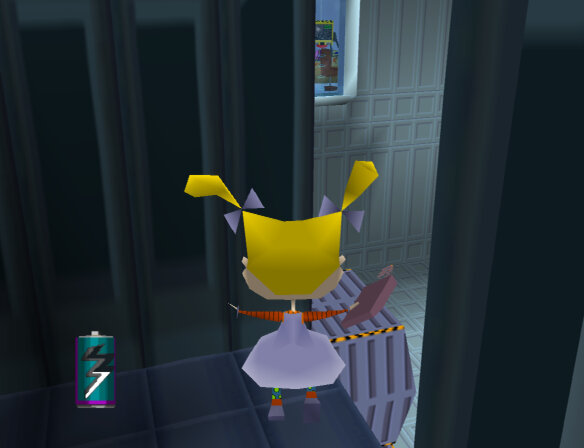
Angelica has seen some deep shit…
The hide and seek game is mainly affected, with the Rugrats randomly appearing around the house once they have been beaten to the playpen
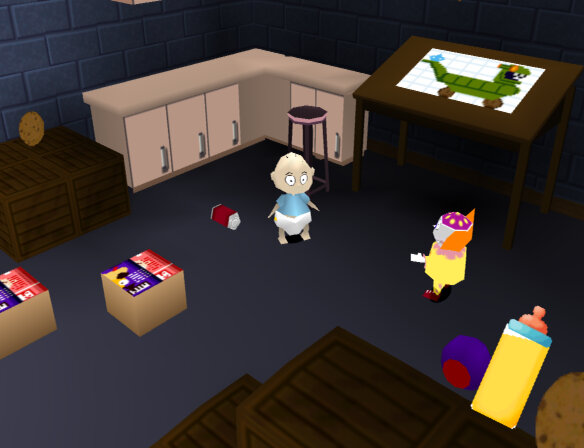
Not a very good hiding place Tommy…
Tommy and Phil have been found, but instead of being in the play-pen, they are in the living room. This issue also occurred with the older builds of ePSXe where rugrats would randomly appear around the house, and issues with cutscenes playing. I’ve not tested it in modern ePSXe (this was around ver1.6)
Rugrats untextured object
An untextured toilet? Found in the cookie race level. I remember something similar occurring on the actual console itself so possibly not an emulator issue. The light above the mirror is also affected in both the cookie race and Chuckie’s glasses.
Navigating the Disc
Opening the SLUS_006.50 in Notepad++ and scrolling to line 168 reveals a few menu name strings, one of which references a Debug Menu, wonder how we activate this?
All the game data is present in the DATA folder, and each of the levels are broken up into different DB folders, with DB00 being the Pickels family home. Inside each folder are multiple BIN folders that follow the name convention. DBxxANM.BIN might refer to the animations for that level. Unfortunately these formats are likely built using proprietary game tool exclusive to N-Space, so there isn’t really much to play about here. Maybe we could rename and swap a few files around and experiment what happens when the game tries to load data intended for another level?
Update: 18/04/2023
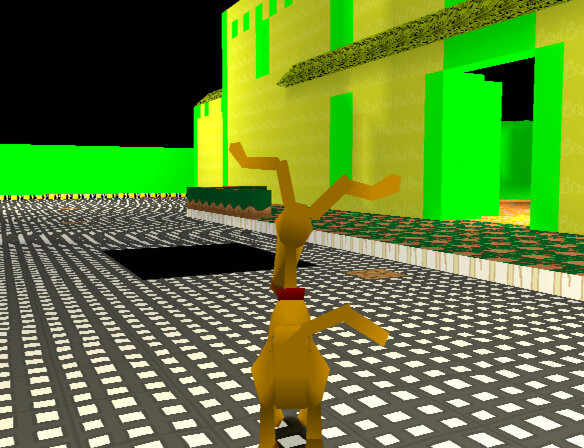
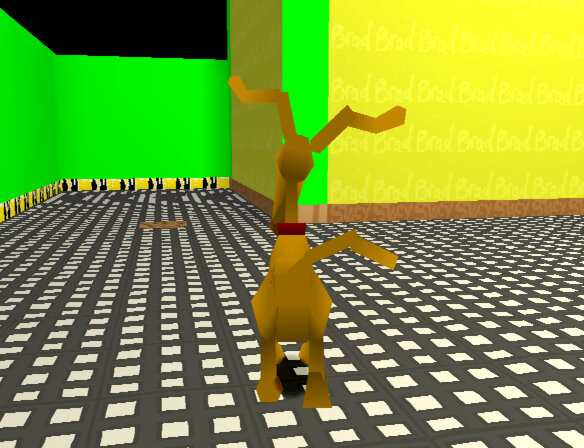
There is also a hidden/unused level known as DB19, which appears to have been scrapped during development. By using CDmage to copy and move the files, we can trick the game into loading. Because of the way PlayStation discs are authored, we need to extract and then inject the files specifically into DB04 – the Voyages of Cynthia as that’s the largest levels that we can fit the files into.
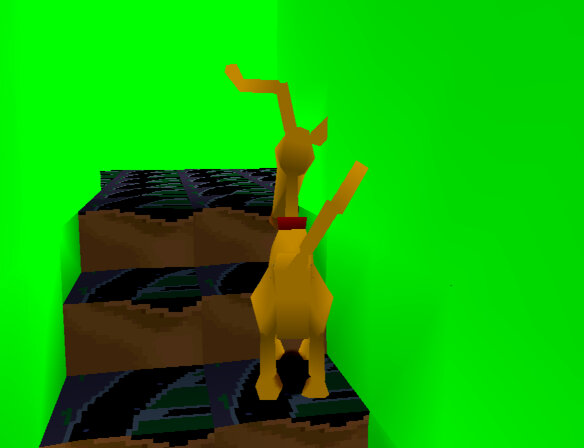
The level appears untextured and looks to be an earlier version of the Pickles household. Notable differences is space around the house, and more narrower stairs. As you are controlling Spike for this level, we have a few issues using the stars, with careful precision you can jump up to the second floor which appears mostly the same layout.
Entering the closet causes the countdown timer to start, likely because the game thinks we are on the Cynthia level and Spike as entered into a specific trigger for the countdown timer.
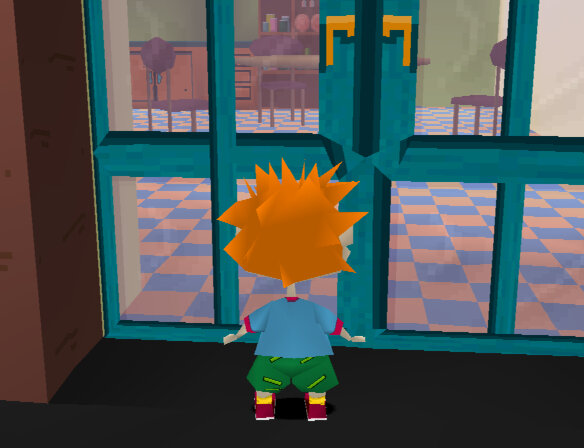
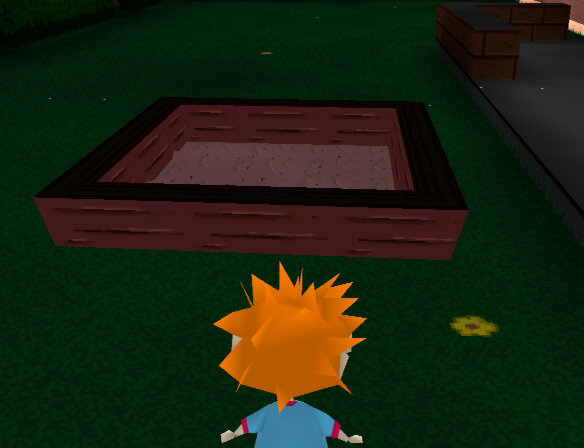
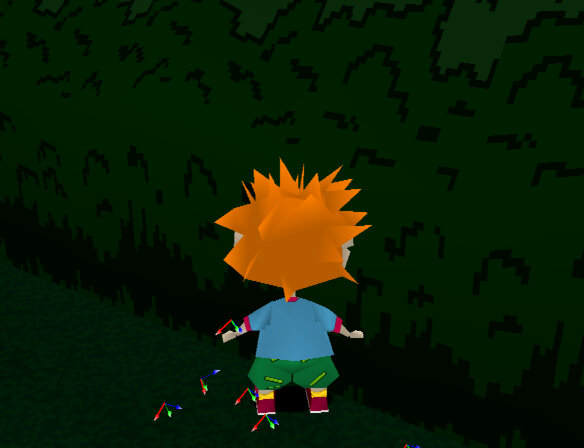
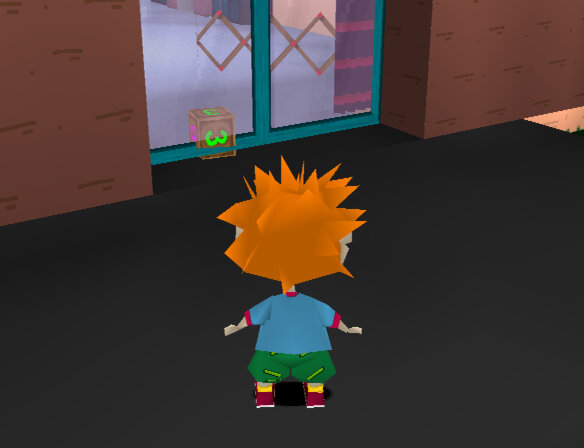
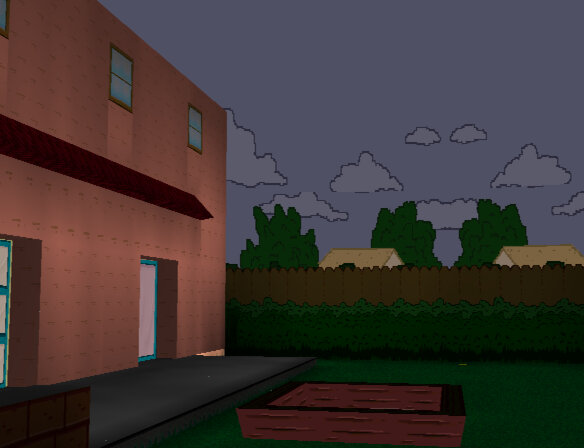
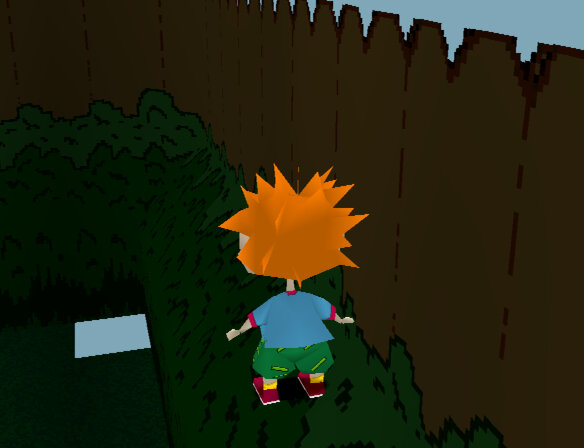
Lastly lets see what’s outside in the level Chuckie’s glasses, by using the cube found in Tommy’s room we can use this to glitch out of the boundaries and into the garden which we normally cannot access. We can see its not raining at all and Spike’s doghouse is missing. Jumping on the buses causes a weird model/prop to come out which spawns shortly after. There’s also a weird square at the edge of the garden which we cannot stand on.
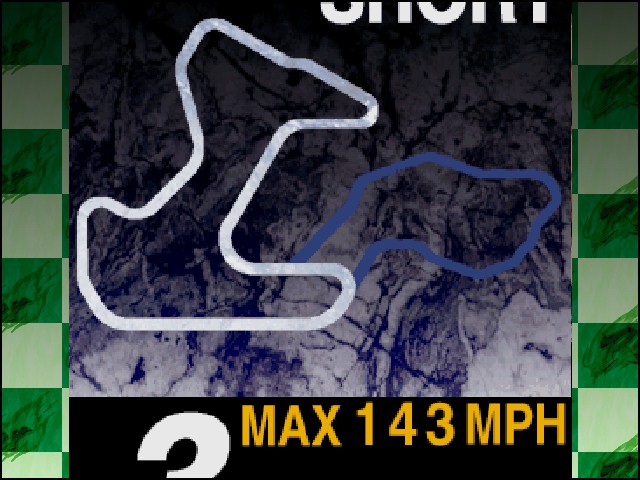
The third arcade instalment of the Ridge Racer series, and the first actual sequel/spin-off, since Ridge Racer 2 was mostly the same as the original except for the revised soundtrack, a revised HUD and multiplayer support.
The music has also been revised with some completely new tracks covering techno/house and electronica genres, and some familiar ones – rare hero returns as a remix. Sadly this gets ruined by the two race announcers who insist on polluting the sound-waves with their rambling takes. The first one is a female sounding voice who is supposed to be the main announcer and has a tendency to repeat the same lies constantly (Go GO GOO This race is yours!!!) She also voices the attract screen. The second announcer is a male voice who seems to be one of the rival cars.
Emulation
Vivanonno
The original emulator for the game that was released in 2002, now has been eclipsed by MAME. Vivanonno could emulate most of the effects but has issues with the car shadows which can dissapear. Like Ridge Racer 2 however, there are a few geometry inaccuracies.
Texture Filtering
Left has filtering disabled and is how it would have appeared on the actual system, right has filtering enabled.
Other
Cars are slightly sunk into the track, but lift up when the race starts
Nintendo 64 Version?
Possible leaked build of the game running on the N64?
Its just the Vivanonno version with the texture reduction set to the highest option, but if it did come to the N64 it may have looked soomething like this.
Mjolnir
This was a fork of MAME and had the goal of emulating the Namco System 22/21 games with hardware acceleration. This had the benefit of better emulation performace since the graphics processing was offloaded onto the GPU.
Sadly Mjolnir was abandoned and the latest build is based off a very old version of MAME, which means System 22 emulation is very primitive and many graphics issues are present with the emulation being incomplete. As a result its difficult to play givern the graphics issues with this build. Also it uses an older ROM set which makes it incompatable with the currernt MAME sets.
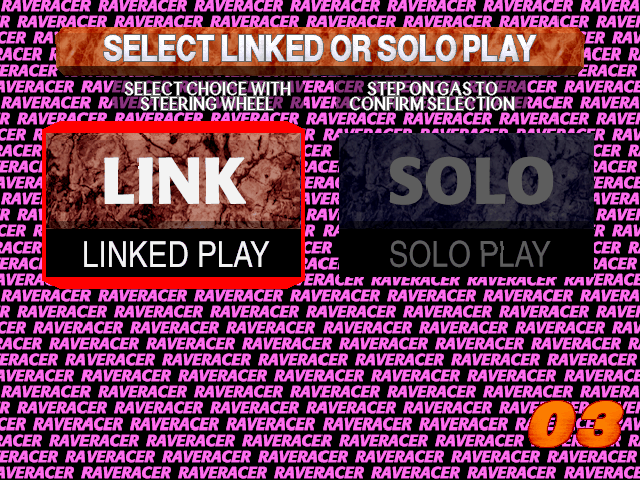
A fork of MAME now allows for link play with selected System 22 games. Unfortunately it is far from perect and only seems to work with only 2 players reliably.
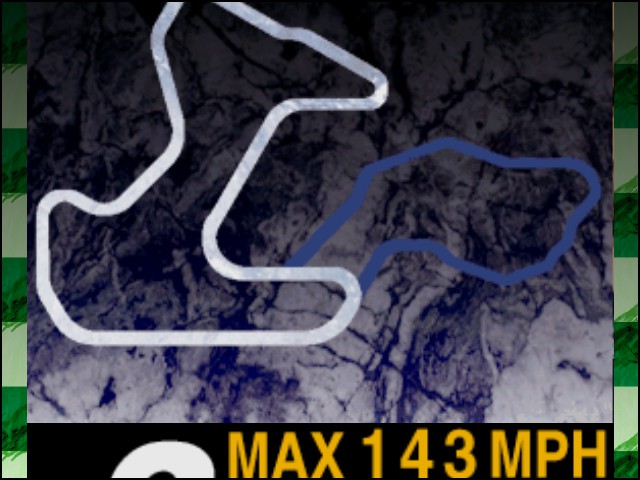
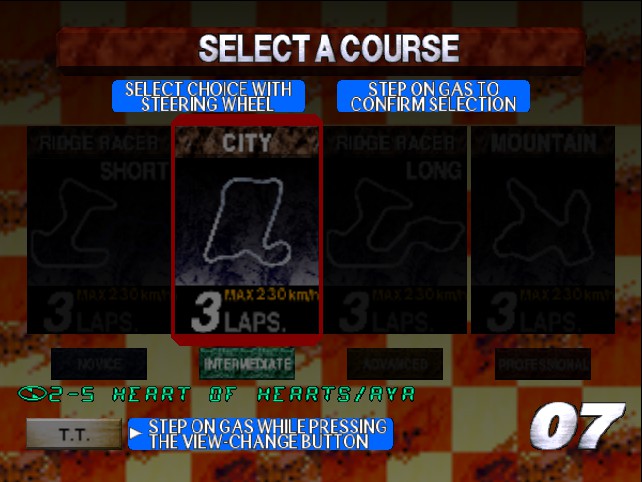
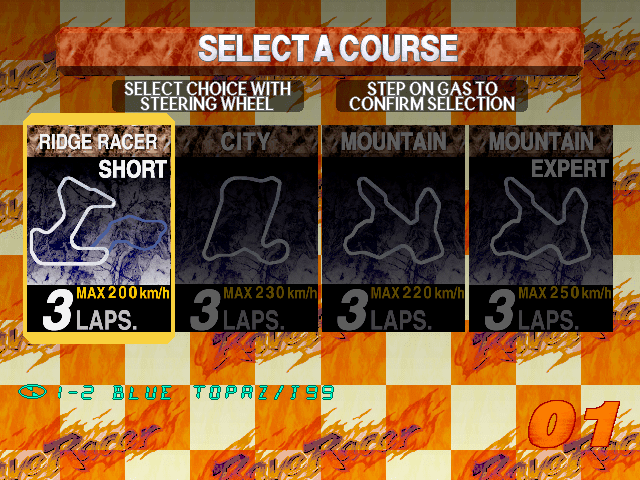
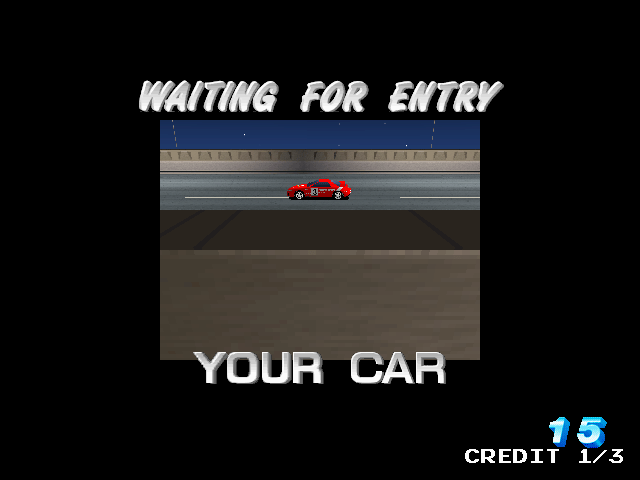
Track selection screen with link play enabled
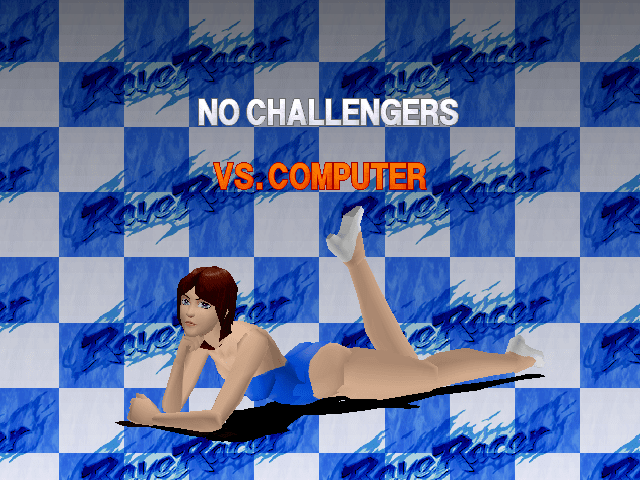
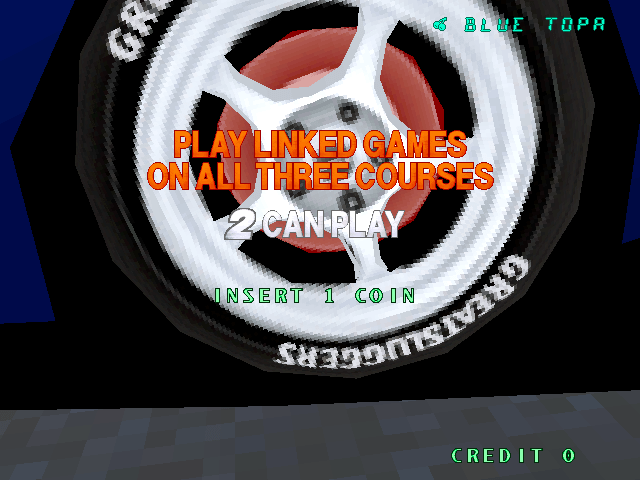
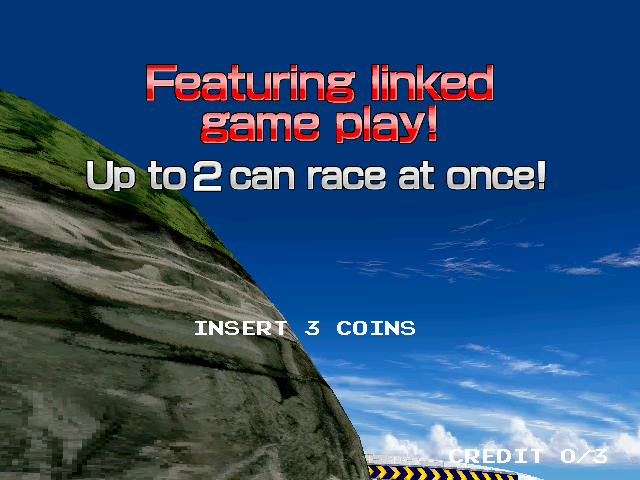
Meanwhile other linked machines will advertise that they are able to join in, the top two are displayed on the idle machines whilst the bottom is displayed on the machine that initated the link paly.
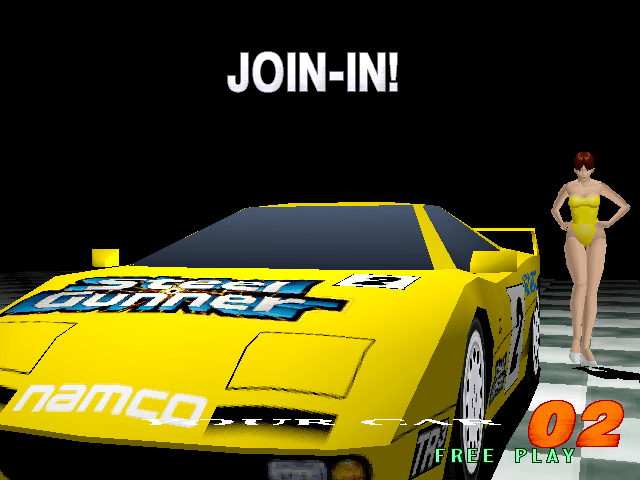
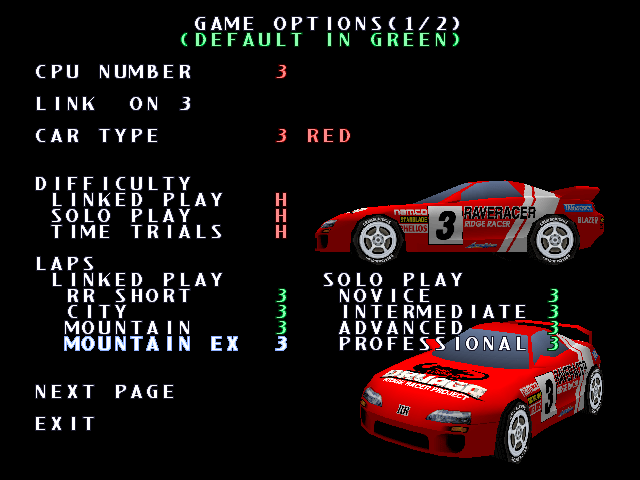
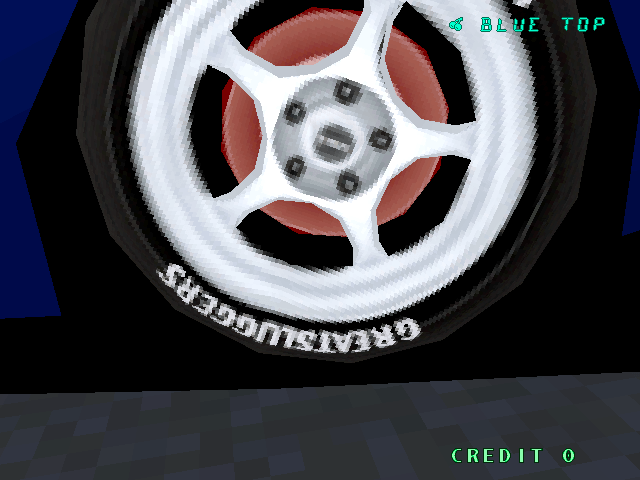
Left: the test mode configuration. Each machine needs to have a unique car colour and CPU number, which allows each machine to identify each toher. On the right the attract screen when link play is detected
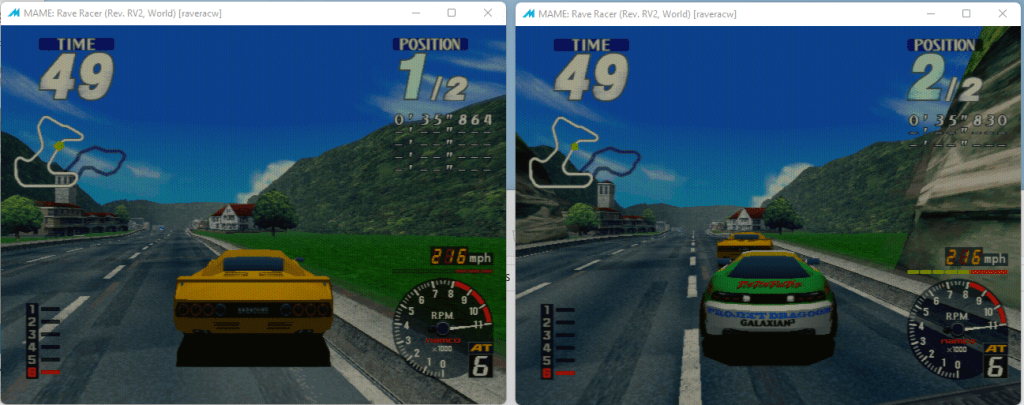
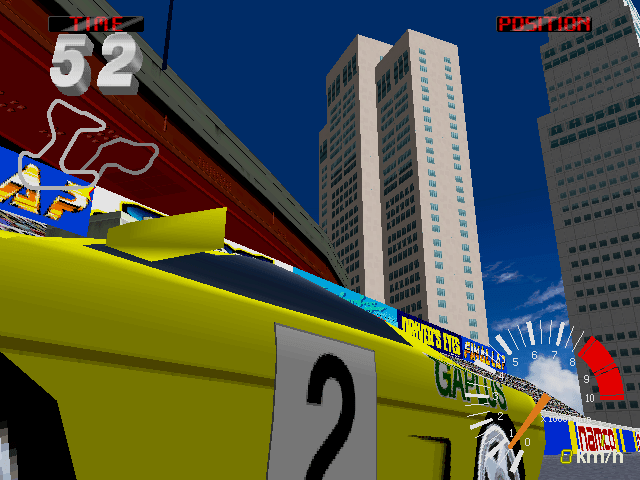
A two player game from both players view. The time is different on both machines because the right has the difficulty settings set to easy mode (H). Seems each machine can have their own independant game configuration. Infact you can have one machine set to complete three laps, whilst the other has to complete five, which does not seem fair. Perhaps Namco would assume the operator had to ensure all systems had the same configurations set?
One has 3 laps, the other has 5. Also both are marked as lap leader
Whilst its possible for two players to play this way, when trying to play with four players there seems to be a few issues. I would assume System 22 networking works on the basis it transmits network packets in a broadcast fashion, like UDP. When playing a ‘four’ player game it seemed that one machine was sending data to one machine, whilst receiving data from another which caused some interesting effects with the map display. Despite setting each machines IP address (emulated through MAME instance, the arcade board has no TCP/IP support) to be unique. It works on some sort of token ring like topology where one machine recieves data and then sends it on a different physical port to another machine, basically every machine has an input and output.
Its also possible that this is due to the early emulation, and may be improved in later releases.
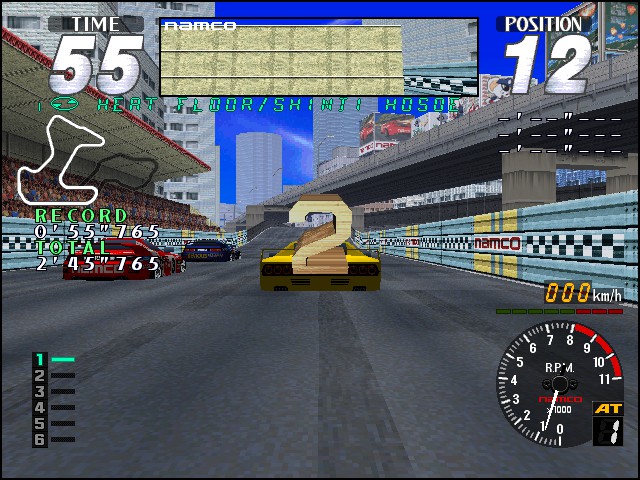
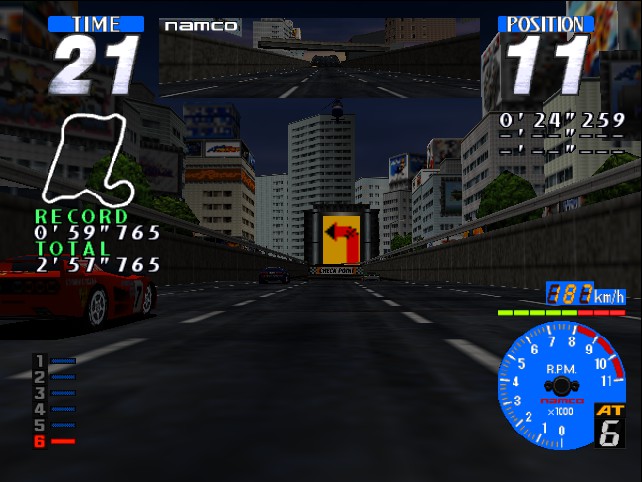
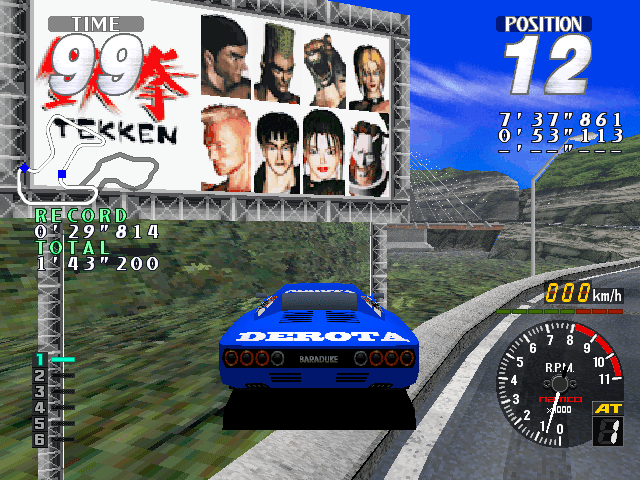
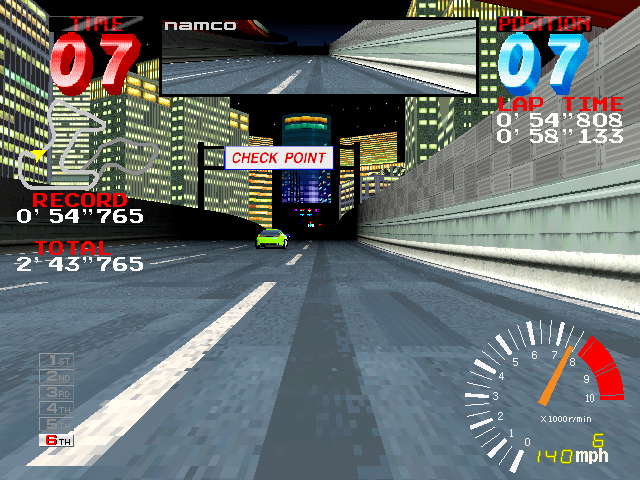
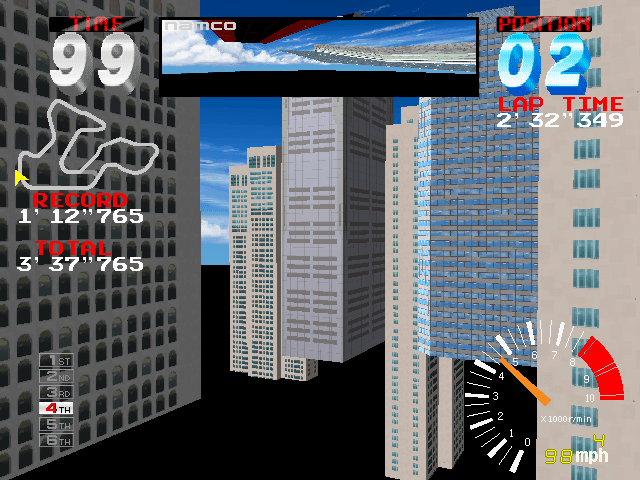
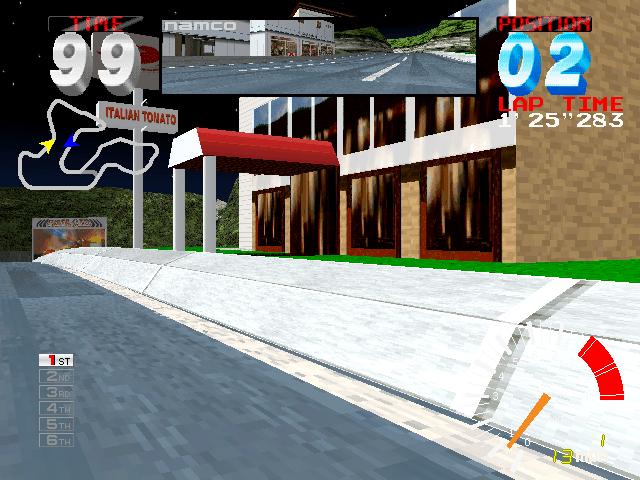
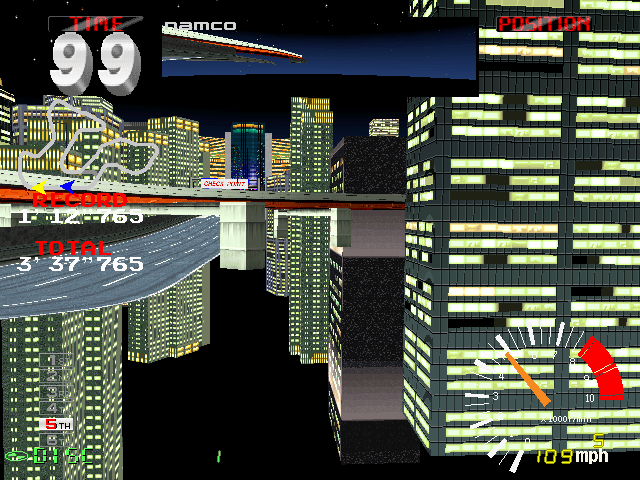
Namco always put a lot of detail into the track environments of their Ridge Racer games, and there are many references to their other arcade and console titles via the use of track billboards or building signs. A lot of this detail gets missed do to how fast paced the game is, and the arcade nature of the game. Many players are not going to stop and admire the buildings close up, which is where MAME and the no-collision cheats comes in.
Once nice detail that gets over looked, in the demo attract sequence, you can see the brake discs heat up as they are applied!
Novice Track
This is the same novice track from the first Ridge Racer game, but has updated textures which give it a more detailed look. Some buildings have been altered but the layout of the track remains the same.
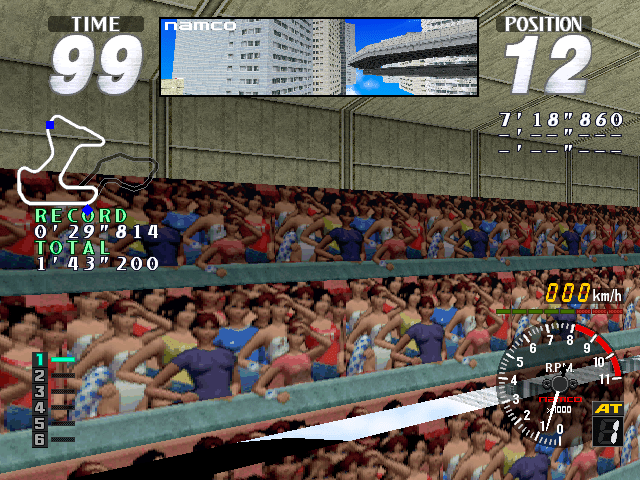
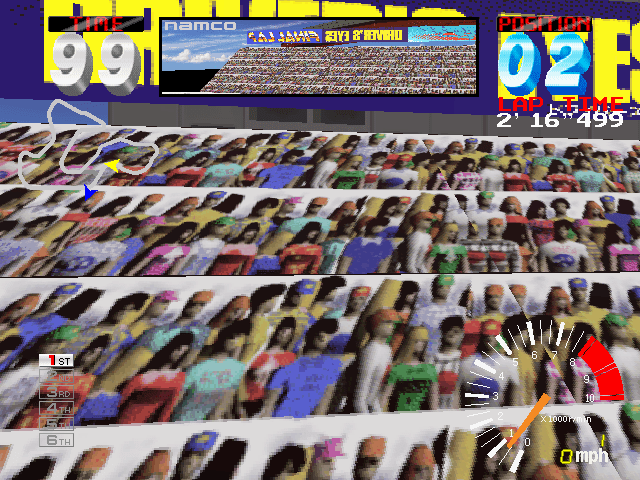
The crowd looks different compared to the Ridge Racer version.
The end of the alternative tunnel path, which is normally blocked off and inaccessible. Seems to lead into the abyss…
Outside of the bridge in the first segment of the track
Closer view of the shops,
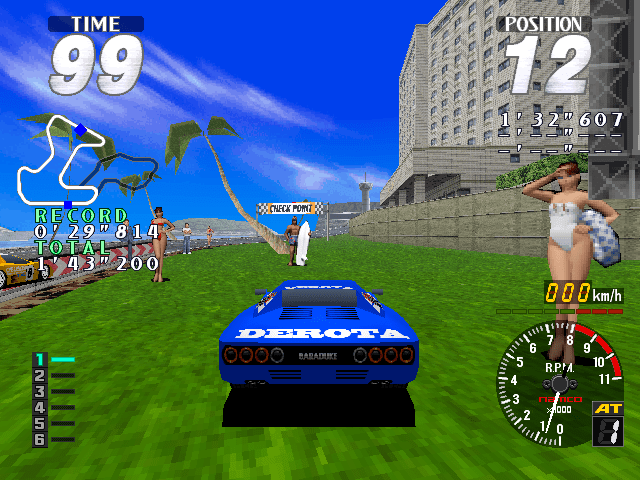
Getting a closer view of the shops near the beach
Driving in the grass, the peds here are unanimated
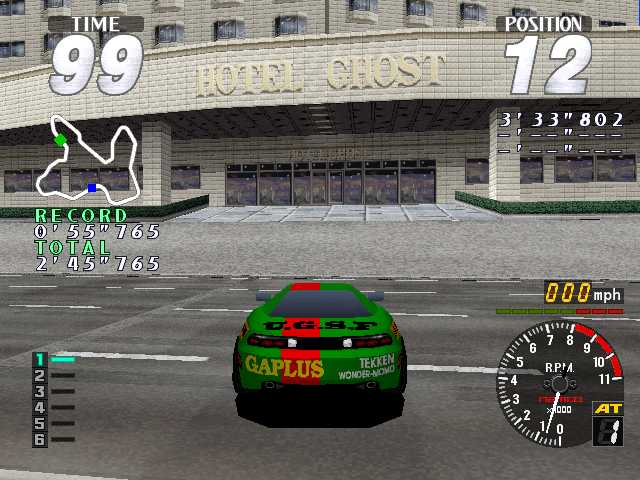
Hotel Ghost?
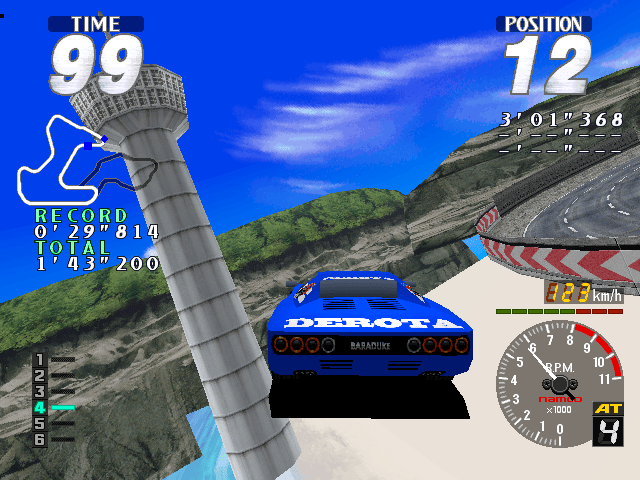
Out of the track and a view of the tower in the background, unfortunately we cannot drive to it since it disappears
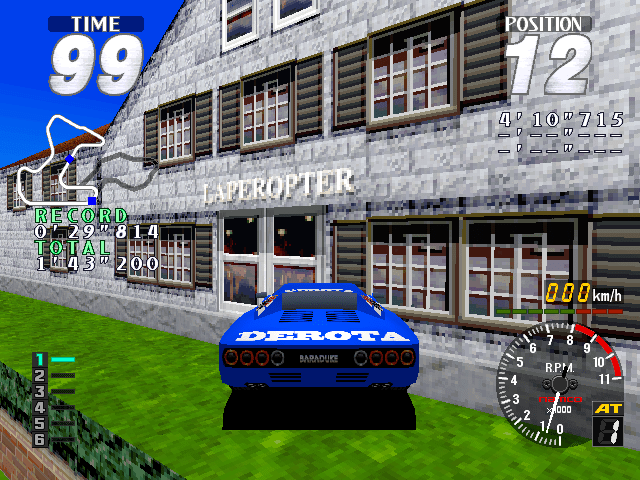
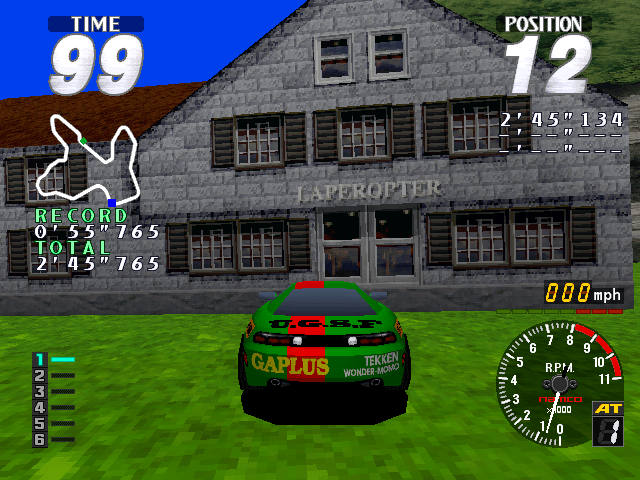
Laperopter?
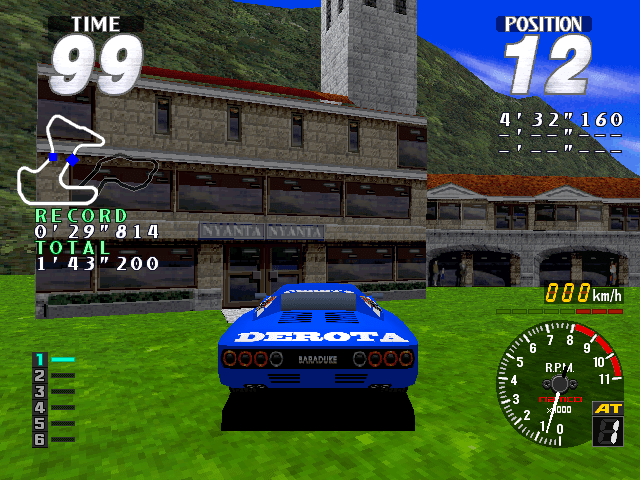
Building that reads Nyanta Nyanta, unsure what that means
On the novice track there is a section that is blocked off, which leads to a track on the Advanced course, driving past here just leads to a empty void, since the world here isn’t populated
Another view from a out of bounds perspective
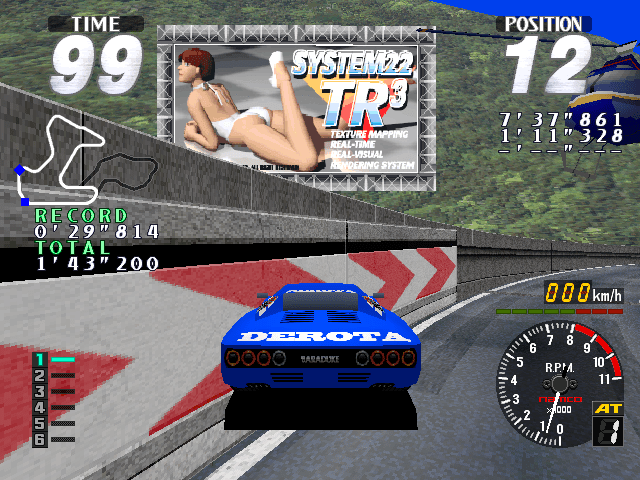
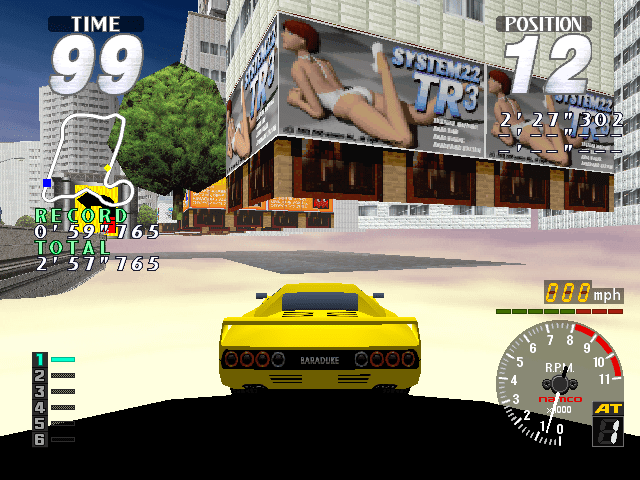
Namco advertising their TR3 chipset that was Co-developed by Evans&Sutherland. Billboard reads Texture mapping Real-Time Real-Visual rendering system
An advert for that other fighting game Namco is known for
Driving on the sea, a closer look at the boats
City
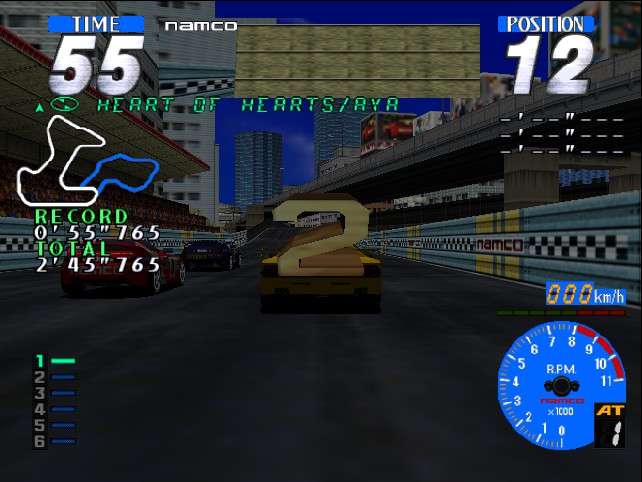
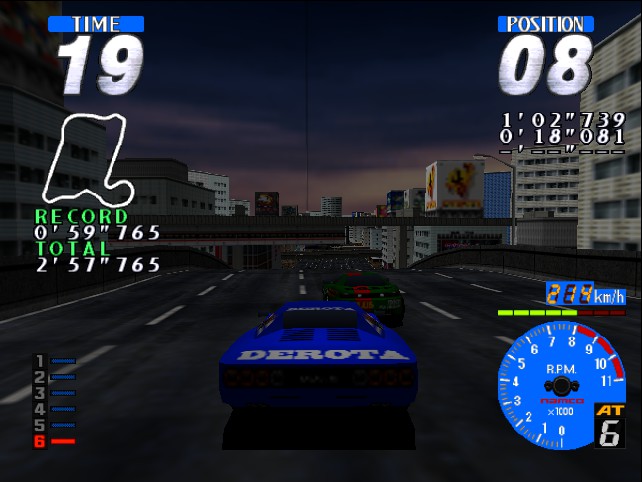
A new track that was previously exclusive to Rave Racer but has since reappeared in the PSP version of Ridge Racer, This one is set in a more urban environment with a rolling highway.
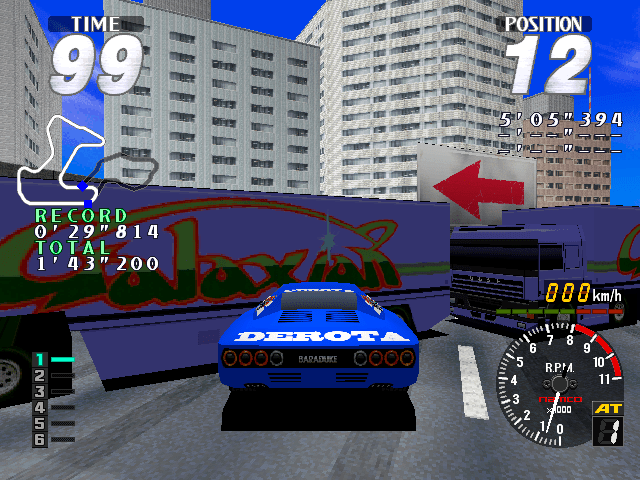
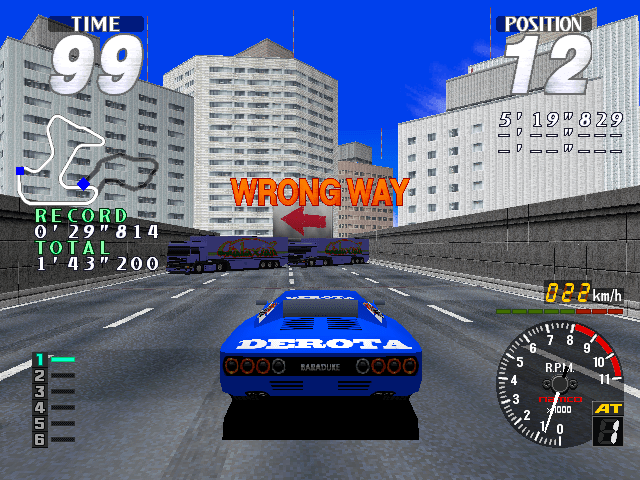
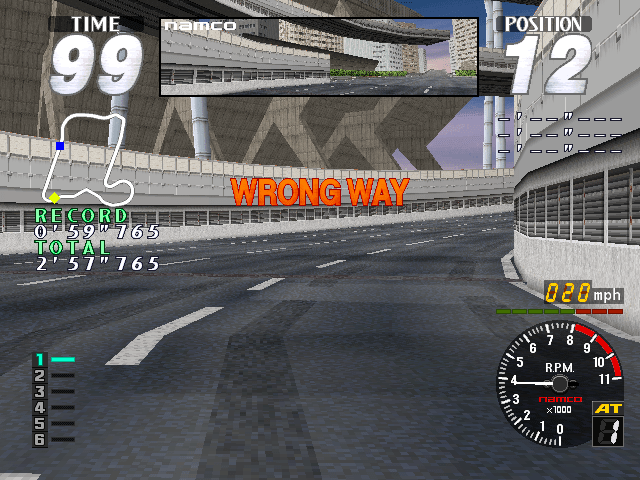
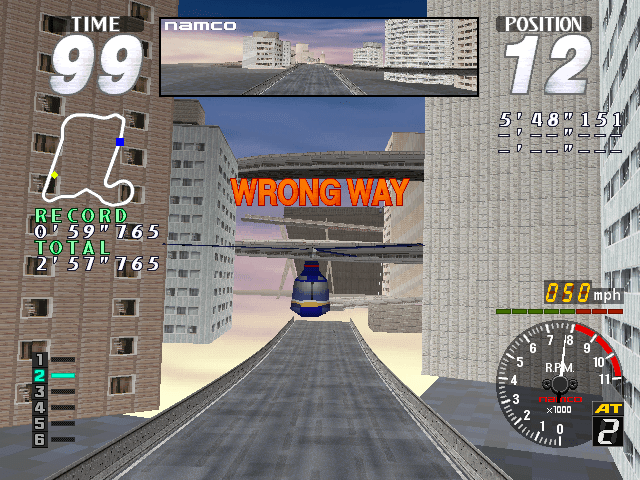
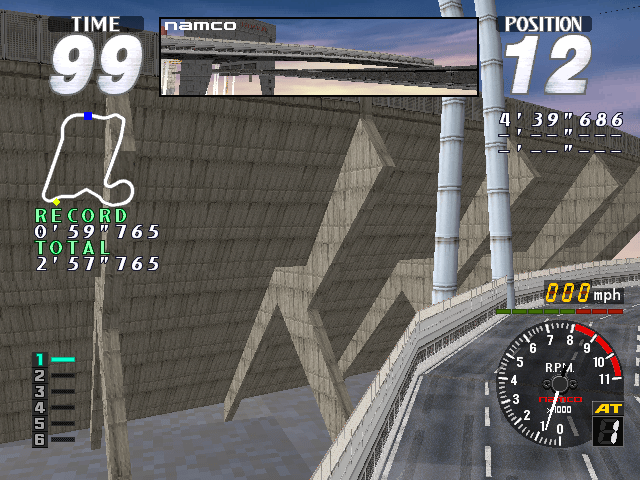
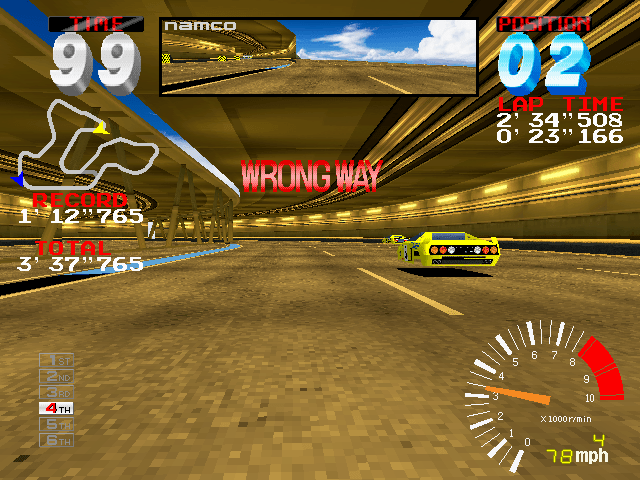
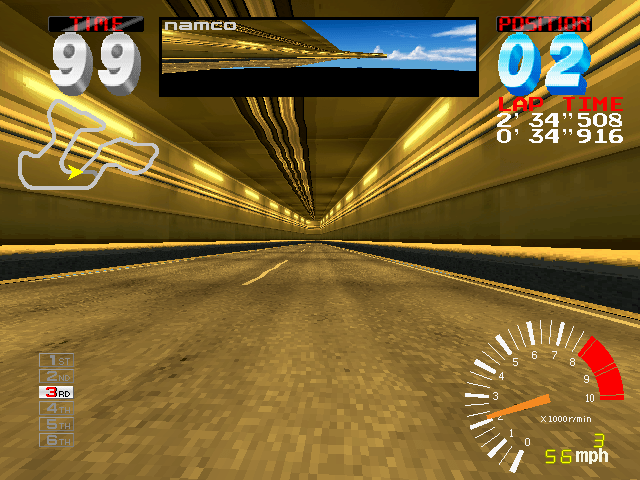
At the start of the track you can turn around 180 degrees and drive through a highway, you can do this without the use of cheats. You can drive until you reach a tunnel, where the game teleports you back out of the tunnel at a higher speed.
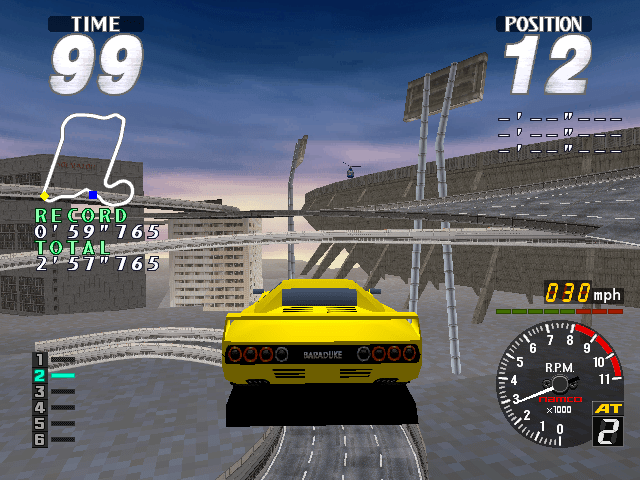
A no-clip like view of the world
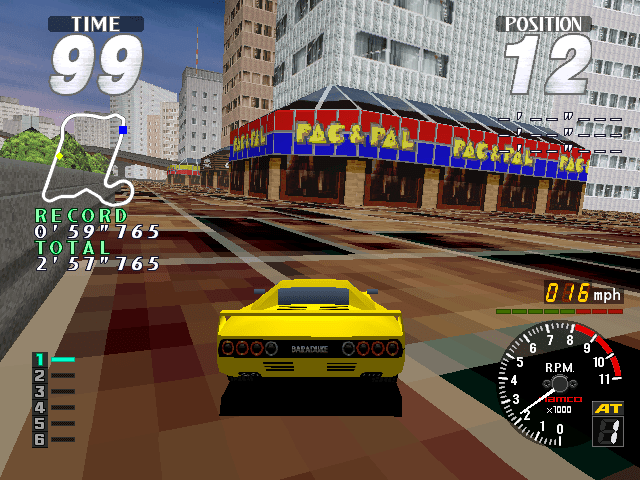
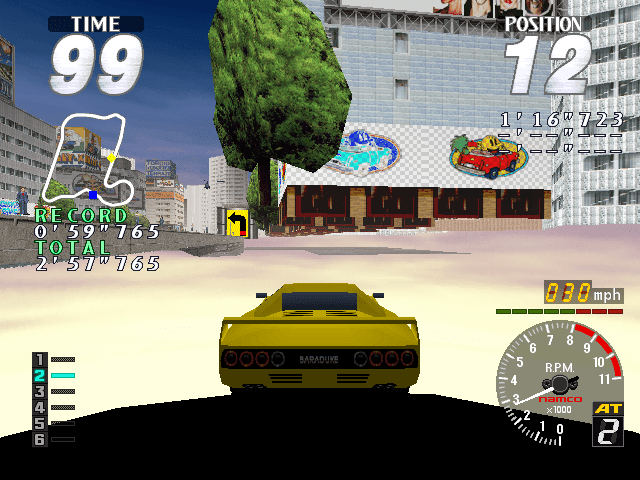
A look at the city, and a Pac&Pal store
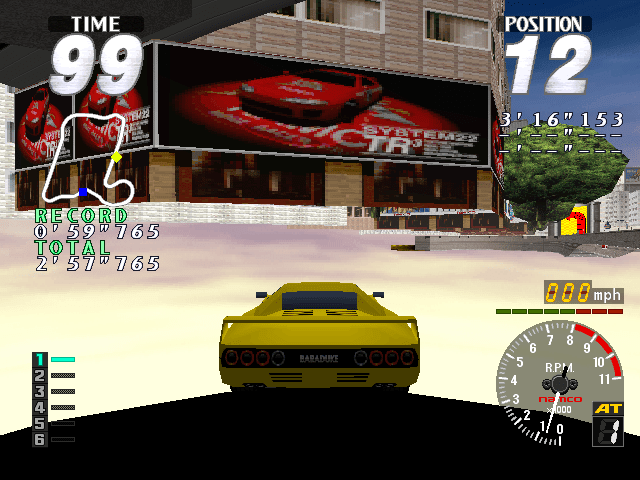
Another system 22 advert, namco were really pround to show their arcade technology off
Another TR3 billboard
Mappy.png
I don’t know if the transparency was intentional or they just forgot
Another noclip like view, except im nearly colliding with a helicopter. Theres no collision data so your car just clips right through the heli
View of the stadium, where LiberoGrandetakes place
Mountain
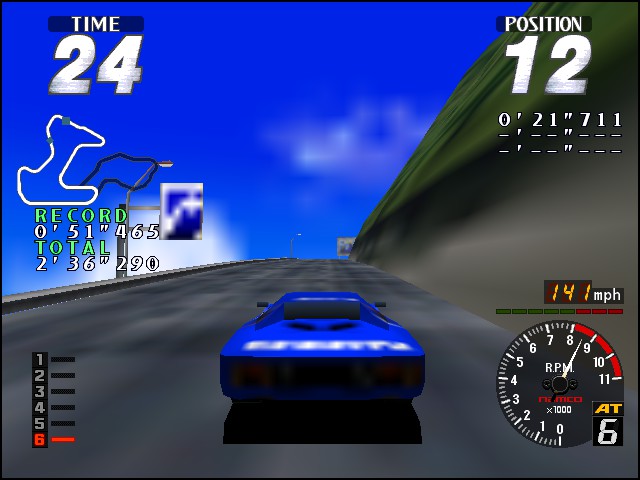
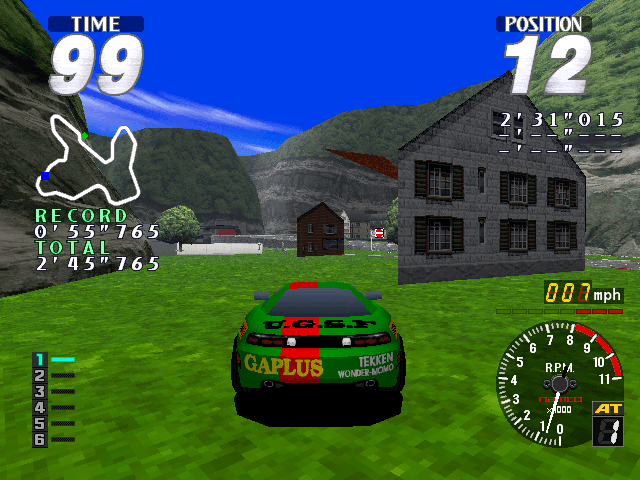
An alternative view of the mountain track, which normally cannot be seen within the game
Carefull…
I later learnt that this is an invisible wall, but when your collides with it at a certain speed the game teleports you to the bottom section, Driving into it at 10mph would just cause the car to bounce back to the track.
Some sort of casino??
Roadside Sign
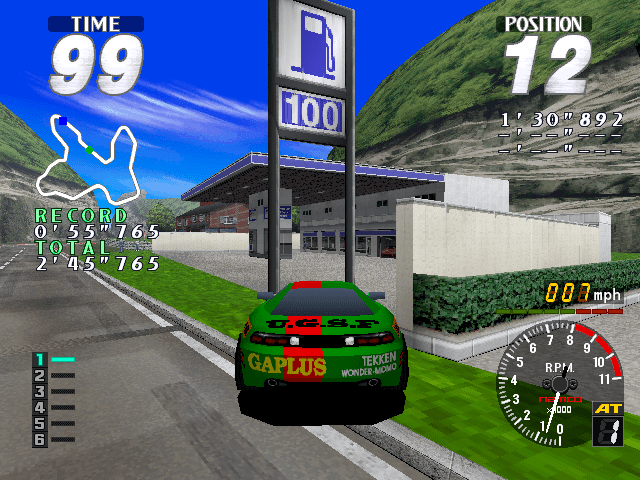
A gas station for when you need to refill your car, although this inst a game mechanic, cars in Ridge Racer do not have fuel
Who’s that?
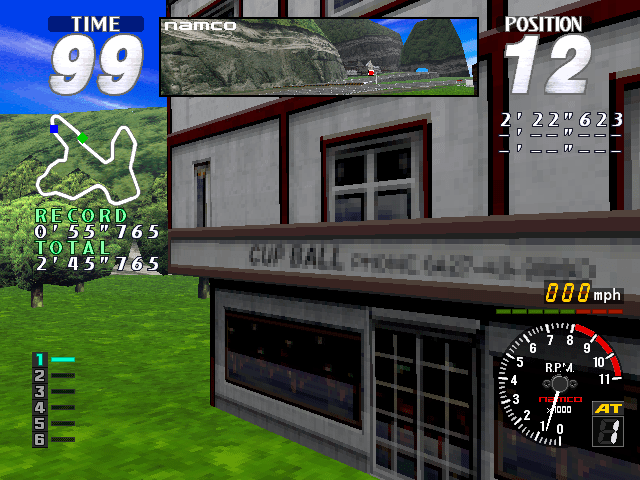
Cup Ball, some sort of bowling center?
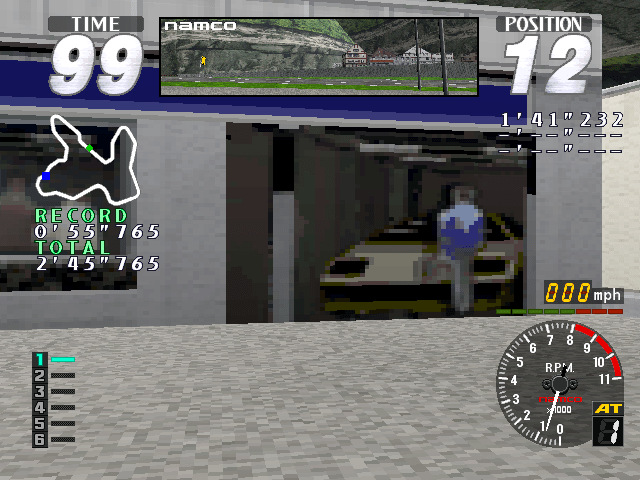
Buildings have no rendering data at the back of them, so the textures just disappear
Same Laperopter building in the first track
Better view of the spooky hotel ghost, seems Namco recycled building models to conserve ROM space
Going up the ramp, however the car clips through it
These tracks would remain exclusive to the arcade, and would not appear in any console version until the PSP version of Ridge Racer, I wonder what changes were made and if any buildings were kept?
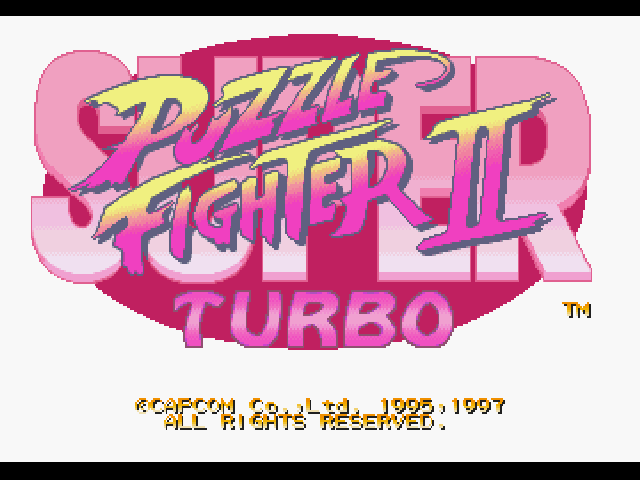
A gem based puzzle game, soft of similar to columns, but instead of matching 3 of the same colours, you have gems and crash gems which are used to destroy a gem of the same colour, and sends a counter gem to the rival player. The game does feature various Capcom characters but they are not directly controllable, merely appearing as avatars. The game is over when the players gems reach the top, similar to Tetris.
Arcade
Arcade version uses an arbitrary resolution. One nice feature is when the blocks are beginning to stack up, the music starts to speed up. As the arcade was the original released, the console and PC versions are based on this version.
PlayStation
Supports both memory cards, Seems to have some overscan (Could be due to the emulator), this can be adjusted in the game settings
Sega Saturn
Saturn version seems to run in a higher resolution compared to the PSone version (Could also be emulator related), also in the Saturn version, Dan randomly interrupts a match in arcade mode, which I have never encountered in the PSone version. The loading times are faster compared to the PSone and Windows version.
Microsoft Windows
The game was ported to the PC. The specs required are higher than I thought, which might be an indicator of a poor port. When running on a PCem based Pentium MMX 100Mhz, there was notable slowdown at 640×480 (not the lowest resolution supported) The graphics card was an ATI Mach64 VT2. Running at 800×600 was near unplayable. A Pentium 2 with a S3 Trio64 gave better resolution.
A nice side effect is the music of the game can be played in any media player, since they are wav files, even the sound effects, They are located in the BGM folder. There is also an EMI folder that contains a bunch of files with the EMI extension, which I’m guessing relates to the background and sprite graphics. There is also a goodies folder which contains images that are also in the goodies section of the game, plus a zip file with a Windows theme. The PlayStation also appears to use the EMI format, but the Saturn does not.
There’s an exe file in the movie folder on the PlayStation version, but trying to run it on windows 98 results in an invalid Win32 application error, trying tor un it from does gives a ‘Program too big to fit in memory’ error
Desktop Theme
Desktop theme
A desktop theme comes bundled in the GOODIES folder which can be installed
Comparison
Saturn version (middle) is run on the RetroArch Yabause core with default settings, PlayStation (left) is using the BeetlePSX HW core which also with default settings, the arcade version is on the right.
The graphics are mostly the same across the different versions, with the PC version having the ability to run at a higher resolution.
Ridge Racer 2 was a slight update to the series, adding linkable multiplayer and a revised soundtrack with several new tracks in addition to remixed versions of the original.
The announcer voice has been altered slightly, and has several new links in response to the players driving ability.
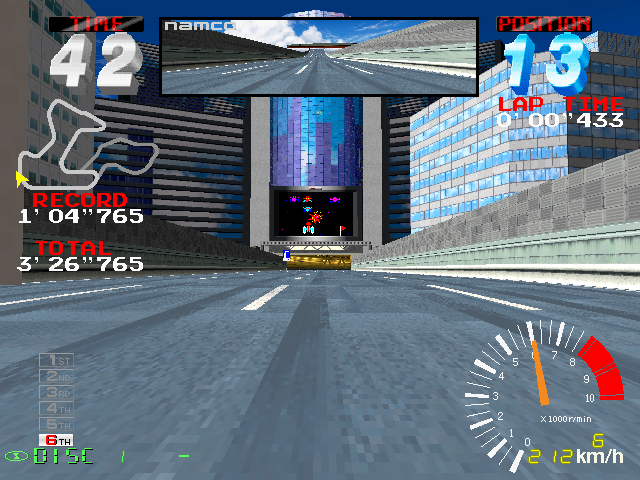
Some graphic effects have changed, whilst the textures are mostly similar to the original, the lighting effects have changed with RR2 using a hue/fog effect to simulate the day to night cycle, rather then the original which dimmed and changed the sky texture. The vehicle HUD has been changed, with the meter needle being thicker and orange which is easier to see.
Lastly a rear view mirror has been added, which required a redesign to the HUD. This makes it easier to block opponents. To accommodate this, some reductions have been made to the graphics, noticeable of which the vehicles looses detail when they farther away, reducing the rendering demand on the graphics hardware. Tire marks also no longer remain on the road surface during a drift.
Some versions of the game remove the cones that are found in the first tunnel, and the second song Grid is renamed to Grip.
Emulation – MAME Vs Vivanonno
Emulation for the game has improved over the years with the MAME System 22 core benefiting from being years in development, whilst Vivanonno has not been updated since 2003. Between the two emulators there are some differences in the rendering, with there being some unique advantages between the two.
Mame is considered to be more accurate to the arcade version, but Vivanonno has some advantages like texture filtering which System 22 is not capable of. This gives the game textures a less blocky appearance.
Comparison
Vivanonno on the left, MAME (238) on the right
Night Time Effects
The MAME version now has a black ‘fog’ effect that covers the track at night, compared to Vivvanonno which misses the effect and leaves the track at full draw distance.
Billboard
This flickers on Vivanonno but works fine on MAME
Cars not aligned correctly on track
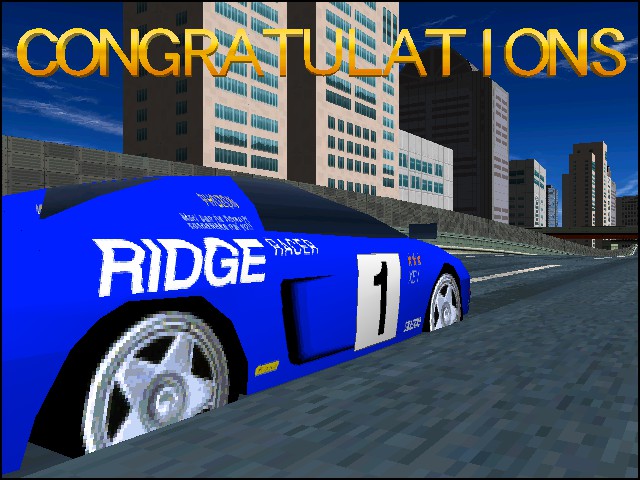
The cars on the Vivanonno version are sunk into the track slightly and are missing the shadows. The brightness is also different, also notice the curve of the car, above where it says RIDGE
Score screen error
Not all of the textures appear on the Vivanonno version
Texture Bleeding
Some of the road textures bleed or overlap, causing the effect
Chevrons
On Vivanonno the chevrons will dissapear at a cetain angle, noticable when you are drifiting.
Link Play
A fork of MAME allows for limited linked play with both instances of MAME, at the moment this is currently running on one machine but should be possible over a local area connection. However latency will be tight since these arcade machines were meant to be linked close together which rules out internet play.
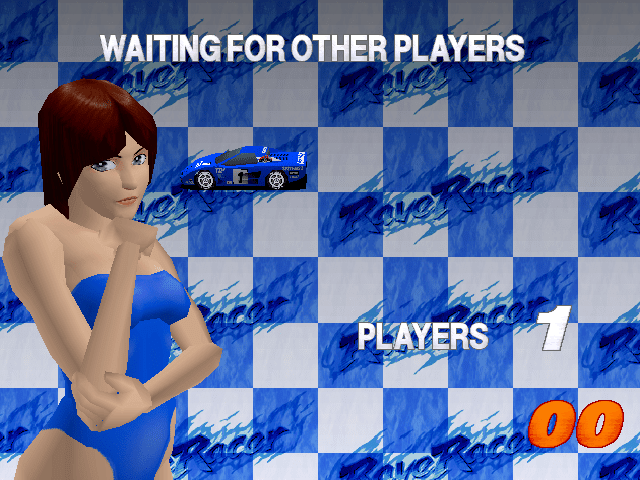
Screen this is displayed when waiting for other players to join, the attract screen on the linked machines changes to indicate players can join.
Starting position for both machines in one game
Boundary break
Thanks to MAME and a few cheats (Drive Anywhere), the car can escape the track, allowing us to get a better view of the scenery.
Another look at the audience at the start of the track, exactly the same as the first Ridge Racer
A look at the buildings outside the track
The fake cars in the other side of the tunnel have changed slightly, they seem to have more detailed textures, but are now lacking wheels. Unless these are floating. anti-gravity cars?
View of the city at night, the game simply swaps the textures rather than apply lighting effects, and the skybox has changed
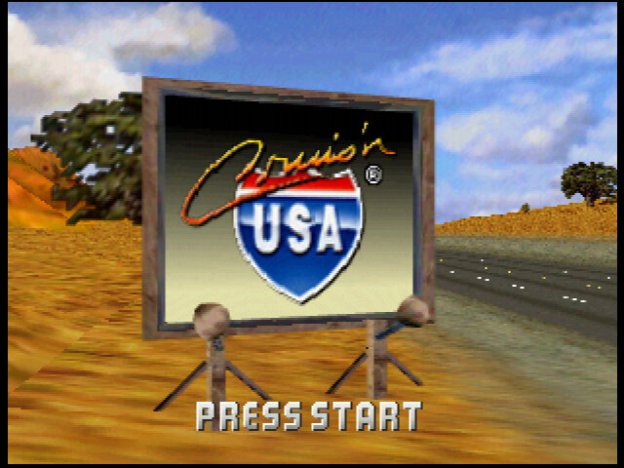
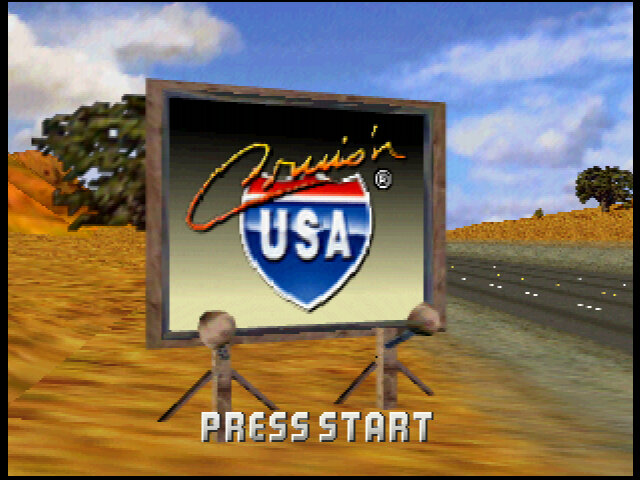
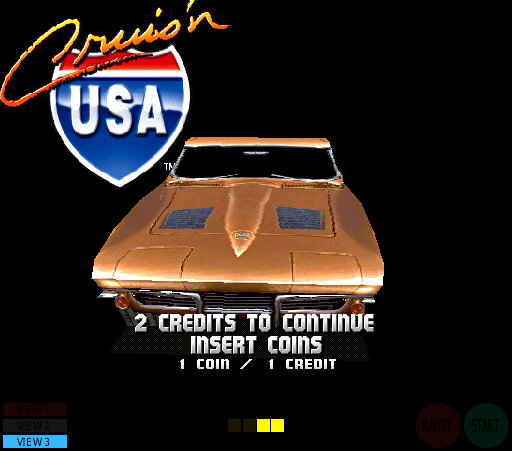
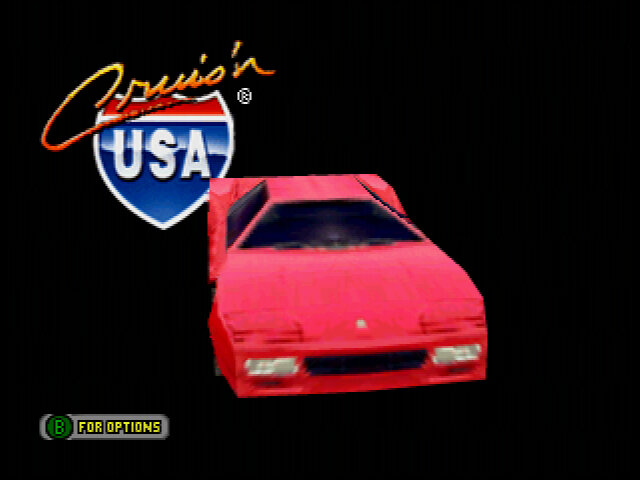
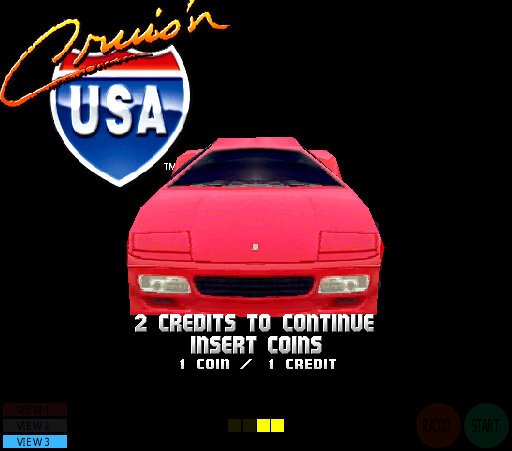
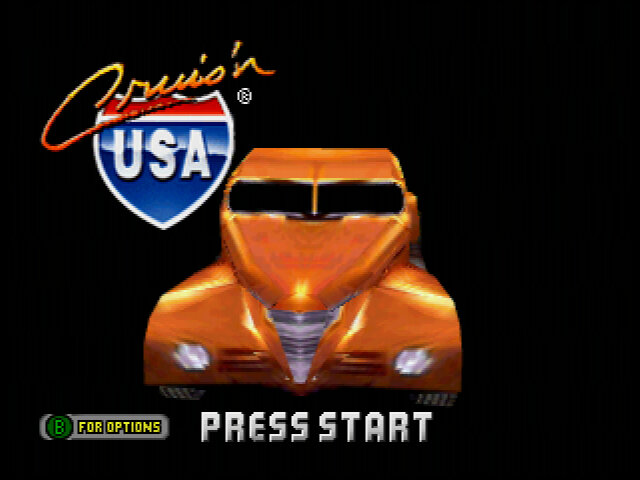
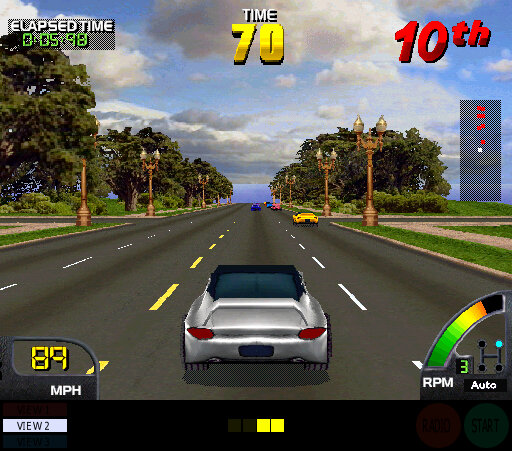
A racing game set across the USA, you play from point A to point B with a single lap, giving the impression you are travelling through (Cruising) the USA. Each track has unique scenery and opponents, with rival cars and traffic becoming a hinderance, thankfully the controls are easy to adapt although collision detection can be an issue.
All of these tracks are set around different parts of the USA, and vary in environmental scenery and difficulty.
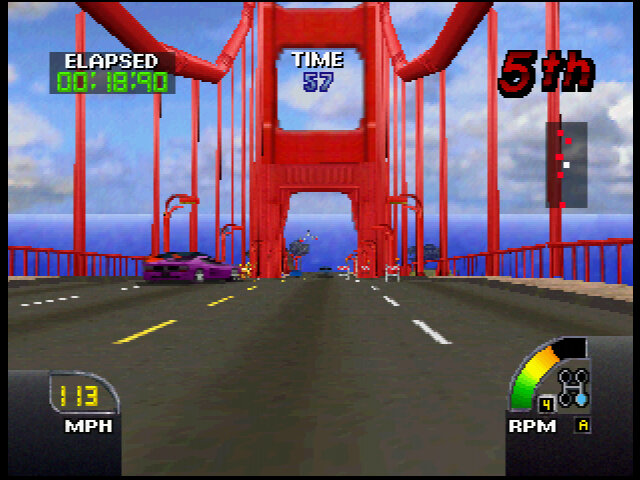
Golden Gate Park: The first track in the game which features the golden gate bridge. Very easy with only slight bends and wide roads
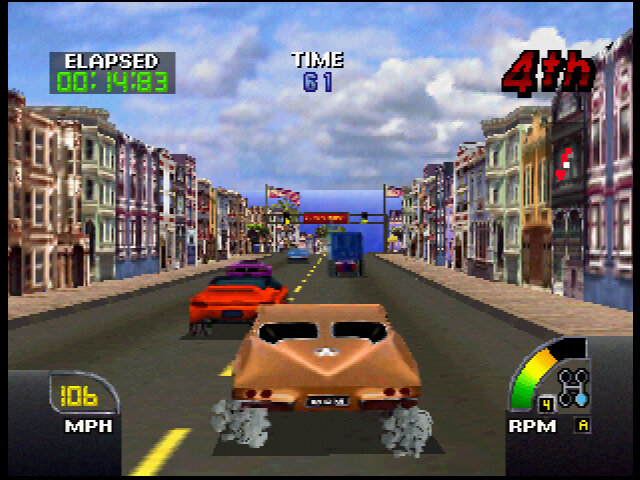
San Francisco: Featuring rolling hills and an increase of traffic from the previous track, ends with a tunnel.
US 101: Set in a rural desert, the track here is narrower and features a lot more bends, there are also gaps in the road which your car must drive over
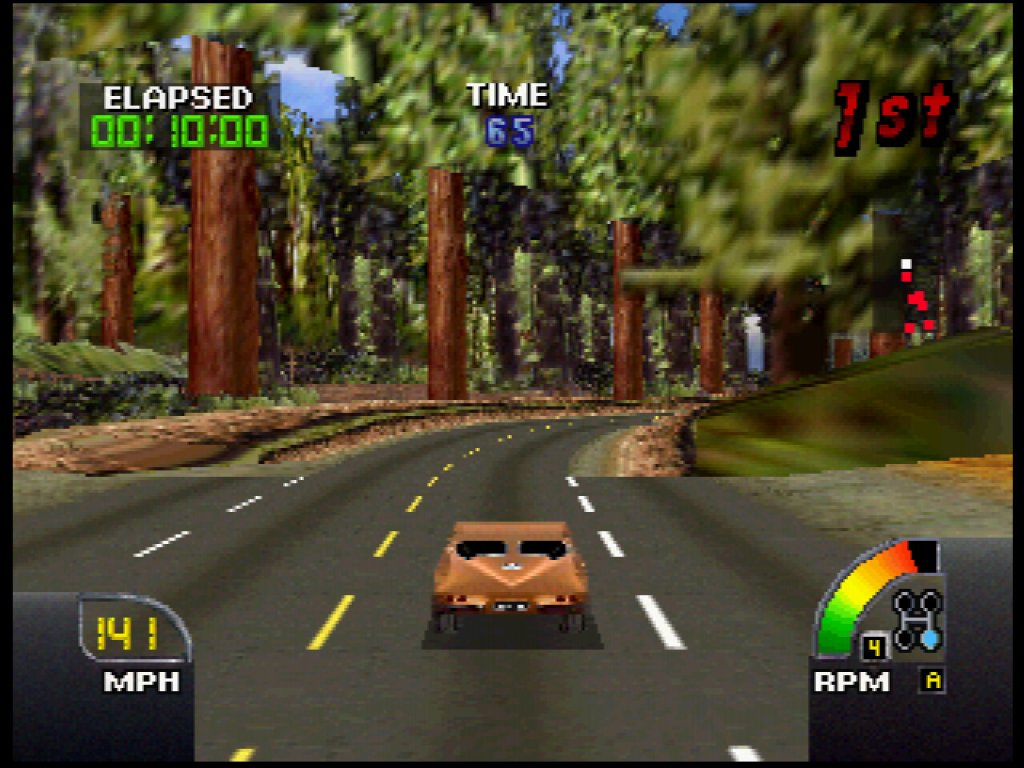
Redwood Forest: Continuing from the desert and into the forest, the road here is a lot more narrow which gives little space to navigate through opposing traffic and rival cars.
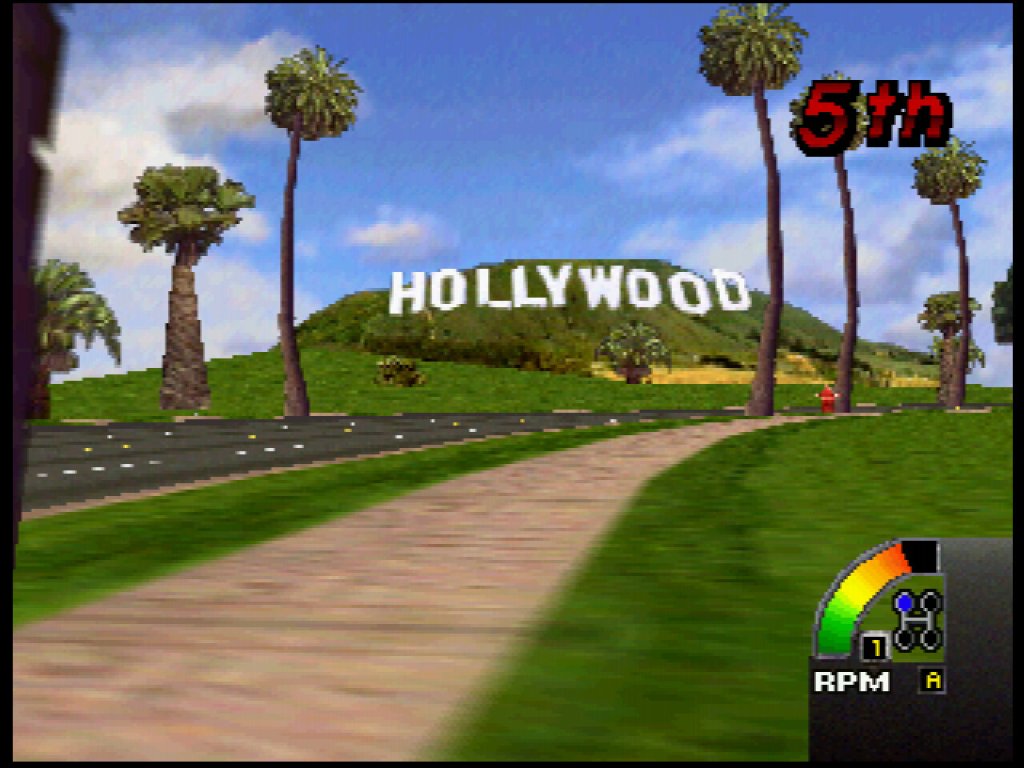
Beverly Hills: Featuring Bel-Air style houses and mansions along with the Hollywood sign. The scenery here can be distracting so try to focus and concentrate on the road.
LA Freeway: There’s a lot more traffic on this one
Death Valley: Sounds a bit morbid but is set in a rural desert area, this one also features a narrow road so watch for traffic
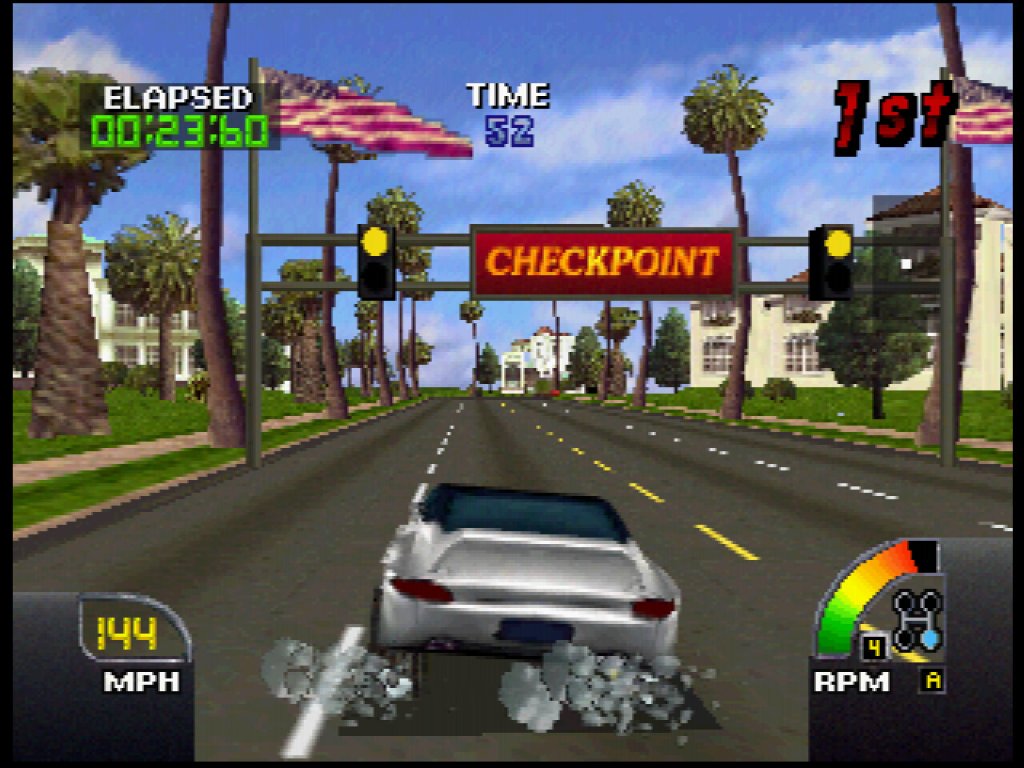
Arizona: Set in a rural desert in the first half, this one has powerlines as obstacles that can be knocked down but will impact your cars speed.
Grand Canyon: Drive through the Grand Canyon itself, again has powerlines as obstacles that can be knocked down, also features Mount Rushmore
Iowa: Set on rural green farm which looks more like an English countryside, has narrow roads and powerline obstacles and a toll booth which you have to be careful not to hit the hubs in between
Chicago: Features factories and an urban like environment with large buildings and an underpass. Be careful not to hit the overhead railway columns
Indiana: Very similar to Iowa
Appalachia: Track with a bumpy road and a lot of curves and hills, defiantly one of the more challenging tracks.
Washington DC: The final stage with a lot of nice scenery but equally as difficult as Appalachia, Ends with a money tunnel
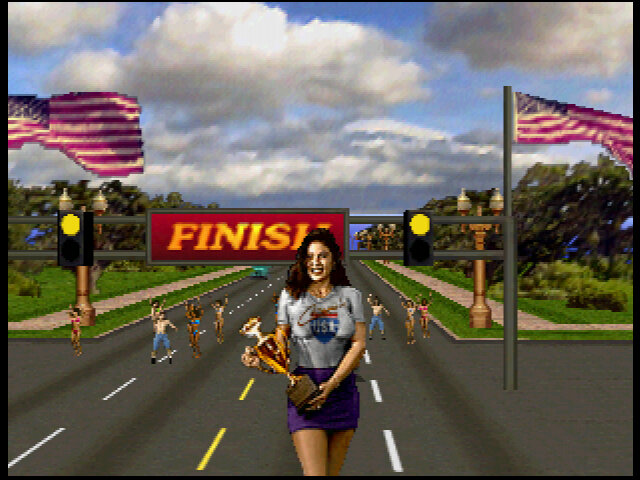
Completing Cruse the USA mode unlocks a faster car, and the arcade features a very special ending FMV featuring the then current Present and the First Lady
Arcade Version
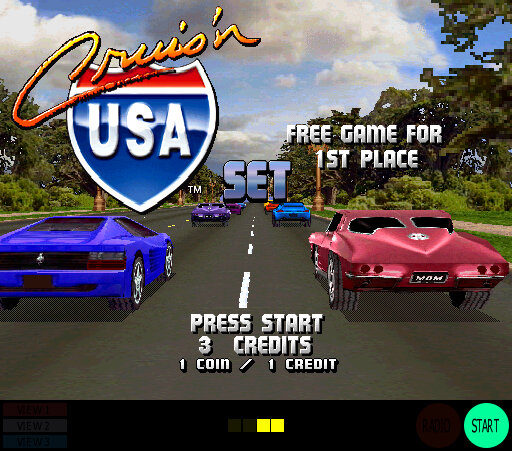
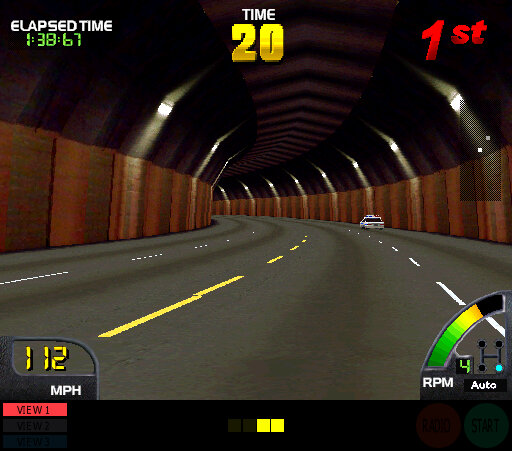
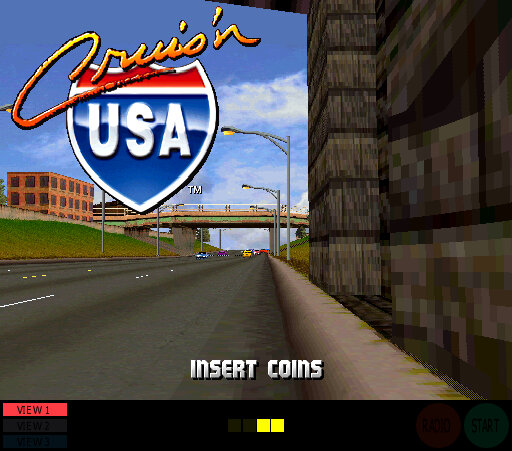
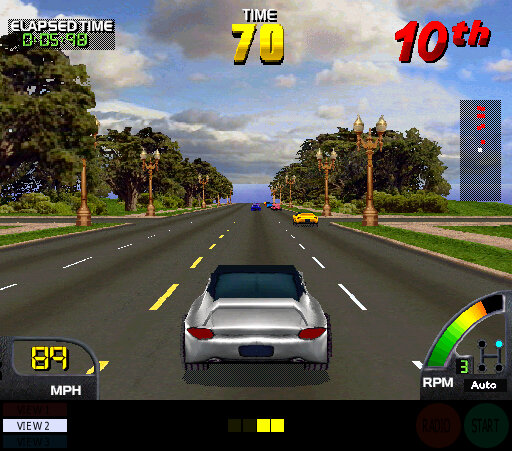
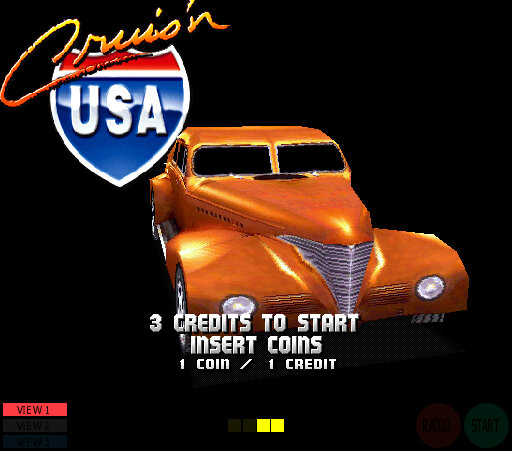
Released in 1994 on the Midway V Unit arcade board, it was one of the early textured 3D racers alongside Ridge Racer and Daytona USA.
Not much is known about Midway’s V unit 3D hardware, originally believed to be based upon the Nintendo Ultra 64 that was in development at the time, however closer inspection of the specification revels the hardware to be very different. With the V Unit running a Texas Instruments TMS32031 CPU at 50Mhz compared to the NEC VR4300 MIPS CPU in the Nintendo 64. Whilst the N64 is complemented by the SGI Reality co-processor, the V unit uses an currently unknown 3D processor, which accelerates the 3D graphics used. As it was released in 1994, there are a few possible vendors:
A PC graphics accelerator like the Yamaha Tasmania 3D or Matrox Millennium
SGI (Possible the V Unit is a very early design of the N64? unlikely since SGI have always used MIPS CPU’s, unless they wanted to cut costs and use a TI CPI instead)
Or it could be an entirety custom chip Midway had designed…
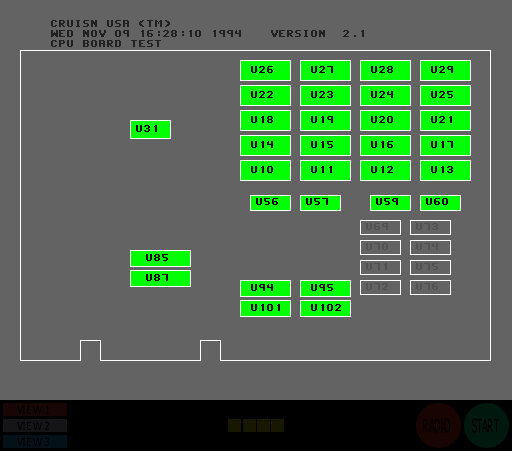
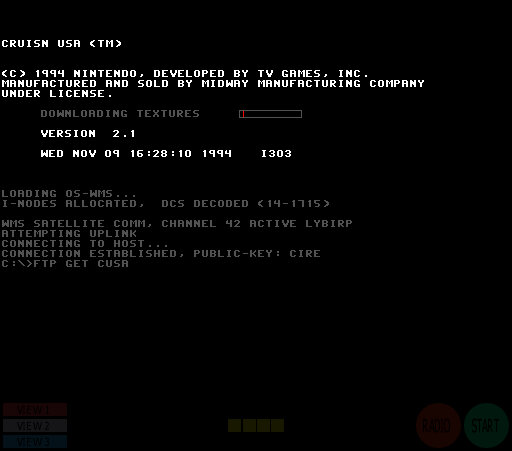
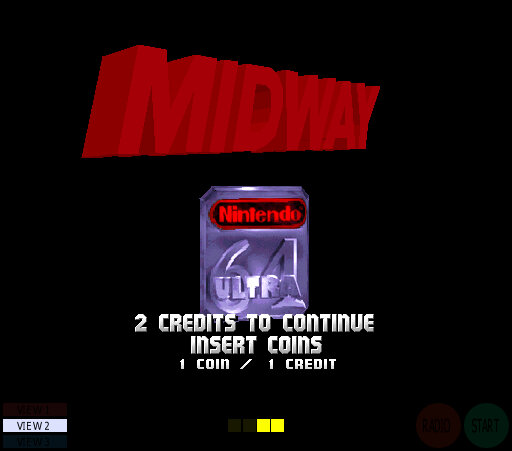
The boot screen of the arcade version is interesting, the first seems to going into some hardware test routine, whilst the second looks like its downloading something off a remote server, or simulating it. OS-WMS is mentioned, and the next line reads WMS Satellite COMM, CHANNEL 42, which makes me think the game was capable of being distributed over the air via satellite? its not out of the ordinary since that’s how Nintendo’s Stellaview worked, and BSB’s data service allowed you to broadcast data in the early hours of the morning whilst its TV channels were off air. The last command looks like it’s trying to retrieve something off an external FTP server, despite the game being stored in ROM. These messages appear every time you start the game, so its not some first-time utilisation process.
Graphics-wise its similar in vein to the other arcade racers of the time, Ridge Racer and Daytona USA, however this is clearly running on lower-end hardware with the framerate and resolution being reduced. Winning first place nets you a free race (adjustable in the games test modes) otherwise you will need to add credit to progress onto the next track. Completing the game gives you an ending cut-scene set on top of the White House.
Nintendo 64 Versions
Released early in the N64 life, Cruis’n USA took a downgrade in the resolution and censored a few aspects of the game. The former caused critism since this was one of the first racing games on the Nintendo 64, and the game was promoted as being built on Nintendo 64 technology, so it was expected to be a perfect port of the game. Meanwhile the PlayStation enjoyed a satisfactory port of Ridge Racer, however by that point it was already two years old by the time it was released in 1996, had the N64 came out in 1995 as originally planned, the port may have been better received.
NTSC
Graphics took a reduction in this version with the textures being downgraded to fit into the Nintendo 64 memory limitations. The framerate is also inconsistent, since having many cars and track objects on screen to reduce it to a crawl, which can frequently happen when you crash into another car, CPU cars will also crash into you and have no awareness of the track, often resulting in a slideshow when there are a lot of cars and track objects on screen. Saying that, the N64 does benefit from perspective correction, which means no warping polygons or textures, and there is also bilinear filtering for the textures, although for this game the arcade unfiltered textures look better.
The sound has also been altered, since the Nintendo 64 didn’t have a dedicated sound processor and had to render the sound on either the CPU or the reality co-processor, depending on how the game was designed, the arcade version has extra fidelity since it was done using the Midway DCS sound system.
One other thing to mention was the saving issues on the Everdrive64, as the game uses the gamepak in order to save data, but upon starting the game it complains about the pack being corrupted/invalid and will not start, removing the gamepak results in another error messages instructing you to insert the pak back into the controller. The only was to start the game was to boot without the controller-pak connected, which results in the game saving to the cartridge memory, which the Everdrive can emulate.
Comparison
Left: Nintendo 64 – Right: Arcade, which has the indicator on the bottom
Textures are generally more detailed on the arcade release, but the Nintendo 64 makes use of texture filtering with the arcade being unfiltered.
N64 version looks more blurry, whilst the arcade version looks sharper.
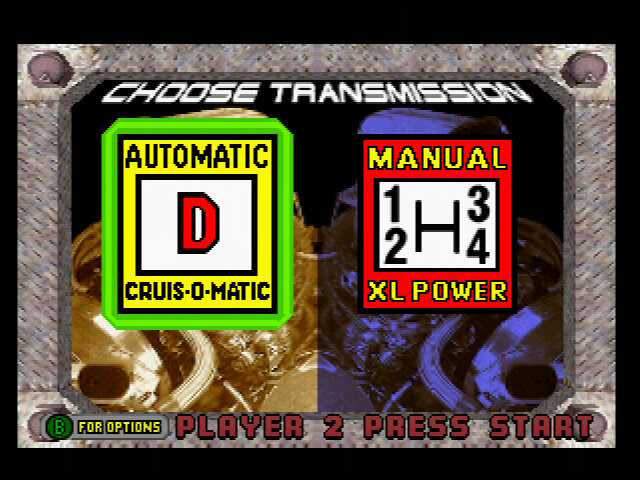
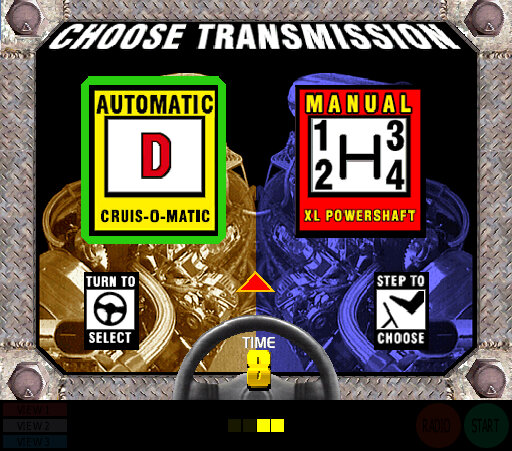
Transmission select screen
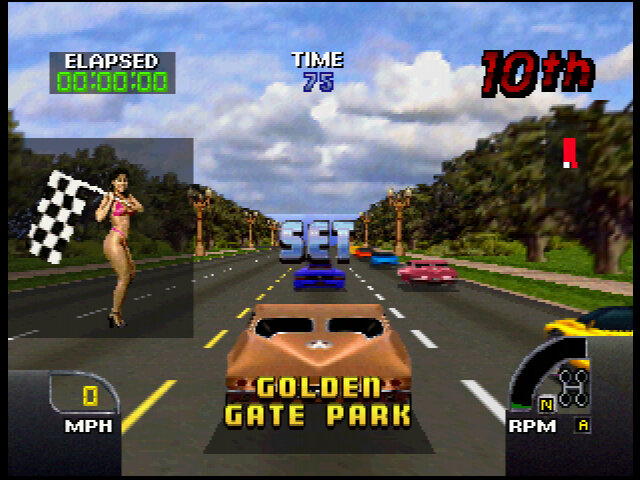
Heads up display of both versions, the N64 compensates of the PAL/NTSC overscan by creating a buffer for the HUD design. The arcade cabinet has illuminated lights which indicated the games status which MAME emulated as an on screen display which can be seen at the bottom.
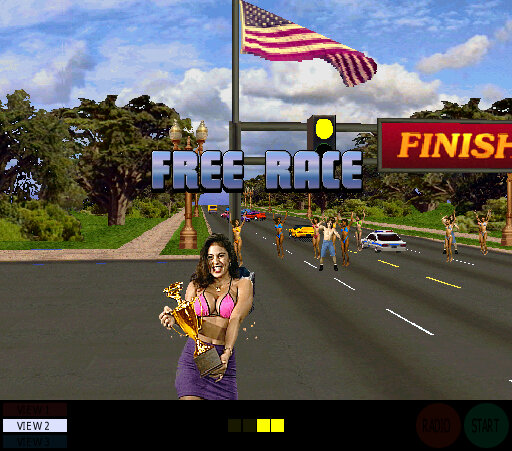
An example of censorship of the N64 version, either that or the woman must have felt cold. A nice feature with the arcade version was you got a free race if you came in first place (dependant on that feature being enabled in the games settings)
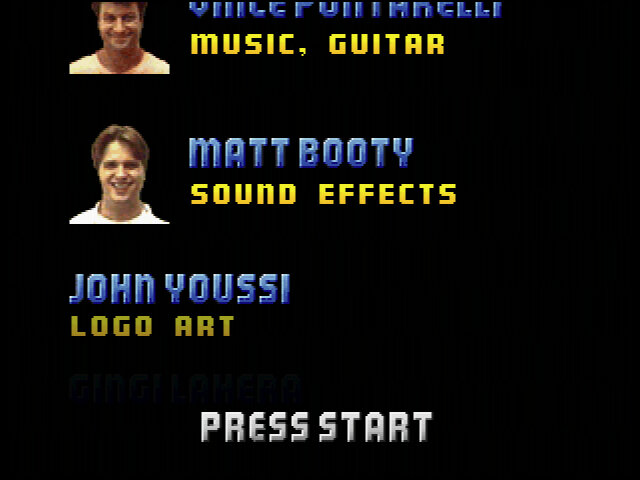
I wonder if that’s the same Matt Booty at Microsoft Studio’s?










































 Drew1440: Blog